Ethereum’s Fusaka upgrade, activated on 3 December 2025, reinforces the network’s position as the primary public settlement environment for tokenized assets, rollups, and institutional-scale activity.
For most investors, banks, and asset managers, Fusaka is not about new jargon. It is about whether Ethereum can handle growing Layer 2 activity, tokenized assets, and higher transaction volumes without introducing new fragility. It reduces node overhead, improves data handling for rollups, and makes settlement more predictable.
Behind these changes lies work that often goes unnoticed in headlines. Ethereum’s behavior is defined and delivered by its client teams. In Fusaka, Nethermind engineers co-authored a majority of the execution layer proposals and helped design the benchmarking framework that underpins safe gas limit increases. This work quietly forms the foundation for institutional adoption.
What Fusaka changes for institutions
Fusaka is often described as a “data availability” and “scaling” upgrade. In institutional terms, three themes matter.
1. More capacity for rollups, at lower operational cost
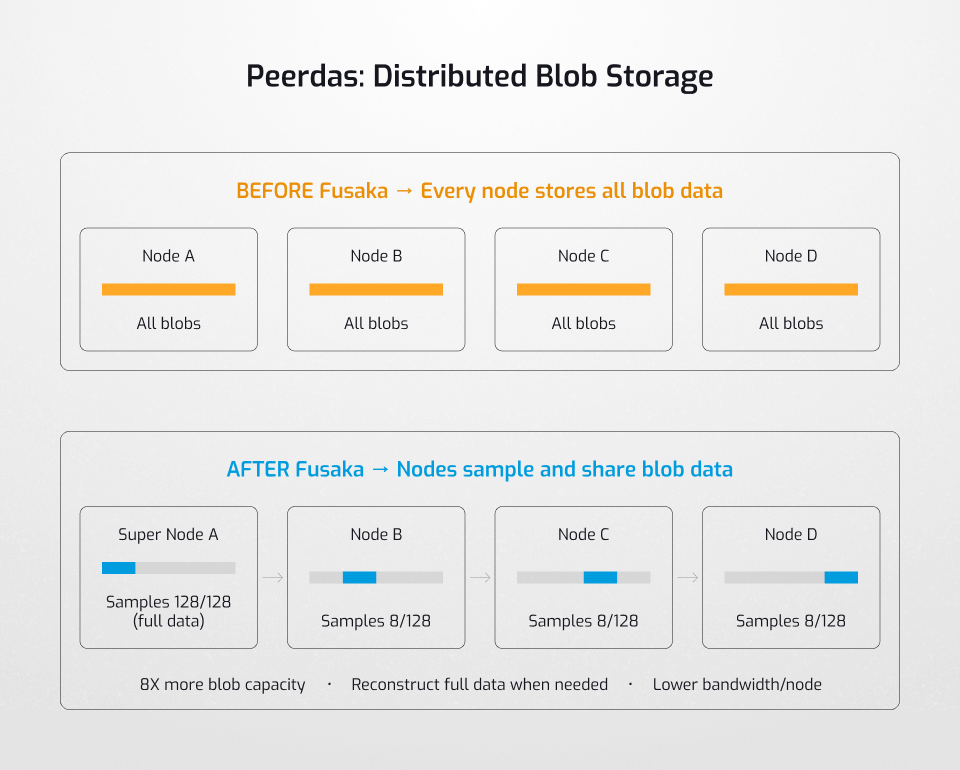
Most Ethereum activity now flows through Layer 2 rollups. These systems post compressed transaction data to Ethereum in the form of “blobs”. Until now, validators had to download and verify entire blobs, which added bandwidth and storage pressure.
Fusaka introduces Peer Data Availability Sampling (PeerDAS). Instead of handling all data, each node verifies small, randomly assigned slices. Data is encoded so that the full blob can still be reconstructed if a sufficient share of slices is available. For institutions that run validators or nodes, this means:
More total capacity for rollup data on Ethereum.
Lower bandwidth and storage requirements per node.
A path to higher throughput without forcing operators into enterprise grade hardware.
2. More predictable fees and economic behavior
Cheap transactions are useful. Predictable transaction costs are more important for institutional planning. Fusaka delivers this through three mechanisms:
Blob fees are kept in line with actual execution costs, which prevents blob markets from collapsing to near zero and then recovering only slowly.
Gas and block size changes are coordinated. The network can move toward a 60 million gas limit while keeping execution payloads within a strict size cap. This reduces the risk of oversized blocks that propagate poorly.
Heavy cryptographic operations are repriced based on measured performance, which closes some attack vectors and aligns gas costs with real resource consumption.
The result: a fee environment that behaves more consistently under load, which is what matters when running production systems.
3. More stable and transparent settlement
Institutions care about transaction finality and thepredictablility of that path. Fusaka improves this by:
Making the schedule of future block proposers more predictable at the protocol level. Applications that depend on reliable sequencing now have better visibility.
Reducing the risk of individual, very large transactions crowding out other activity, through a cap on per transaction gas use.
These are not headline features, but they are the kind of refinements that reduce edge cases and operational surprises.
How Nethermind helped design these changes
Ethereum upgrades are not decided in a vacuum. They are proposed, tested, and refined by the teams who implement the protocol in clients. For Fusaka, Nethermind engineers helped shape the execution layer at the specification level, not just in code.
Nethermind’s contributions cluster in three areas that matter for institutions.
1. Efficiency and node costs
One of the most visible changes is the removal of unnecessary data from Ethereum’s networking messages. Over time, nodes were regenerating, and shipping fields that syncing peers immediately discarded. This was wasting hundreds of gigabytes of bandwidth per sync.
Nethermind engineers co-authored the proposal that simplifies these receipts and introduces “history serving windows”, which let nodes advertise which parts of history they hold. This supports the network’s long-term move to more efficient history storage and reduces the cost of running infrastructure today.
2. Safe throughput increases
Ethereum can only raise its gas limit if every client can handle worst-case blocks. If one implementation falls behind, the network as a whole is at risk.
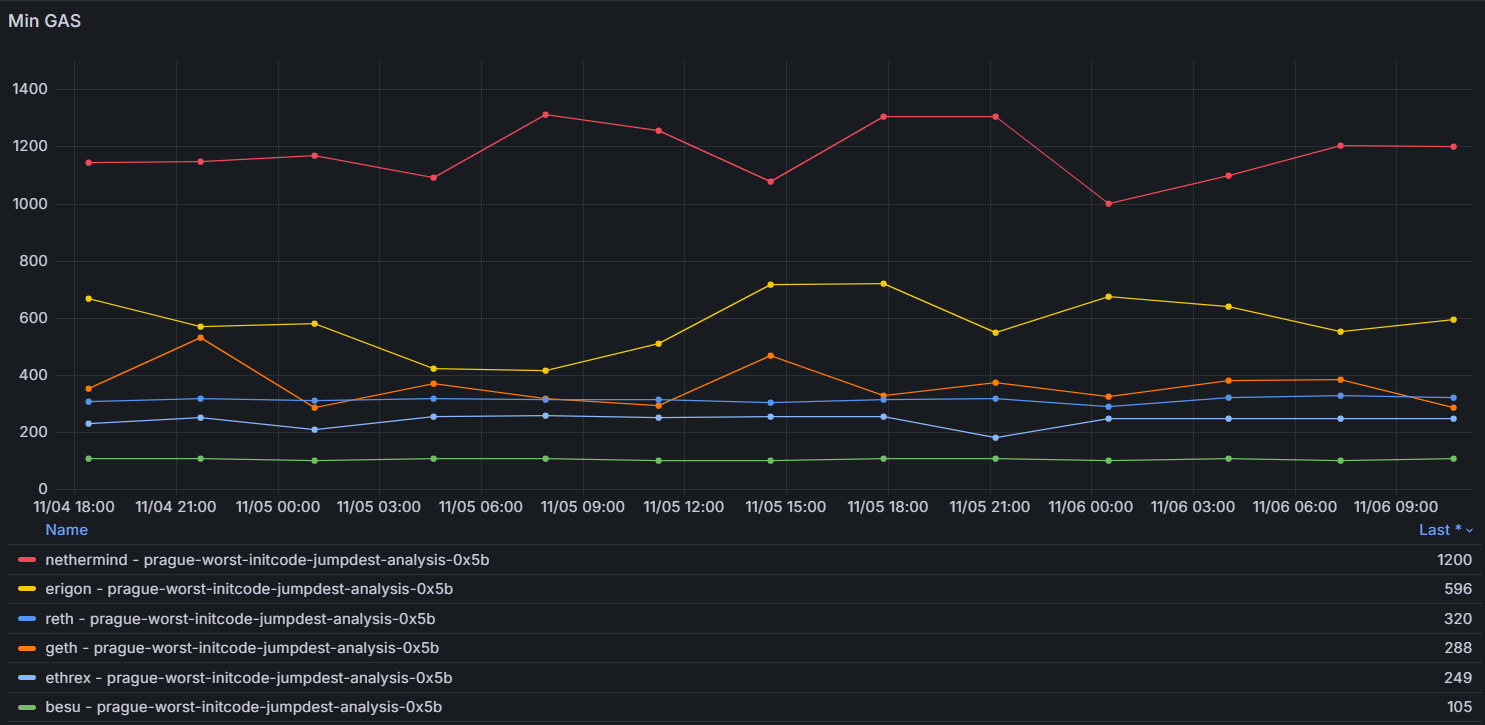
Nethermind originated Gas Benchmarks, a framework that builds blocks out of single operations or precompiles, then measures how fast each client can process them under stress. This work started as a Nethermind experiment funded by a Worldcoin grant and is now a common standard used by the Ethereum Foundation and all major client teams.
The first major outcome was ModExp repricing. Tests showed that certain cryptographic operations were much slower than their gas costs implied, across all clients. The result was a protocol change, coordinated optimisations in implementations, and a clear, data based path to higher gas limits. That process now underpins decisions around moving from 36 million to 45 million gas, and toward 60 million and beyond.
Gas limit changes are now grounded in shared, repeatable benchmarks, rather than intuition. Nethermind played a central role in establishing that standard.
3. Predictable economics and settlement
Several Fusaka proposals authored or co-authored by Nethermind engineers shape how Ethereum behaves under load and how applications can reason about settlement.
A hard limit on execution block size that aligns with what the consensus layer can safely gossip. This prevents “invisible” blocks that some nodes see and others drop, which could create inconsistent views of the chain.
A new, low cost opcode that replaces complex hand written logic in smart contracts, especially in zero knowledge and compression systems. For rollups and proof systems, this lowers proving costs and reduces bytecode size.
A mechanism that prevents blob data fees from drifting out of sync with the cost of processing blob transactions, which keeps fee markets functional even when demand is low.
These details matter because they translate into fewer failure modes, more transparent pricing, and a smoother experience for applications built on top.
Why this matters for tokenization and long-term adoption
Fusaka arrives at a time when tokenized real-world assets on Ethereum have surpassed the multi-billion-dollar mark, and large asset managers are expanding their on-chain activities. At the same time, most user transactions are moving to rollups that rely on Ethereum for settlement and data availability. For these users, “scaling” is not an abstract goal. It is a requirement for:
Running larger portfolios and higher frequency strategies on chain.
Keeping operating costs under control as usage grows.
Meeting regulatory and internal risk standards around reliability and finality.
Fusaka strengthens Ethereum’s position in this environment. It enables more rollup activity at lower infrastructure costs, improves fee behavior, and refines the mechanics of settlement. It also demonstrates that upgrades are informed by data and operational experience, rather than solely by theory.
Ethereum’s path forward, and Nethermind’s role
The next stages of Ethereum’s roadmap, including further rollup scaling and forms of parallel execution, will only increase the demands placed on execution clients. Each step will require the same combination of research, specification work, benchmarking, and careful implementation that defined Fusaka.
Nethermind is one of the teams doing that work. By co-authoring core proposals, running and sharing benchmarks, and shipping a production-grade client, the team helps ensure that Ethereum grows in ways that institutions can rely on.
Fusaka is not just a code change. It is evidence that Ethereum’s infrastructure is being engineered and validated with the level of discipline that long-term capital expects, and Nethermind is one of the primary architects behind that shift.