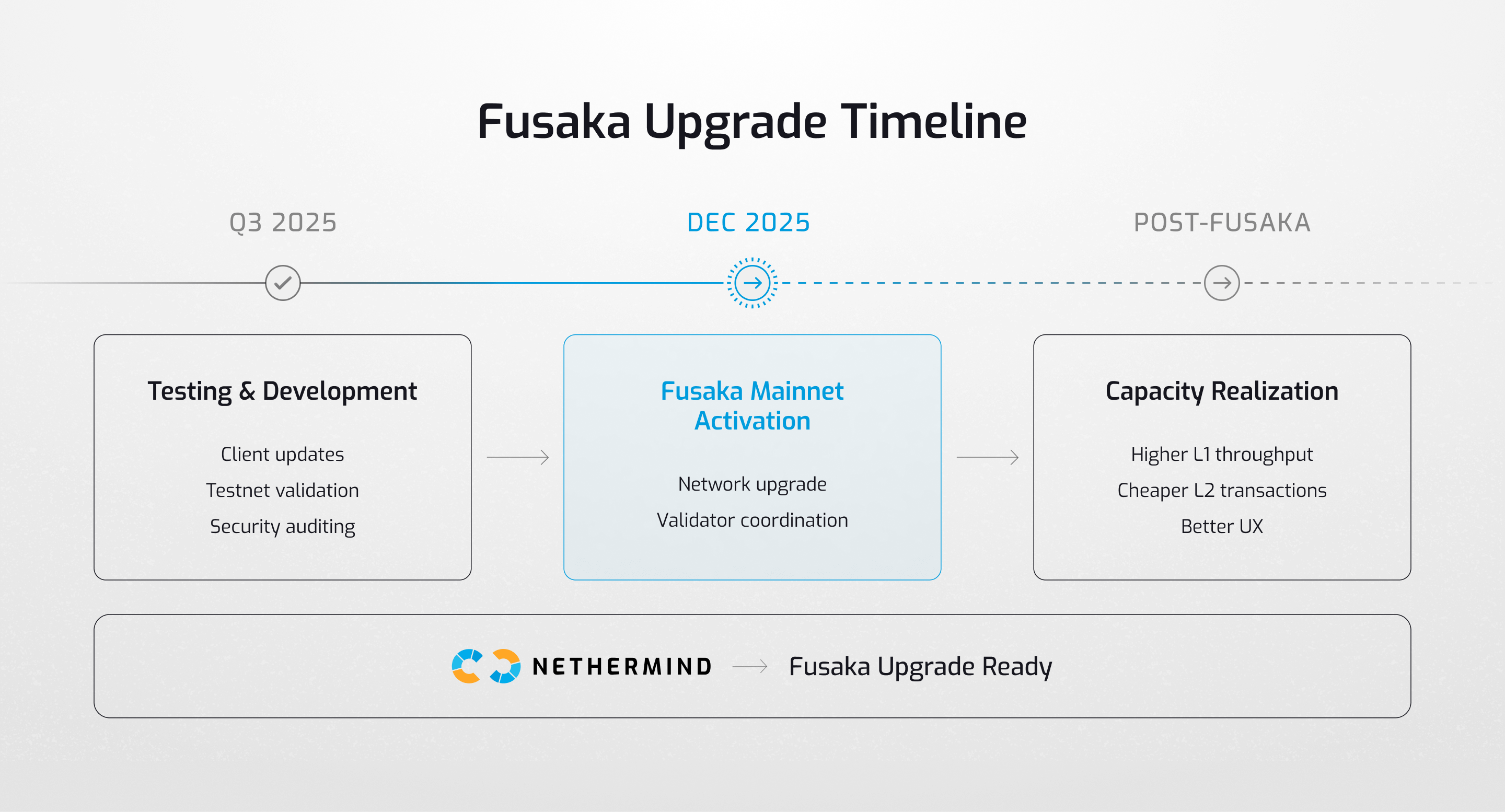
Ethereum is about to take an important step forward in scale and performance. Scheduled for December 3, 2025, the Fusaka upgrade will expand Ethereum’s capacity at every layer: throughput on Layer 1, capacity for Layer 2 rollups, and a smoother experience for applications and validators.
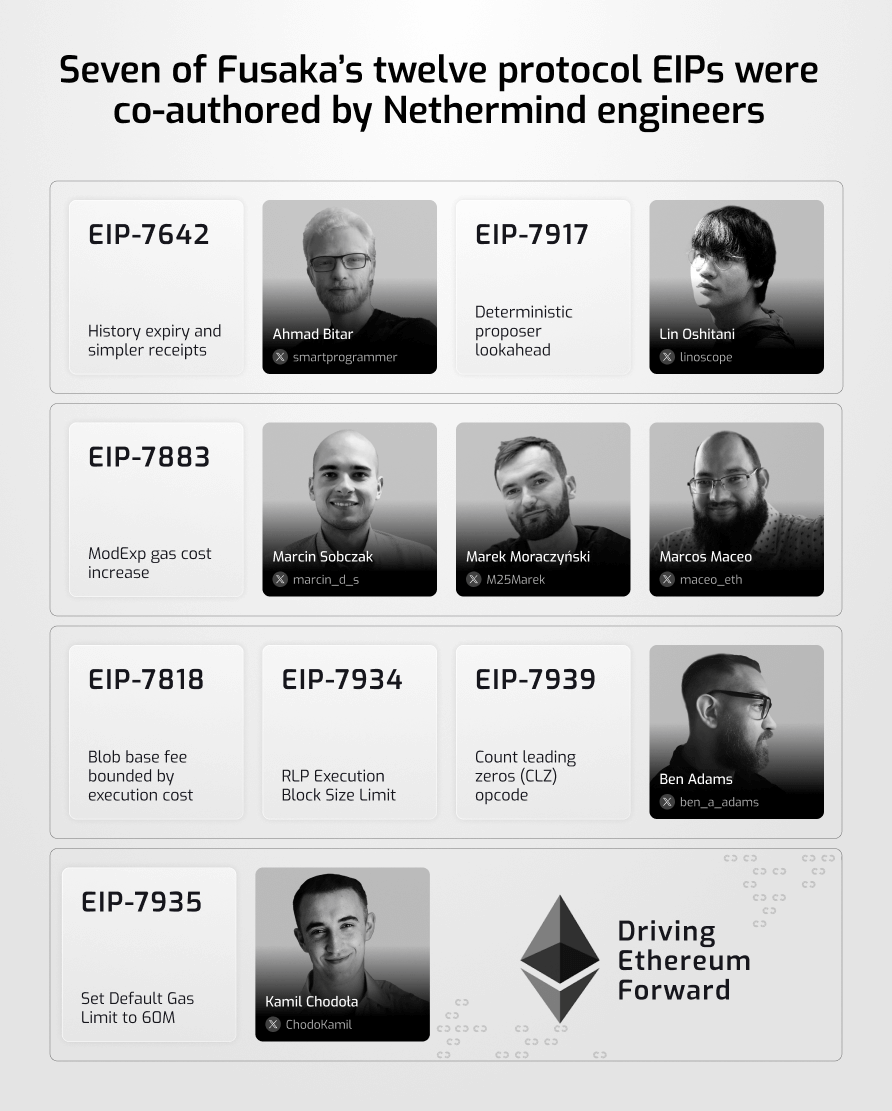
Ethereum upgrades move forward through the work of its clients. Our engineers co-wrote seven of the twelve protocol proposals included in Fusaka, giving them a defining role in how the upgrade takes shape. Nethermind implements the execution layer changes and delivers a stable client for validators, enterprises, and developers.
Our Engineers' Contributions to Fusaka
Fusaka reflects significant work from our engineering team at the specification level. Our engineers co-wrote seven of the twelve proposals included in the upgrade. Their work shapes execution layer growth, strengthens security under load, and improves conditions for rollups and applications in production.
These contributions anchor Fusaka in real execution client experience and ensure that growth happens safely and predictably.
Fusaka introduces changes that improve throughput and stability on Layer 1.
EIP-7642 (eth/69 - history expiry and simpler receipts): By removing the bloom filter from receipts in the networking protocol, this change eliminates roughly 530GB of unnecessary bandwidth during each node sync. Previously, serving nodes regenerated bloom filters for billions of transactions only for syncing peers to verify and discard them. The proposal also introduces a history serving window, allowing nodes to advertise which block ranges they store, making the network more efficient as Ethereum transitions toward history expiry.
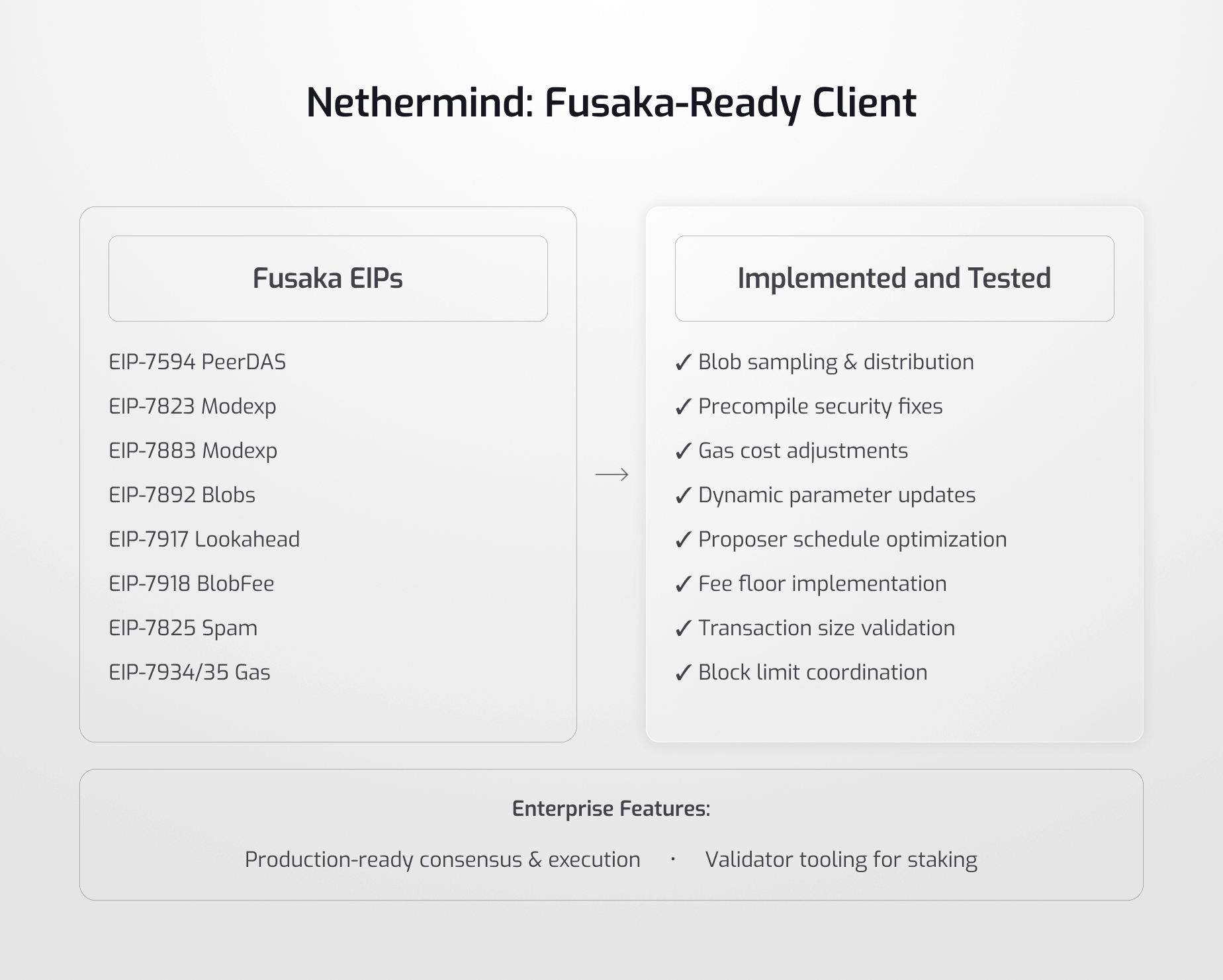
EIP-7823 and EIP-7883 (Modexp worst cases): By capping parameters and adjusting gas costs for the Modexp precompile (a built-in function for modular exponentiation used in cryptographic operations), these changes close potential attack vectors and ensure pricing better reflects resource usage. This lays the groundwork for future increases to the block gas limit.
EIP-7934 and EIP-7935 (Block size and gas limit): Together, these proposals coordinate execution-layer growth by setting a hard cap on block data size and raising the default gas limit to 60M. This ensures throughput expansion happens safely, predictably, and in sync across all execution clients.
EIP-7939 (CLZ opcode): This introduces a new opcode that counts the number of leading zero bits in a 256-bit word or log2, providing a fundamental building block for mathematical operations, compression algorithms, and data structures. The native opcode makes compute cheaper, reduces bytecode size, and dramatically lowers ZK proving costs. Current Solidity implementations rely on expensive bitwise shifts that cost 1.6x more than multiplication to prove in zkVMs, making this a substantial efficiency gain for developers building on Ethereum.
These changes secure the execution layer while opening the door for safer expansion.
Expanding Rollup Capacity and Improving L2 Economics
Ethereum’s rollup-centric roadmap depends on more efficient ways to handle rollup data. Fusaka delivers this with new tools that make rollups cheaper, faster, and more flexible.
EIP-7594 PeerDAS (Peer Data Availability Sampling): PeerDAS makes it possible to include more rollup data, known as blobs, without requiring each node to store all of it. This means more capacity for rollups, cheaper L2 transactions, and reduced bandwidth requirements for operators.
EIP-7892 (Blob parameter-only forks): This introduces the ability to adjust the number of blobs per block without waiting for another major upgrade. It gives Ethereum flexibility to scale more quickly in response to network conditions.
EIP-7918 (Blob base fee bound): By setting a minimum blob fee, this proposal prevents the market from collapsing to zero, resulting in healthier fee dynamics and reinforcing Ethereum’s economic security.
These EIPs make rollups more cost-effective and ensure the system can scale sustainably.
Improving Predictability and Consistency for Users, Developers, and Validators
Fusaka also improves how users and applications interact with Ethereum, focusing on security, predictability, and performance.
EIP-7825 (Congestion resistance): By capping transaction size, this change reduces the risk of congestion, ensures consistent network performance and allows for predicable transaction parallelisation.
EIP-7917 (Deterministic proposer lookahead): By making the block proposer schedule known in advance, this proposal speeds up confirmations and creates a more predictable environment for applications.
These proposals improve Ethereum’s resilience and create a faster, more reliable experience for both developers and end users.
What Fusaka Means for Ethereum
Fusaka is a pivotal step in scaling Ethereum across every layer:
L1 throughput: Modexp fixes and coordinated gas limit changes support safer growth.
L2 economics: PeerDAS and blob-related proposals expand capacity and stabilize fees.
UX and reliability: Congestion resistance and proposer lookahead improve stability and predictability.
Our teams are testing the Nethermind client across devnets and testnets, with production readiness scheduled ahead of mainnet activation. The engineering effort focuses on stability, robustness, and clarity for operators.
Fusaka marks a significant step for Ethereum and shows the strength of our engineering team. By co-writing a considerable portion of the protocol changes and delivering a stable client implementation, our engineers continue to shape the evolution of Ethereum in production.





.png)
.png)