Some of the biggest crypto thefts of 2026, at Binance, Drift and KelpDAO, never touched a private key. The keys stayed where they were, and the attackers got them to sign anyway.
That's worth knowing if your team holds an admin, upgrade or treasury key. A key only signs when something asks it to. That could be your release pipeline shipping an upgrade, a council member approving a proposal, a bridge confirming a message, or an AI agent sending a transfer. Each of those is a way in.
This guide walks through one example, the four routes behind some of this year's biggest losses, and a table you can fill in for your own keys. It ends with six fixes and what each one leaves open.
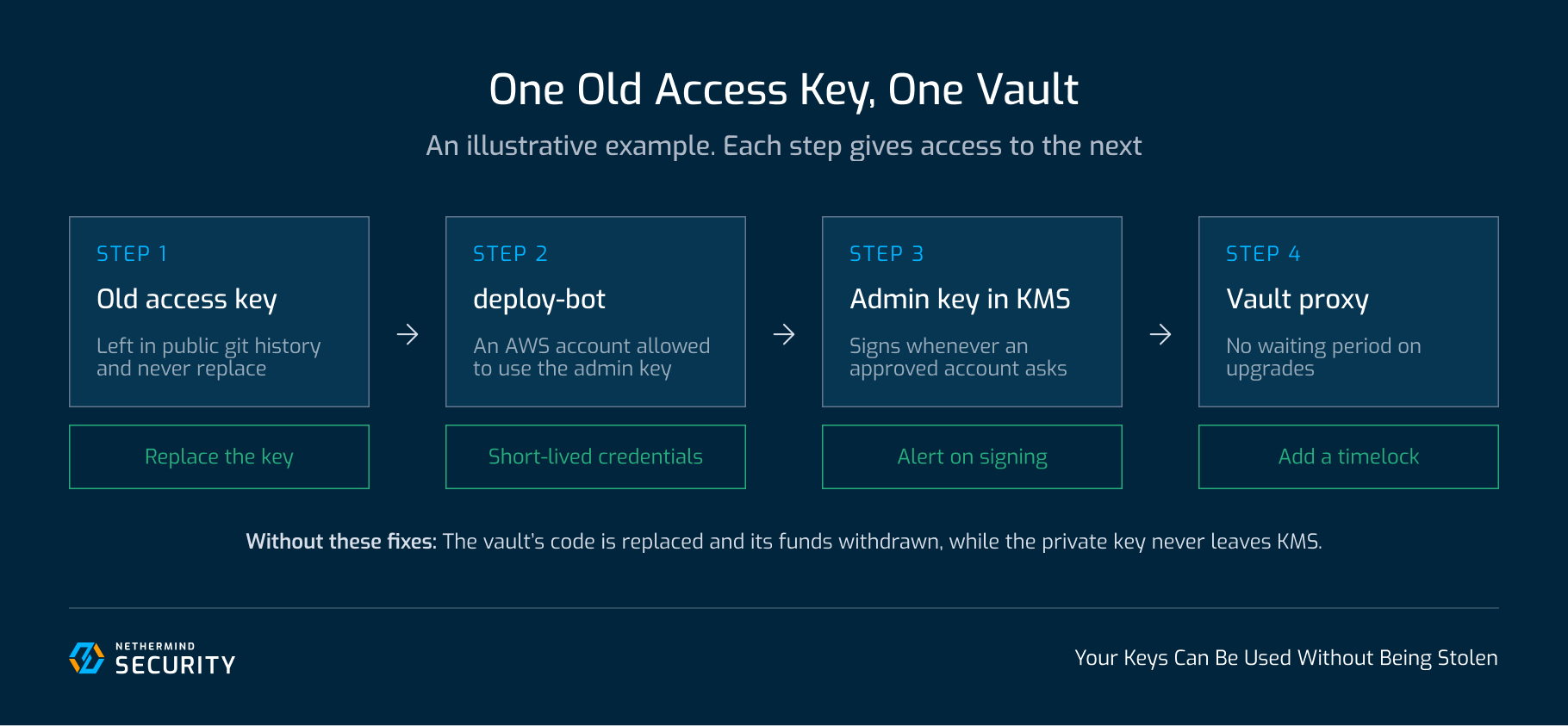
An example: one old access key, one vault
This example is a composite. Every step comes from patterns in real incidents, and the numbers are only there for scale.
A DeFi team runs a lending vault with about $40 million in it. The vault sits behind an upgradeable proxy, which means whoever controls the admin key can swap the vault's code for new code.
The team keeps that admin key in AWS KMS, Amazon's key management service. KMS holds the key and signs whenever an approved system asks, so the key itself never leaves. The team's release pipeline uses it to ship upgrades.
The pipeline signs through an AWS account called deploy-bot, which is allowed to use the key.
Two years ago, someone committed deploy-bot's access key, a long-lived password for that account, in a test script. They deleted the file later, but the access key stayed in the repository's public history, and nobody replaced it.
Anyone who searches that history can use the access key to ask KMS for a signature, upgrade the vault to their own code and withdraw everything. There's no waiting period on upgrades, so the team finds out after the money is gone.
The private key never leaves KMS. It just signs for the wrong person.
Why each review can be right and still not show it
Different people usually check each step, and each of them can be right. The audit treats the admin as trusted because that's its scope, and the cloud review sees an ordinary deploy permission. The secret scanner flags an old key, which looks like housekeeping.
You only see the problem when you connect them: this access key belongs to deploy-bot, deploy-bot can use this KMS key, and this KMS key controls the vault.
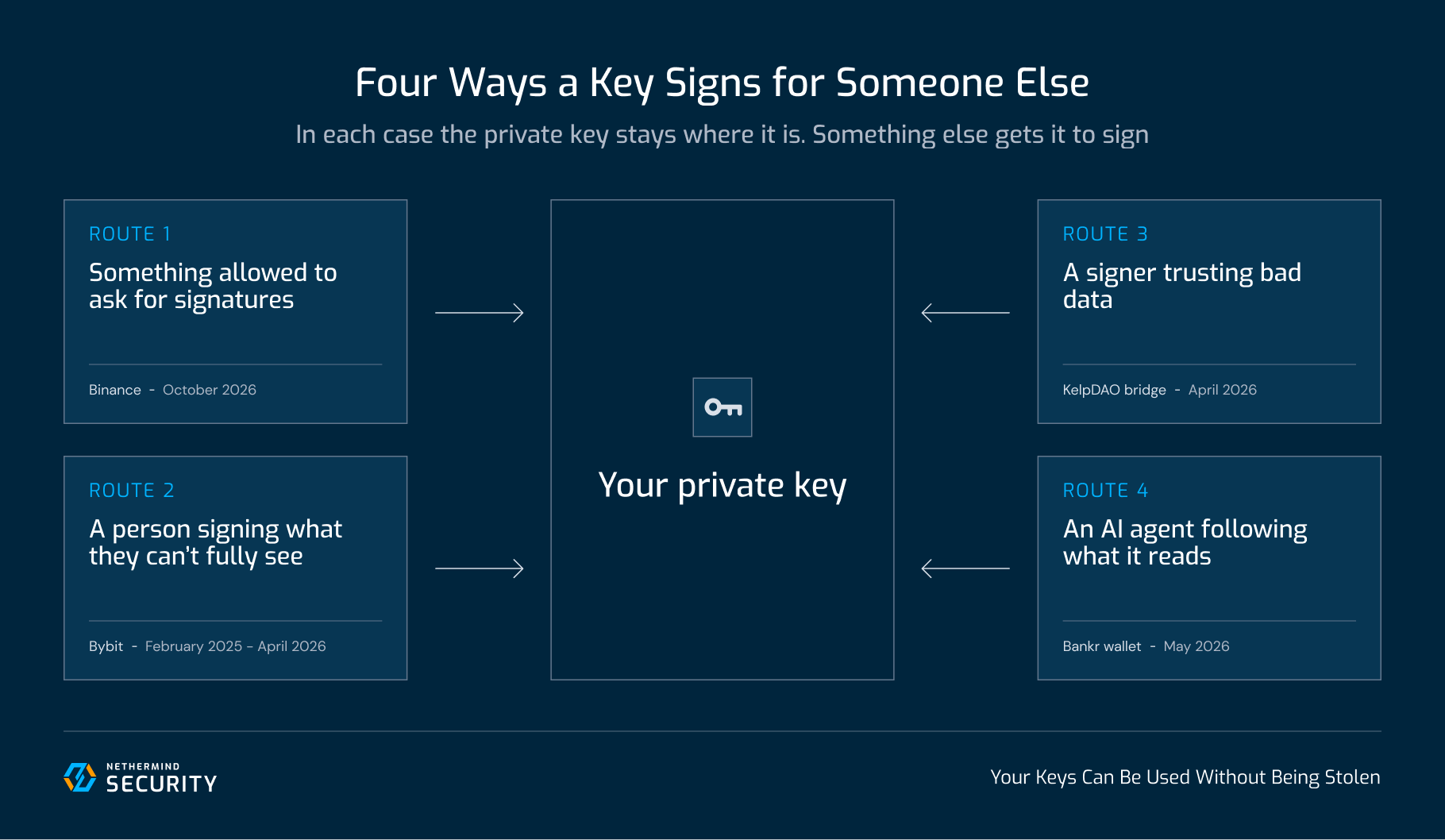
Four ways a key signs for someone else
TRM Labs counted 207 hacks in the first half of 2026. Most of them, 125, exploited bugs in smart contract code. But attacks on infrastructure and operations caused about 76% of the $972 million stolen, while making up only around 15% of incidents.
Several of this year's largest cases show four routes.
Something that's allowed to ask for signatures. That's the route in our example. Binance's report on its October theft describes it at a much larger scale. Attackers spent months working through engineers' laptops, found a token that could deploy software, and used it to reach Binance's own signing service. The service signed what they asked for. In its first update, Binance said: "We have found no evidence of any wallet private key leak." On Ethereum, the signing service also signed 50 EIP-7702 authorizations, which let a wallet run another contract's code. One of them took effect and pointed a hot wallet at the attacker's contract. From then on, the attacker needed nothing more from Binance: the contract kept emptying the wallet without any new signatures.
A person signing something they can't fully see. Signers approve what their screen shows them. At Bybit in February 2025, attackers changed the Safe{Wallet} web app so signers saw a routine transaction while their devices signed a different one, which gave the attacker control of the cold wallet. At Drift in April, two of the five Security Council members signed transactions ahead of time, likely without knowing what was in them. A Solana feature called durable nonces kept those signatures valid until the attacker used them. Days earlier, the council had removed the waiting period on admin actions, so the transactions went through instantly.
A signer trusting bad data. Some signers sign because data tells them to. KelpDAO's bridge released funds when a single verifier, run by LayerZero Labs, confirmed a message from another chain. In April, attackers swapped the software on two of the nodes that verifier read from, so those nodes reported a message that never happened. Then they flooded the honest nodes until they dropped out. The verifier confirmed the fake message, and the bridge released about $290 million in rsETH. LayerZero says the verifier itself was never breached.
An AI agent following what it reads. Bankr gives AI agents wallets they control through posts on X. In May, an attacker sent a membership NFT to the wallet Bankr had set up for Grok, which reportedly raised its transfer limits. Then they asked Grok to translate a message written in Morse code. The decoded text was a transfer instruction, and Bankr's bot carried it out: 3 billion DRB tokens, worth about $150,000 to $175,000. Some of it was later returned.
Write down what can make each key sign
You can find these routes in your own setup with one table. List every key or signer that can move funds or change code. For each one, write down everything that can lead to a signature. Here's how it looks for the examples above.
Key
What it can do
What can ask it to sign
What gets checked first
Waiting period
Who'd notice
Vault admin key in AWS KMS
Replace the vault's code and take everything in it
The release pipeline, and anyone with deploy-bot's access key
Any two members, including transactions they signed ahead of time
Whatever each signer's screen shows
The timelock, if there is one
Whoever watches pending admin actions
Bridge verifiers
Release or mint your token on another chain
Any message the verifiers confirm
What each verifier's nodes report
Usually none
Whoever checks token supply across chains
AI agent's wallet
Transfers and swaps up to its limits
The agent, and anything it reads: posts, web pages, other agents
The agent's own filters
None
Whoever looks at the wallet later
Once it's filled in, start with the riskiest keys. Those are the ones where more things can ask for a signature than you expected, where only one thing gets checked before signing, or where nothing makes the action wait.
Six fixes, and what each one doesn't cover
Fix
Helps with
What it still leaves open
Search the full history of every repository and CI system for keys and passwords, replace what you find, and give each build its own short-lived credentials
Leaked credentials, like in the example
A hacked build can still ask for signatures while its credentials are valid
Keep asking for a signature, checking the rules and signing in separate systems, and have the signer read the full transaction rather than a hash
A hacked system asking for signatures it shouldn't get
The rules need updating as new transaction types appear, like EIP-7702
Put admin actions behind a multisig with a timelock, keep the timelock on changes to the multisig itself, and have signers check each transaction on a second device
Signers who are tricked by their screen or rushed into approving
Someone has to watch pending actions, and signatures given ahead of time can still be used
Require two or more independent verifiers, each reading from its own nodes, before funds move
One bad data source
Verifiers that share node providers or software can still fail together
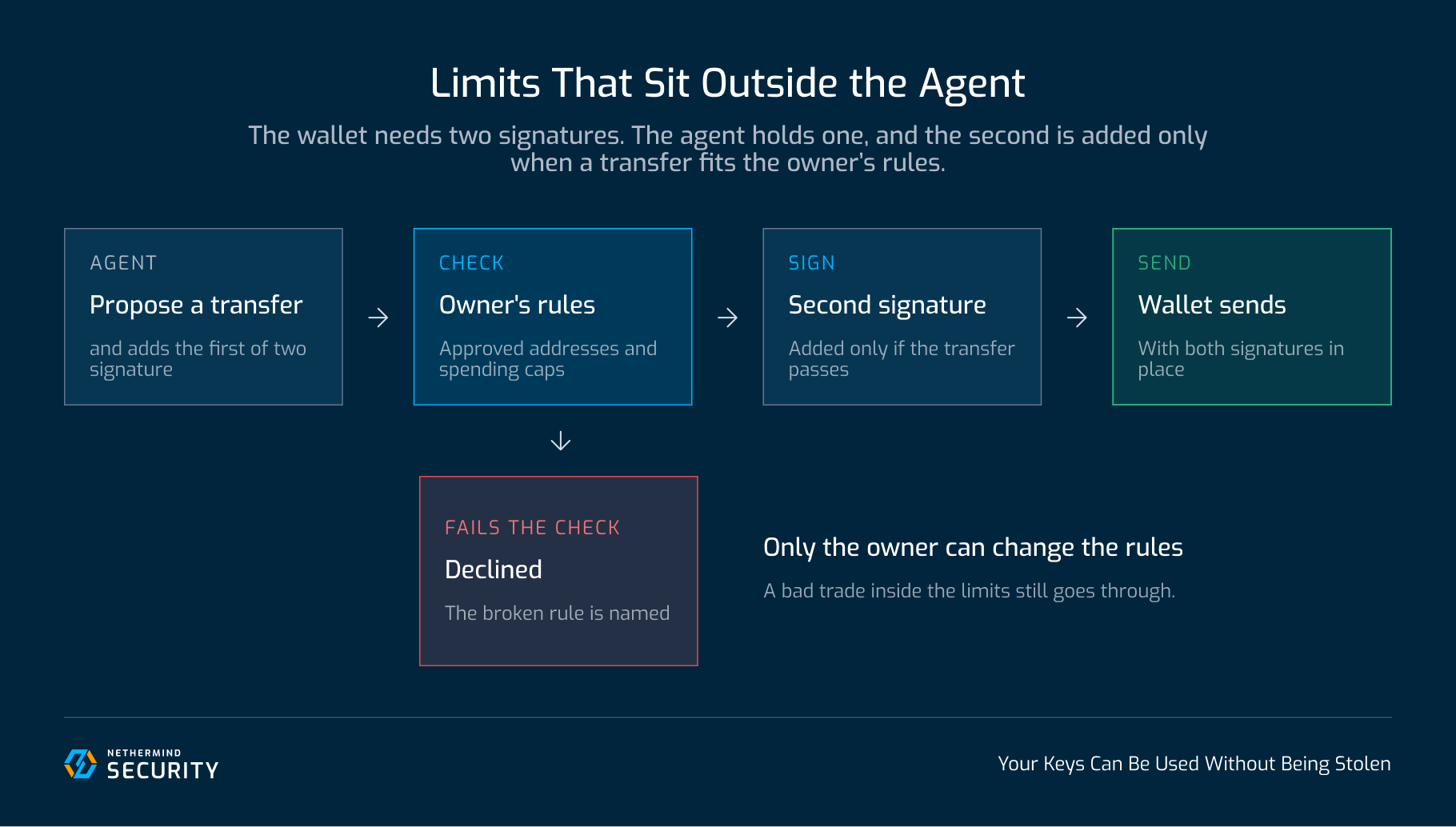
Set an agent's limits outside the agent: a second signature that's only added when a transfer fits rules the owner sets, like approved addresses and spending caps
Agents tricked by what they read
A bad trade within the limits still goes through, and you now trust whoever runs the check
Get alerts for signature requests from unexpected places and for changes to who controls what, such as a new delegation, a new multisig member, a shorter timelock or a new verifier setup
Spotting any of the four routes early
Alerts don't block anything, so they only help if someone acts fast
Questions to ask your team
Which keys can replace a contract's code or move all of its funds, and is there a waiting period before either happens?
Apart from the system you meant, what can ask each of those keys for a signature?
Do your signers read the full transaction, or only a hash?
Have you searched the full history of every repository and CI system for credentials, and replaced everything you found?
Do any of your multisig signers share a laptop, a cloud account or the same web app?
Are there signatures that stay valid until someone uses them, and would you notice one being used?
Does anything that releases funds rely on a single verifier or a single data source?
If an agent has a wallet, does it read content you don't control, and can it change its own limits?
Does your audit scope say where each admin key is kept and what can use it?
How we can help
Nethermind builds and runs Ethereum infrastructure, including the Nethermind execution client and validators. Nethermind Security audits smart contracts and ZK systems, formally verifies critical code, and runs AuditAgent and AgentArena for AI-assisted review. Our audits map out what the privileged roles in your contracts can do. If you'd like to talk through the systems around those roles, get in touch.