Tokenized funds, bonds and equities on public blockchains are visible to everyone: every holder, position and transfer. Shielded pools can hide that, but a security token placed in a standard shielded pool loses the compliance controls regulators require.
This post presents a compliant shielded pool for ERC-3643 tokenized securities. Only verified holders can transact, frozen holders cannot move value, an authority canclaw back a position without the holder’s key, and a supervisor can read the full history. We built it using Paladin's Zeto, an open source framework for programmable private tokens on the EVM.
A money-market fund, a bond, or an equity carries obligations that the token has to reproduce. In practice, that means extending the token with identity, eligibility, and transfer rules. These rules exist to meet the regulatory obligations attached to financial assets. A holder can be sanctioned, or fail a periodic review. A court can order a position moved. An investor can lose the key to their wallet and still be entitled to their holding. A supervisor can demand to see who held what, and when. An instrument whose issuer cannot respond to all four is not one a regulated market will accept.
Several standards exist for that structure. On Ethereum, ERC-3643 extends ERC-20 tokens with additional identity and compliance rules, and CMTAT defines an equivalent set of controls as a blockchain-agnostic framework.
ERC-3643 and CMTAT tokens are entirely public. Every holding and every transfer is visible to anyone, which is a poor fit for instruments whose holder base, position sizes, and rebalancing are sensitive information. One could be tempted to adopt shielded pools to provide privacy to a tokenized security. However, a general-purpose shielded pool cannot enforce the compliance controls these assets depend on.
We built on top of Paladin, a framework for programmable privacy on EVM chains, by extending Zeto, its family of shielded tokens. Zeto already provides KYC checks and auditor access. Regulated assets need more: tokens can be clawed back after a court order, holders can be frozen if their funds are considered illicit, and the authority enforcing a clawback must be able to find what it is taking.
Why shielded pools break compliance for tokenized securities
Inside a shielded pool, each holding is a note: a record whose owner and amount are hidden onchain. A general-purpose shielded pool exposes three operations: deposit, transfer, and withdraw. For an unregulated asset that is all you need.
For a tokenized security it is not sufficient. The moment the token lands in the pool, every compliance control stops working. A frozen account can still spend its notes from its in-pool address, because "frozen" was a public-ledger concept the pool never learned. A seizure order has nothing to act on, because the issuer cannot tell which notes belong to the sanctioned party. Anyone without a viewing key sees only cryptographic data that reveals nothing about who holds what.
For an unregulated token that is a feature. For a security it is a disqualifying defect, because the pool becomes a compliance escape hatch, and the cleanest way to launder a frozen position would be to deposit into it.
The gap is not privacy. Shielded pools solved that. The gap is that the controls a tokenized security needs are precisely the ones that depend on seeing what a pool is built to hide.
What compliance controls a tokenized security needs
These are the properties a shielded pool has to provide before a tokenized security can live inside it. Some of the terms are used loosely elsewhere, so we fix their meaning here.
Confidentiality: Transaction details are hidden from everyone other than the sender, the receiver, and any authorized authority.
Identity gating: Only holders with valid KYC may hold or receive the asset. An onchain KYC registry remains the source of truth about who is verified, and the pool proves that its counterparties are members of that registry.
Selective disclosure: A designated authority, and only that authority, can reconstruct the full detail of a transaction without the holder's cooperation and without any ability to move value. Here the term means disclosure to a named supervisor holding a global viewing key that applies to every transaction in the pool.
Enforceable freeze: A holder can be barred from transacting, with the bar applying inside the pool and not only on the public ledger.
Clawback: An authority can move an asset out of an account that does not cooperate, without that account's key. The operation is also called a seizure, and we use both words below.
How a compliant shielded pool works
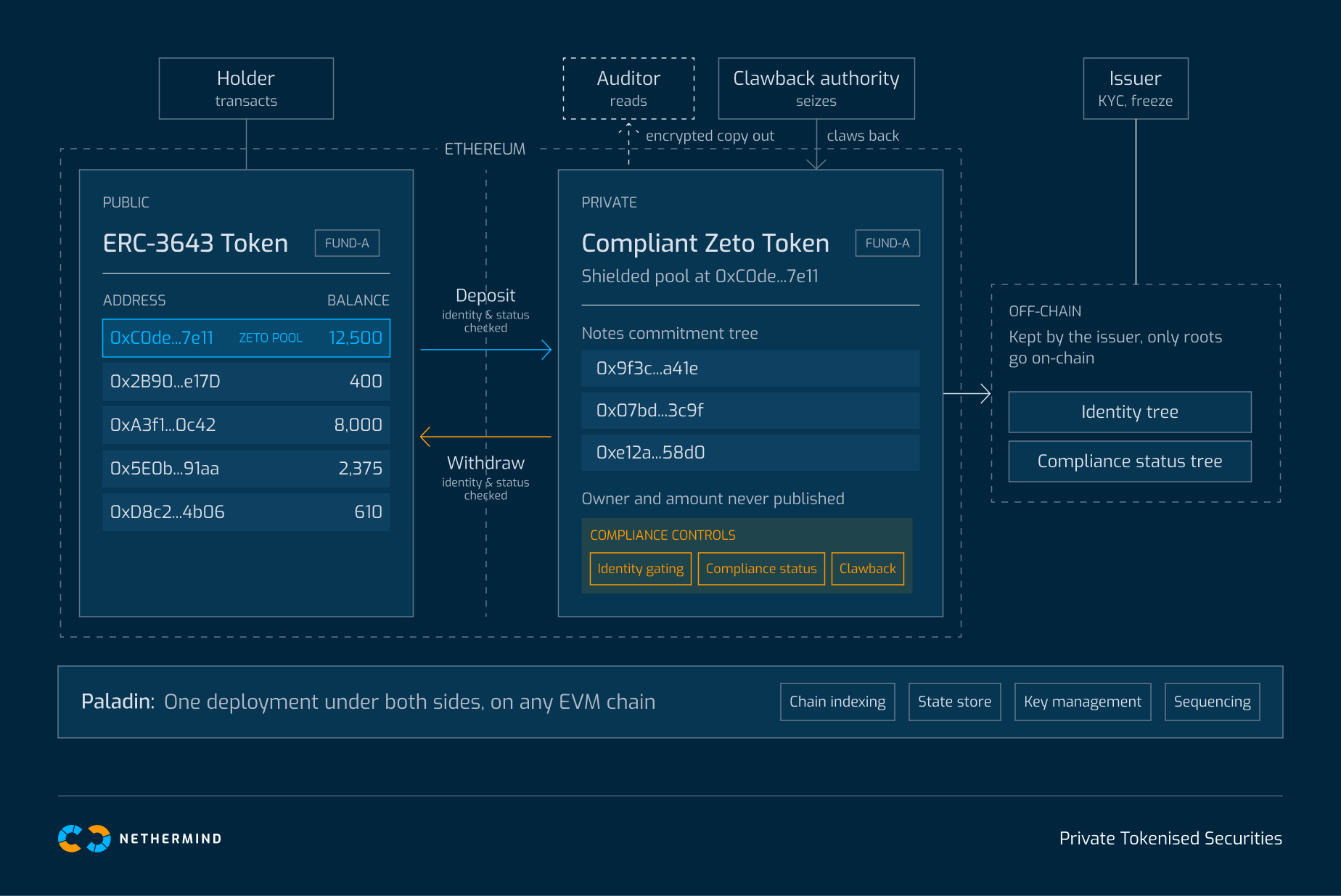
We extended a general-purpose shielded pool with the compliance controls a tokenized security requires. The result is a compliant shielded pool for tokenized securities.
Inside the pool a holding is a note, and a transfer reveals nothing onchain beyond the fact that it is valid. So we added those compliance controls to the conditions a transfer must meet to be valid.
A transfer is valid only if the sender and the receivers are identity-verified and active, which means a frozen holder cannot produce a proof at all. We also added what an authority needs to inspect the full transaction history and to claw funds back when required. Value still crosses in and out by deposit and withdrawal.
That took us to five additions to the pool.
A compliance status tree. The issuer records every holder as active or frozen, in a tree alongside the identity tree Zeto already keeps, with only the roots published onchain.
A declared clawback authority. Every note commits the key of the authority entitled to seize it, alongside the key of its owner.
A clawback proof path. The authority can consume a frozen holder's notes without their key.
A second nullifier on every note. A nullifier is a public marker that shows a note has been spent without revealing which one. The second nullifier per note lets the authority consume a note without the owner’s key, while making sure no note can be spent twice.
Compatibility with ERC-3643. Identity gating, freezing, forced transfer, and lost-key recovery each have a counterpart inside the pool.
We built the pool on top of Zeto, Paladin's general-purpose shielded token, rather than from scratch, and that choice mattered as much as the cryptography. A shielded pool needs a lot of machinery around its proofs: an indexer that tracks which holdings are still live, local state that each proof is built against, a reader for the encrypted notes stored onchain, and an interface an application can actually call. Paladin already ships all of it, along with key management and transaction sequencing (see Appendix B). Starting from scratch would have meant rebuilding that machinery, and every rebuild is a fresh source of subtle bugs. Because what we produced is still a Zeto token, it plugs into any Paladin deployment and inherits all of this.
The public ERC-3643 token and the private pool side by side. Identity and status are checked whenever value moves in or out.
Both Paladin and Zeto are open source under LF Decentralized Trust, and our version is published in the Nethermind Zeto repository. It can be deployed into an existing Paladin setup and to act as a privacy layer for any deployed ERC-3643 instrument.
Because Paladin is composable, this is not a silo. An issuer tokenizing financial assets can run the public instrument and its confidential pool side by side, and a bank operating that fund can use the same Paladin deployment for both, alongside other domains for the cash leg of a settlement.
We first compare this approach with the main alternative, then show how each ERC-3643 control carries over into the pool. Readers who want the mechanism will find it in the technical deep dive at the end.
Shielded pools vs. FHE confidential tokens (ERC-7984)
Confidential tokens hide amounts but leave the sender and receiver visible. A compliant shielded pool also hides who transacts with whom, and that is what makes its compliance controls harder to build.
An alternative design keeps the account model and encrypts the numbers instead of hiding holdings in a pool. That approach is standardized as ERC-7984, the confidential fungible token standard, where balances are held encrypted and computed over using fully homomorphic encryption (FHE), without ever being decrypted.
T-REX Network adopted Zama's FHE protocol as the confidentiality layer of its ledger, combining ERC-3643 compliance with the ERC-7984 confidential token standard.
It is a good design and it solves a different problem, which the transfer function makes plain:
confidentialTransfer(address to, externalEuint64 encryptedAmount, bytes inputProof) → euint64
The amount is encrypted. The recipient is an ordinary address and the sender is msg.sender. Zama's page on confidential RWA tokenization states the consequence directly, that "sender and receiver addresses remain public; investor holdings, trade amounts, and fund composition stay encrypted". The numbers are confidential and the transaction graph is not.
In this model, compliance controls come naturally. Because the contract can always see which address is transacting, freezing an address and forcing a transfer out of it are ordinary operations on visible state. Intuitively, the difficulty of the controls is proportional to how much you hide, and hiding the transaction graph is what makes them hard.
The table below compares confidential tokens with our compliant shielded pool. As a comparison framework we recall the properties a privacy-preserving protocol should provide, which we set out in the first post of this series.
Property
Confidential tokens (FHE)
Compliant Shielded Pool (this work)
Confidentiality
Balances and amounts encrypted
Note contents hidden
Sender anonymity
No, the sender is a public address
Yes, within the pool's anonymity set
Receiver anonymity
No, the recipient is a public address
Yes
Unlinkability
No, the transaction graph is public
Yes
Double-spend prevention
Account balances, homomorphically
Nullifiers
Value conservation
Homomorphic arithmetic
Enforced in the proof
Public verifiability
Yes
Yes
Freeze, forced transfer
From the ERC-3643 layer above, acting on visible addresses
Supported, and the substance of this work
Partial freeze, pause
From the ERC-3643 layer above
Pause supported, partial freeze through a clawback into an issuer-held escrow note
Trust model
Soundness of the FHE scheme, and an MPC committee that must not collude to decrypt
Soundness of the proof system, and single auditor and clawback key holders, each a point of exposure
Caption: FHE confidential tokens hide amounts. A compliant shielded pool also hides who holds what and who transacts with whom.
An issuer choosing between them is really choosing how much they need to hide. If encrypted amounts on a public graph are sufficient, the FHE route is straightforward and wraps an existing position without migration. If the holder relationships themselves are the sensitive part, which for most funds they are, then the graph has to go, and the controls we built are what it takes to keep the instrument enforceable once it does.
How each ERC-3643 control works inside the pool
Every ERC-3643 control keeps working inside the pool, except transfer rules that need transaction history (see Limitations).
ERC-3643 is a collection of smart contracts that implement the functionalities of a tokenized security. At its core there are three pillars: the token is an ERC-20 whose transfers are controlled; the identity registry holds the verified investors and answers whether a given address is eligible; the compliance contract evaluates the issuer's transfer rules through pluggable modules. Behind the registry sit the onchain identities and the claim registries that decide who counts as verified, which we leave to Appendix A.
Two roles operate the system. The owner is the issuer, holding governance authority. The agent is the operator who executes privileged actions such as minting, freezing, and forced transfers.
The table below lists the functions that govern an ERC-3643 token. Each exists to meet a regulatory obligation of tokenized securities. Making the instrument confidential means keeping every one of them working once the tokens are shielded. The right-hand column shows how our pool does it.
ERC-3643 Function
What it does
In the shielded pool
isVerified
Answers whether an address is KYCed
Every sender and recipient must be verified, without revealing who they are
canTransfer
Answers whether a specific transfer satisfies the issuer's rules
Holder status is checked on every transfer without revealing the parties. Rules that need transaction history are not supported yet (see Limitations)
setAddressFrozen
Locks an entire wallet, blocking transfers in and out
A frozen holder cannot move anything inside the pool
forcedTransfer
Moves tokens between holders on an agent's authority, bypassing compliance rules
The clawback authority can claw back a frozen holder's tokens, without their key and without revealing which tokens
recoveryAddress
Moves a holding from a lost wallet to a replacement, keeping the investor's identity
The same clawback, sending the holding to the investor's new account
mint, burn
Create and destroy supply, with batch forms of most of the above
Unchanged on the public token. Value enters and leaves the pool through checked deposits and withdrawals
transfer, transferFrom
Ordinary ERC-20 movement, gated by the two checks above
Private transfer, with amount, sender and recipient hidden
freezePartialTokens, unfreezePartialTokens
Lock and release a specific quantity, leaving the rest usable
The locked quantity is clawed back into an issuer-held escrow note and returned on release
pause, unpause
Halt and resume every transfer of the instrument
A pool-wide pause, under which the pool rejects every transfer, deposit and withdrawal
To summarize, keeping an ERC-3643 instrument compliant inside a shielded pool comes down to three things that must work together:
Deposits and withdrawals: where public meets private
Inside the pool both sides of a transfer are hidden, and the proof checks both. Deposits and withdrawals are different, because one side of them is public. The pool can check only the half that sits inside it, and the public token covers the other half. So the two crossings are not checked the same way, and the controls on either side have to be read together.
Deposits
The tokens leaving the depositor are still an ordinary ERC-3643 holding, so the transfer into the pool passes isVerified and canTransfer, and a frozen address cannot make it at all.
On the pool side, every new note names a holder, and the proof checks that this holder is verified and active, so a frozen holder cannot deposit into a position they still control. New notes are also placed under the clawback authority from the moment they cross.
What neither half does is identify the depositor inside the proof. A deposit creates notes without consuming any, so there is no sender identity in the statement to check. That is covered on the public side, where the depositor is a visible address subject to the token's own freeze.
Withdrawals
Inside the pool, the sender and any change recipient must be verified and active, and the withdrawal consumes the note just as a transfer does. A frozen holder cannot withdraw their way out, and a note that has been clawed back can no longer be spent, so it cannot be withdrawn either.
The value lands as an ordinary ERC-3643 holding, so the receiving address has to pass the same isVerified and canTransfer checks as any other transfer of the instrument.
Taken together the two crossings leave no escape hatch open. A frozen holder cannot carry value in, cannot carry it out, and cannot move it while it is inside.
Limitations
Some limits are deliberate and some are simply where we drew the line for a first release.
Transfer rules that need transaction context: ERC-3643 evaluates transfer rules behind the canTransfer method. Checking the compliance status of a holder is a binary check on the status tree, which the pool handles. However, financial assets may be subject to a cap on the number of holders, a rolling volume limit, or a rule comparing a transfer against recent ones, and evaluating any of those means reading the graph of previous transactions, which is exactly what the pool hides by design. Some of this logic could move inside the proof, and some is genuinely in tension with the privacy model.
Clawback redirects value into new confidential notes: A clawback does not convert notes directly out to a public balance. Converting to public is a separate step taken by the recipient, which keeps the exit gated on that recipient's own identity and status.
The clawback authority can be rotated, but not simply replaced: A note created earlier still names the authority in force at the time, so the pool has to go on recognizing retired keys for those notes to remain usable. The contract must hold a list of recent clawback authorities, so that new notes bind to the current entry while older notes prove against the list. Dropping a key from that list is a deliberate act that strands every note still naming it, spendable and seizable by no one. Rotation is routine, but retiring the old key is a migration.
Compliance policy is enforced, but it is not proven: The circuit does not prove why a holder was frozen, or that a clawback was backed by a court order. That judgment stays offchain.
The public registry leaks the holder set: An observer cannot see what moved or between whom, but ERC-3643 keeps its identity registry on the public side, where anyone can read it. Confidentiality inside the pool therefore sits on top of a public list of who is eligible to hold the instrument, and that list bounds the anonymity set. For most regulated instruments this is the correct trade, since the holder base is a matter of record anyway.
What this means for issuers
In this post we tackled the problem that neither privacy nor compliance solves on its own. Moving financial assets on chain as tokenized securities carries obligations that assume the ledger can see who is transacting and what compliance status they hold. Privacy is a crucial aspect of these assets, because it is not acceptable to leak the positions of investors in a money-market fund or the trading strategies of its participants.
We discussed how to adopt shielded pools as a privacy layer for financial assets. The question left open was what happens when a tokenized security is deposited into a pool. Every compliance control is lost.
Our answer to this problem is a compliant shielded pool that enables enforcement of compliance rules under its privacy model. We built it as a Zeto token inside Paladin, so an institution can plug it into an existing deployment rather than assemble the tooling first.
Onto that we added what ERC-3643 asks for, taking the standard as our case study. Identity gating and selective disclosure came from Zeto, and we brought them together with a compliance status tree and a clawback path so that one token gates identity, discloses to a supervisor, enforces freezes and supports clawback. The controls a regulated instrument needs survive the trip into the pool.
Finally, we compared our approach with the FHE-based alternative, confidential tokens. Ours is the design to reach for when the holder relationships and the transaction graph are what must stay private.
What comes next
Building the pool as a Zeto token rather than as a shielded pool of our own was a design choice with consequences beyond the ones already described. It makes the token native to Paladin, so it inherits the platform's programmability rather than sitting beside it. Four things could follow.
Private and atomic delivery-versus-payment. A securities leg settling against a cash leg in a single commit, with neither side exposed to the other's failure, using Paladin's approval-based atomic interoperability.
Verifiable compliance policy. Moving the justification for a freeze or a clawback inside the proof, so entitlement is demonstrated rather than asserted.
Multiple clawback authorities. Per-jurisdiction or per-tranche authorities become a registry question rather than a new construction, because each note already names its own.
Corporate actions. Dividends, coupons, redemptions, and voting are workflows that need shared private state and programmable logic which Pente, Paladin’s domain for private smart contracts, provides when paired with a Zeto token.
Privacy and compliance enforceability were supposed to be in tension, and we have shown how to relax that tension with compliance built inside a shielded pool.
We thank Goutham Denthaje for the implementation of the compliant shielded pool described in this post and our colleagues at Nethermind Research for the fruitful discussions and for reviewing this work.
Technical deep dive
This section is for readers who want the mechanism. It starts from what Zeto already provides, then builds the three missing controls one at a time.
What Zeto already gives
Zeto is Paladin's family of zero-knowledge UTXO tokens. Its central idea is that a confidential token is a composition of reusable layers, each adding one capability, so you build the token you need by choosing how far up the stack to go.
Layer
What it adds
Anonymity
Commitments that hide amounts and parties, with value conservation enforced in the proof
Encryption
Each receiver learns the contents of their own new note, with no out-of-band channel
Nullifiers
A spend model that prevents double-spends and unlinks a spend from the note it consumed
Identity
Only keys registered in an onchain identity tree may transact, checked inside the circuit
Non-repudiation
Every transfer carries an encrypted copy of its details for a designated auditor
Zeto ships identity gating and non-repudiation as two independent building blocks. In our work, we inherited those layers to build a version of Zeto that combined them together along with the enforceable freezing and clawback functions.
Notation
H is a collision-resistant hash function. A participant is identified by a keypair (pk, sk), and subscripts name whose key it is, pk_own for the holder and pk_cb for the clawback authority. A note is committed as cm. Spending a note publishes a nullifier nf, which the pool records so that the same note cannot be spent twice. Each tree stores leaf values and publishes a root. ECDH is a Diffie-Hellman shared secret, computable by either of the two parties.
How access controls work in a shielded pool
In our second post we introduced access controls for shielded pools as user-level association sets. A curated set of public keys lets the pool prove that a counterparty is approved, with policy attached to the identity rather than to individual notes. Here the issuer curates the sets and ERC-3643 supplies the policy.
The mechanism is the same in both. The issuer keeps a tree of public keys and publishes only its root onchain inside the pool. Every transaction then proves, with the zero-knowledge proof, that the keys it involves sit in that tree, without revealing which leaves they are. Nothing about the holders reaches the chain, and the check cannot be skipped, because a proof that omits it is not a valid proof.
The Zeto implementation follows the same approach. Identity gating implements KYC controls as a Merkle tree holding the public keys entitled to hold the asset, and then each transfer proves in zero knowledge that the sender and every recipient are members of that tree. For each transfer, the proof checks:
identity check
  sender's pk     derived in-circuit from the sender's secret key
  recipient's pk  taken from the commitment of the note being created
  identitiesRoot  the published root of the issuer's identity tree

  then, for the sender and every recipient:
    leaf = H(pk)
    verify inclusion of leaf in identitiesRoot
On the public side that check is isVerified, answered by the registry. In the pool it is the same decision, proved in zero knowledge rather than queried.
Freezing a position you cannot see
We implemented freezing holders under the same mechanism. We built a second tree, the compliance status tree, alongside the identity tree. The status tree records each participant as active or frozen. Every transfer and withdrawal proves that the sender and the recipients are active. Deposits prove it of the recipients, because value arriving from the public side is still under that token's own controls until it crosses.
We use a sparse Merkle tree, where each leaf is addressed by a key and carries a value. The key is the holder's public key, and the status is bound into the leaf value.
status check
  pk              as above, for the sender and every recipient
  complianceRoot  the published root of the issuer's status tree
  STATUS          the status being proved, active or frozen

  then, for the sender and every recipient:
    leafKey   = H(pk)
    leafValue = H(pk, STATUS)
    verify inclusion of (leafKey, leafValue) in complianceRoot
On the public side the equivalent is setAddressFrozen, a flag the token checks on every transfer. In the pool there is no flag and no branch to check, because a frozen holder cannot produce a valid proof at all. A non-compliant transfer has nothing to submit, rather than something an implementation might forget to reject.
Clawing back a note without the key
Tokenized securities need a way to move an asset out of an account that will not cooperate, whether to enforce a court order, a sanctions designation, or a lost-key recovery.
In a normal shielded pool this is impossible by construction. The only party who can spend a note is whoever holds the owner's private key, because that key is baked into the nullifier the pool uses to prevent double-spends. That is precisely what makes the note theirs, and it is also what makes seizure unachievable.
Here we introduce a second way to spend a note. A designated authority can exercise a clawback from a frozen holder, without weakening the holder's normal control and without revealing onchain which note is being taken.
This starts with the note itself. Alongside the holder's own key, every note now commits the public key of the authority entitled to claw it back.
note = (
  pk_own,   // the holder's public key
  value,    // the amount
  salt,     // commitment randomness
  pk_cb     // the clawback authority's public key
)

cm = H(note)
The authority's key is registered in the pool contract, and every note created has to commit a key the contract recognizes. A holder cannot mint notes naming an authority of their own and walk out from under the control, and because pk_cb sits inside the commitment, no later change to contract state can alter which authority a given note answers to.
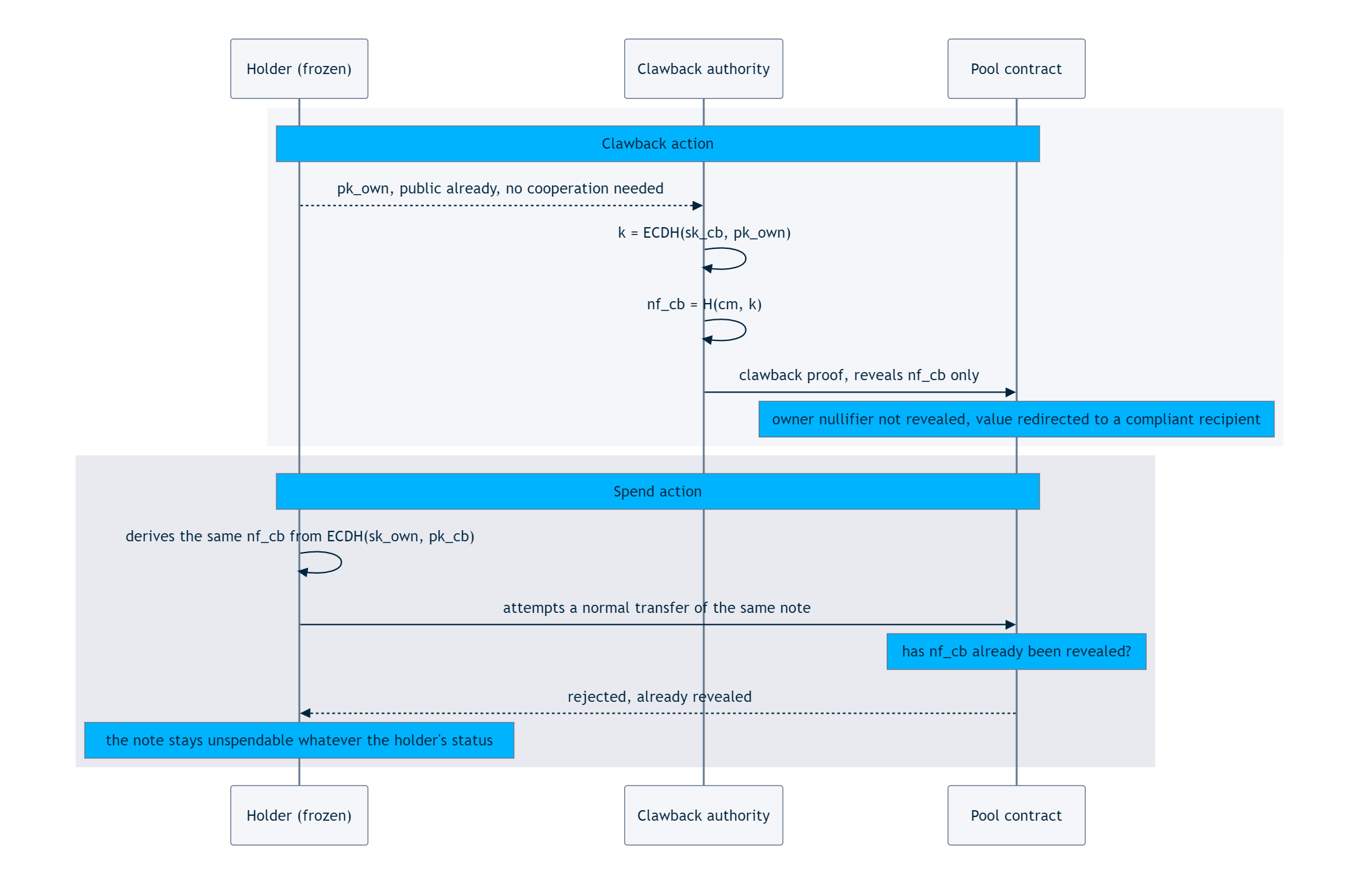
To spend a note we leverage Diffie-Hellman symmetry. Alongside its normal nullifier, every note carries a second one, a clawback nullifier, derived from a shared secret between the holder and the clawback authority the note names. Because such a secret can be computed from either side of the pair, the holder and the authority independently arrive at the same nullifier for the same note, from opposite directions, and neither needs the other's secret.
k       = H(ECDH(sk_own, pk_cb))   // the holder's derivation
        = H(ECDH(sk_cb, pk_own))   // the authority's derivation
nf_cb   = H(cm, k)
A note counts as spent once either of its nullifiers has been revealed onchain. The table below shows which operation reveals which.
Operation
Owner nullifier
Clawback nullifier
Transfer
revealed
revealed
Deposit
n/a
n/a
Withdraw
revealed
revealed
Clawback
not revealed
revealed
A holder must compute both nullifiers, since they know their own key and the authority's public key. The natural worry is that a holder who sees a freeze coming could reveal the clawback nullifier alone, keeping the note alive for themselves while making it unseizable.
They cannot. There is no operation that reveals the clawback nullifier alone from the holder's side. A normal transfer or withdrawal reveals both nullifiers together, which consumes the note entirely and leaves nothing to seize. Only the clawback path reveals the clawback nullifier alone, but producing that proof requires the authority's private key. The holder's only move is to spend the note properly, and then there is nothing left to take.
The clawback flow is shown in the diagram below.
The authority claws back a frozen holder’s note. When the holder later tries to spend it, the pool rejects it.
After a clawback, the holder's later spend attempt fails, because the normal spend path checks that the clawback nullifier has not been revealed before, and finds that it has. Their own derivation of the nullifier collides with the one the authority already revealed. This holds even if their standing is restored afterwards, so a clawback does not quietly unwind when a freeze is lifted.
Partial clawbacks are possible. The authority chooses the output notes, so it can take part of a holding and leave the rest with the holder, which matters for court orders that specify an amount rather than an account.
This mechanism naturally unlocks lost-key recovery as well, a clawback that moves the holding to the investor's new account rather than to a recipient chosen by the authority.
What an observer sees onchain is some clawback nullifiers, some new commitments, and ciphertext. The note being taken and the identity it belonged to never appear. The clawback is enforceable, and the affected party is not exposed by the act of enforcing.
On the public side the equivalent is forcedTransfer, a call an agent makes against a named address, in full view of anyone watching. Here the authority proves it may take the note, and neither the note nor the holder appears onchain.
Extending viewing keys to the clawback authority
Zeto already provides selective disclosure. Every transfer carries an encrypted copy of its full details under a designated auditor's viewing key, so a supervisor can reconstruct who sent what to whom without the holder's cooperation and without any ability to move value.
The clawback authority needs the same view. To build a clawback proof it has to know which notes belong to the frozen holder, and that means reading the same trail the auditor reads. So every transfer carries a second encrypted copy, under the clawback authority's key.
We keep the two keys separate for simplicity, and because the two roles are genuinely different, one read-only and one able to consume a note. Other arrangements are possible. A single key shared through multi-party computation, for instance, would give the same visibility while requiring several parties to agree before anything is decrypted.
Appendix A: ERC-3643
ERC-3643 is an Ethereum standard for permissioned tokens. It is not a single contract but a system of them, and understanding the pieces is what makes the privacy problem concrete.
Component
Role
Token
An ERC-20 whose transfers are gated on identity and compliance
Identity Registry
Holds the verified investors and answers whether an address is eligible
Identity Registry Storage
The persistent whitelist, shareable across several registries
ONCHAINID
The onchain identity carrying an investor's claims
Claim Topics Registry
Declares which claims an investor must hold
Trusted Issuers Registry
Declares who may issue those claims
Compliance
Evaluates token-level transfer rules through pluggable modules
Appendix B: Paladin
Paladin is an open source, LF Decentralized Trust project providing programmable privacy for EVM chains. It runs as a sidecar process alongside an Ethereum execution client and works with any unmodified EVM chain, which remains the base layer.
In the vocabulary of our first post, Paladin is the canonical privacy group framework. What we built sits inside one, and it is an instance of application-level privacy, the shielded pool model. Our first post presented those two models as alternatives. They are not. This post is what it looks like when they compose.
Component
Role
Runtime
A sidecar process alongside the EVM node
Transaction manager
Distributes assembly, submission, and confirmation across runtimes
State store
Keeps private state, masked, anchored on the base ledger
Key management
Enterprise key handling, many identities per runtime, HSM integration
Transports and registry
Secure channels for selectively disclosing private data between nodes
Base ledger contracts
The EVM chain remains the source of truth for order and finality
Domains
The pluggable privacy models. Zeto, Noto, and Pente
The three privacy domains
A domain is a privacy model that plugs into that runtime, and Paladin ships three. They differ in how a transaction is shown to be valid, which is what makes them suited to different jobs.
Zeto. The UTXO-based shielded token. Transaction validity is proven with zero-knowledge proofs verified onchain. Zeto is suited to tokens where no party should see the transaction.
Noto. A UTXO-based token where a notary validates the transaction and endorses it. Suited to tokens where an issuer or agent is already trusted to sit in the loop.
Pente. EVM logic runs inside a privacy group, visible only to its members. Suited to private smart contracts and multi-party workflows.
The three domains are composable. A single flow can hold a Zeto token, a Noto token and private EVM logic running in a Pente group, each keeping its own privacy model, and settle them together atomically.