XDC Prime Stake
V3 Vault

Covered the PrimeStakedXDC_V3 ERC4626 vault and its V2-to-V3 migration bridge, spanning validator delegation, withdrawal queues, and share migration, across two audit stages.
report id
0843
category
DeFi & Yield
language
Solidity
final report
May 8, 2026
lines of code
1391
Content

Download audit report

1

Executive Summary

This document presents the results of a security review conducted by Nethermind Security for PrimeNumbers Labs' PrimeStakedXDC_V3 liquid staking protocol and its accompanying PrimeStakedXDC_V3MigrationBridge.

PrimeStakedXDC_V3 is an ERC4626 vault that accepts native XDC and issues psXDC shares in return. Deposited XDC is delegated to XDC Network masternodes through a round-robin operator selection system, and validator rewards flow back to the vault to appreciate the share price over time. The contract provides both instant withdrawals (subject to a configurable liquidity buffer) and a queued withdrawal path for larger exits, with timelocked governance controls for all sensitive parameter changes.

PrimeStakedXDC_V3MigrationBridge facilitates the transition from the existing upgradeable V2 token to the standalone V3 vault. Users migrate by burning their V2 psXDC tokens through the bridge, which mints equivalent V3 shares on their behalf. The underlying XDC backing the V2 supply is separately transferred to the V3 contract by the migration manager to maintain full collateralization.

Section 3.1 (Stage 1 Findings) presents the issues identified during the initial audit of the codebase. After the PrimeNumbers Labs team implemented fixes addressing those findings, Nethermind verified the remediations; additional issues that surfaced during that fix verification are presented separately in Section 3.2 (Stage 2 Findings).

Audit assessment
Audit TypeSecurity Review
Initial ReportMarch 26, 2026
Final ReportMay 08, 2026
Initial Commitf92b803
Final Commit2d97d9b
Documentation AssessmentMedium
Test Suite AssessmentMedium
Total findings
21
Fixed
18
Acknowledged
3
Mitigated
0
Unresolved
0

Findings by severity

  • Critical1
  • High2
  • Medium1
  • Low6
  • Informational9
  • Best Practices2

2

Audited Files

#ContractLoCCommentsRatioBlankTotal
1PrimeStakedXDC_V3MigrationBridge.sol20163.0%46253
2PrimeStakedXDC_V3.sol1190191.6%2331442
Total1391251.8%2791695

3

Summary of Issues

#FindingSeverityUpdate
1Returned masternode stakes are double-counted in trackedTotalAssetsCriticalFixed
2Malicious receivers can trigger a gas bomb attack in _processWithdrawalQueueInternal(...) blocking the withdrawal queueHighFixed
3Permissionless syncTrackedAssets() during migration allows early migrators to steal funded liquidity via share price manipulationHighFixed
4Deferred withdrawal liabilities are not ring-fenced, enabling share price inflation and claim insolvencyMediumFixed
5Flawed _nextOperatorIndex reset logic in removeOperator(...) skips validator turnsLowFixed
6Legacy withdraw() is permanently bricked due to nested nonReentrant guardsLowFixed
7Migration manager can freeze all user-facing operations instantlyLowFixed
8The removeOperator(...) function reshuffles the operators array causing validators to skip their turnsLowFixed
9triggerAutoPropose reverts on validator failure unlike _autoProposeOneLowFixed
10Bridge withdrawal timelock can be neutralized by instantly changing delay and capInfoFixed
11Constructor seed without share mint sets an unfavorable initial exchange rateInfoFixed
12No mechanism to resign or unstake masternodes through the contractInfoFixed
13The OperationsManager can pause the protocol via bufferBps manipulationInfoFixed
14Timelocked governance changes can be silently overwritten without cancellation eventsInfoFixed
15Users can frontrun the reportValidatorLoss(...) function to evade slashing penaltiesInfoAcknowledged
16V3 has no dedicated emergency pause mechanismInfoFixed
17setValidator and setMinStake emit no eventsInfoFixed
18Unreachable guard in _syncTrackedAssetsExcludingInflowBest PracticesFixed
19executeOwnerTransfer to self permanently locks admin roleBest PracticesFixed
20Constructor does not enforce a non-zero seed at deploymentLowAcknowledged
21redeemWithQueue and withdrawWithQueue use all-or-nothing logic, queueing the entire request even when partial immediate liquidity existsInfoAcknowledged

4

System Overview

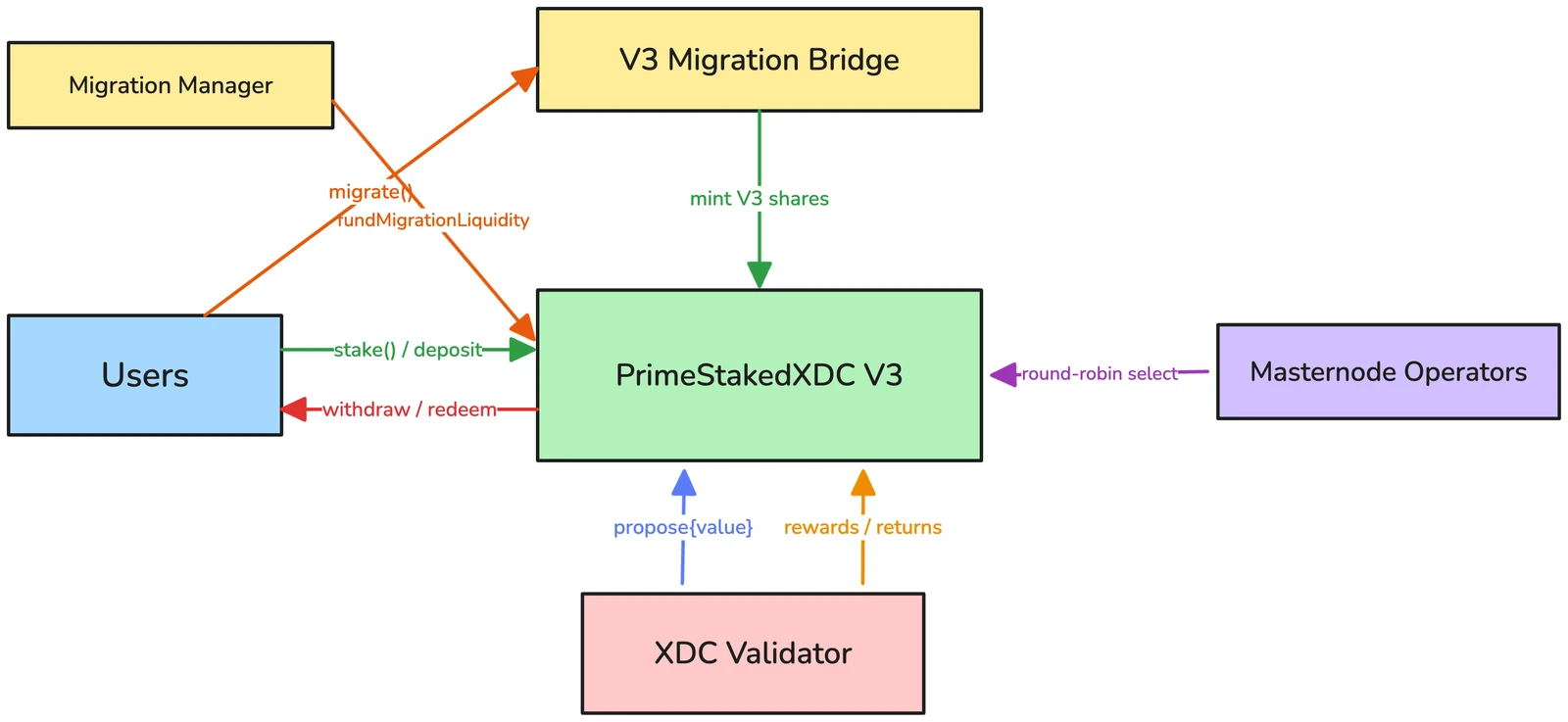
PrimeStakedXDC V3 system architecture and contract interactions
Figure 1: PrimeStakedXDC V3 system architecture and contract interactions.

4.1 PrimeStakedXDC_V3

The PrimeStakedXDC_V3 contract is a non-upgradeable ERC4626 vault that implements liquid staking for native XDC. Users deposit XDC through stake() or depositNative() and receive psXDC shares representing their proportional claim on the vault's managed assets. The share price appreciates as validator rewards flow into the contract through its receive() function and are incorporated into trackedTotalAssets.

Deposited XDC is delegated to XDC Network masternodes via proposeMasternode() or through an automatic proposal system, which selects the next eligible operator in a round-robin fashion from a registered operator set. A configurable liquidity buffer (bufferBps) is retained in the contract to service instant withdrawals.

The contract provides two withdrawal paths. Instant withdrawals through withdraw() and redeem() are available up to the liquid buffer. When insufficient liquidity exists, users can queue withdrawals via redeemWithQueue() or withdrawWithQueue(), which lock their shares in the contract until the queue is processed. Queue processing is permissionless via processWithdrawalQueue(), and deposits also opportunistically process one queued request each. If a queued payout transfer fails, the owed amount is recorded in a deferred claims mapping for the user to retrieve later via claimQueuedAssets().

The vault is deployed through a payable constructor that accepts an optional native XDC seed via msg.value, which is assigned directly to trackedTotalAssets. Notably, no shares are minted at construction time. The contract relies on a _decimalsOffset of 9, which introduces virtual shares and virtual assets into the ERC4626 exchange rate formula to mitigate first-depositor inflation attacks. As a result, the effective initial exchange rate is established by the first migrate(), stake(), or depositNative() call, where the ratio of deposited assets to minted shares is governed by the virtual offset rather than a pre-seeded share supply.

Governance follows a timelocked two-step pattern (schedule, then execute after a configurable delay) for all sensitive parameter changes, including role assignments, loss reporting thresholds, and ownership transfers. The contract defines five privileged roles via OpenZeppelin's AccessControl: DEFAULT_ADMIN_ROLE for governance and role management, PROPOSER_ROLE for masternode proposals, OPERATIONS_MANAGER_ROLE for day-to-day parameter tuning, RISK_MANAGER_ROLE for reporting validator losses, and MIGRATION_MANAGER_ROLE for controlling the migration lifecycle and funding liquidity. Direct role mutations through grantRole(), revokeRole(), and renounceRole() are disabled, enforcing that all role changes pass through the timelocked governance flow.

4.2 PrimeStakedXDC_V3MigrationBridge

The PrimeStakedXDC_V3MigrationBridge facilitates the one-way migration from the existing upgradeable V2 psXDC token to the standalone V3 vault. Users approve the bridge to spend their V2 tokens and call migrate(), which burns the V2 tokens and instructs the V3 contract to mint an equivalent amount of shares to the user. A minSharesOut parameter provides slippage protection against exchange rate changes during migration.

Users should claim any accrued V2 staking rewards via getReward() before migrating, as the bridge's transferFrom call does not trigger the V2 reward accounting for the migrating user. Any unclaimed rewards accrued since the user's last V2 interaction will be forfeited once the migration transfers their token balance to zero.

The migration process is split into two independent streams: share migration (handled by the bridge) and liquidity migration (handled by the migration manager). The migration manager separately transfers the underlying XDC from V2 to V3 via fundMigrationLiquidity(), which credits the contract's native balance without altering trackedTotalAssets to avoid distorting the share price for subsequent migrators.

The bridge includes a timelocked withdrawal mechanism for recovering any accidentally sent native XDC, with a configurable delay and daily cap. Ownership transfer follows the same two-step timelocked pattern as the V3 contract.

4.3 Trust Assumptions and Centralization Risks

The protocol relies on several trusted roles whose correct and timely behavior is essential for the system to function as intended. The following outlines the key trust dependencies and the risks they introduce.

4.3.1 Migration Manager and Migration Lifecycle

The migration manager controls the migrationInProgress flag, which gates all user-facing deposit and withdrawal functions via the whenMigrationFinished modifier. While migration is active, the entire protocol is frozen for non-migration operations. The migration manager is also responsible for transferring the underlying XDC from V2 to V3 in the correct amount and at the correct time. If liquidity is funded before all users have migrated, permissionless calls to syncTrackedAssets() can incorporate migration liquidity into the share price, skewing the exchange rate for later migrators. The protocol assumes the migration manager will fund liquidity only after all share migrations are complete.

4.3.2 Operations Manager

The operations manager controls day-to-day operational parameters without a governance delay: the liquidity buffer target (bufferBps), auto-propose configuration, scan limits, the validator oracle address (validator), and the minimum masternode stake. The validator address is particularly sensitive, as it determines both the destination for staked XDC and the KYC verification oracle.

4.3.3 Risk Manager

The risk manager reports validator losses via reportValidatorLoss(), which directly reduces trackedTotalAssets and lowers the share price for all holders. Per-report and daily loss caps bound the magnitude, but within those bounds the risk manager has unilateral authority to reduce the vault's net asset value.

4.3.4 Proposer and Masternode Operators

The proposer role (or admin) controls which operators receive staked XDC and in what amounts. Once XDC is sent to a masternode via proposeMasternode(), it cannot be recalled through the contract, as there is no built-in resign mechanism. Registered operators must be KYC-verified through the validator oracle before they can be selected for proposals. The admin manages the operator set via addOperator() and removeOperator().

5

Risk Rating Methodology

The risk rating methodology used by Nethermind Security follows the principles established by the OWASP Foundation. The severity of each finding is determined by two factors: Likelihood and Impact.

Likelihood measures how likely the finding is to be uncovered and exploited by an attacker. This factor will be one of the following values:

  1. High: the issue is trivial to exploit and has no specific conditions that need to be met;
  2. Medium: the issue is moderately complex and may have some conditions that need to be met;
  3. Low: the issue is very complex and requires very specific conditions to be met.

When defining the likelihood of a finding, other factors are also considered. These can include but are not limited to motive, opportunity, exploit accessibility, ease of discovery, and ease of exploit.

Impact is a measure of the damage that may be caused if an attacker exploits the finding. This factor will be one of the following values:

  1. High: the issue can cause significant damage, such as loss of funds or the protocol entering an unrecoverable state;
  2. Medium: the issue can cause moderate damage, such as impacts that only affect a small group of users or only a particular part of the protocol;
  3. Low: the issue can cause little to no damage, such as bugs that are easily recoverable or cause unexpected interactions that cause minor inconveniences.

When defining the impact of a finding, other factors are also considered. These can include but are not limited to data and state integrity, loss of availability, financial loss, and reputation damage. After defining the likelihood and impact of an issue, the severity is determined according to the table below.

Impact / LikelihoodLowMediumHigh
HighMediumHighCritical
MediumLowMediumHigh
LowInfo / Best PracticesLowMedium
UndeterminedUndeterminedUndeterminedUndetermined

To address issues that do not fit a High, Medium or Low severity, Nethermind Security also uses three more finding severities: Informational, Best Practices, and Undetermined.

  1. Informational findings do not pose any risk to the application, but they carry some information that the audit team intends to pass to the client formally;
  2. Best Practice findings are used when some piece of code does not conform with smart contract development best practices;
  3. Undetermined findings are used when we cannot predict the impact or likelihood of the issue.

6

Issues

6.1 Returned masternode stakes are double-counted in trackedTotalAssets

FileFix commitTypeStatus
PrimeStakedXDC_V3.solPR #25
PR #25
PR #25
PR #25
CriticalFixed

When XDC is sent to the validator via proposeMasternode or auto-propose, the native balance decreases but trackedTotalAssets is intentionally left unchanged because the assets are still managed by the protocol, just illiquid at the validator.

IXDCValidator(validator).propose{value: amount}(candidate);
emit MasternodeProposed(candidate, amount);

If that staked XDC later returns to the contract (e.g., the masternode is resigned externally, the validator deregisters the node, or a network-level return occurs), the incoming XDC arrives through receive(). The validator contract does not hold any privileged role, so it follows the non-privileged sender path:

receive() external payable {
if (migrationInProgress) {
require(
hasRole(MIGRATION_MANAGER_ROLE, _msgSender()),
UnauthorizedMigrationManager()
);
emit MigrationLiquidityFunded(_msgSender(), msg.value);
return;
} else if (
!hasRole(OPERATIONS_MANAGER_ROLE, _msgSender()) &&
!hasRole(DEFAULT_ADMIN_ROLE, _msgSender())
) {
require(msg.value >= MIN_REWARD_DISTRIBUTION, InsufficientLiquidAssets());
}

trackedTotalAssets += msg.value;
_syncTrackedAssetsExcludingInflow(0);
}

The returned stake passes the MIN_REWARD_DISTRIBUTION check and is added to trackedTotalAssets. However, those assets were never removed from trackedTotalAssets when they were originally proposed. The result is that the returned stake is counted twice: once from the original proposal (never deducted) and once from the receive() increment.

The receive() function cannot distinguish between reward inflows (new income that should be tracked) and stake returns (already tracked, should not be added again). This inflates the share price, causing new depositors to receive fewer shares than they should, and allowing existing holders to redeem at an artificially high rate.

Recommendation

Consider adding a privileged function that allows the operations manager to receive returned masternode stakes without incrementing trackedTotalAssets, or tracking proposed-but-not-returned amounts so that receive() can offset returns against outstanding proposals.

Update from Nethermind Security

The fix introduced a new bug that leads to yield suppression and wrong trackedTotalAssets accounting.

The previous issue was addressed, but the new fix introduced a bug that leads to wrong accounting in the case of slashing events.

The main vulnerability resurfaced.

The issue is partially fixed, but the yield suppression vulnerability resurfaced.

Fixed under the assumption that validators will not return the principal amount staked directly to the contract to trigger the receive() logic. Tokens must always be returned via the resignMasternode(...) flow.

6.2 Malicious receivers can trigger a gas bomb attack in _processWithdrawalQueueInternal(...) blocking the withdrawal queue

FileFix commitTypeStatus
contract/PrimeStakedXDC_V3.sol—HighFixed

The PrimeStakedXDC_V3 contract allows the operations manager to process queued user withdrawals via the processWithdrawalQueue(...) function. This function iterates through pending requests and attempts to send the owed native XDC to the designated receiver. To gracefully handle receivers that cannot accept native tokens (like certain smart contracts), the protocol catches the boolean result of the external call and defers the payout if it fails.

function _processWithdrawalQueueInternal(uint256 maxRequests) internal {
// ...
while (processedCount < maxRequests) {
// ...
request.processed = true;
_burn(address(this), request.shares);

trackedTotalAssets -= assetsOut;
totalWithdrawnByUser[request.owner] += assetsOut;
// ...

The vulnerability lies in the external call lacking a strict gas limit stipened.

        // ...
// @audit-issue External call forwards 63/64 of available gas
(bool success, ) = payable(request.receiver).call{value: assetsOut}("");
if (!success) {
// @audit This remaining logic requires gas to execute successfully
pendingQueuedAssets[request.owner] += assetsOut;
emit WithdrawalQueuePayoutDeferred(...);
}

emit Withdraw(...);
// ...
}
}

An external call forwards 63/64 of the currently available gas to the target address. An attacker can set their withdrawal receiver to a malicious "gas bomb" smart contract. This contract can implement a receive() function that purposely runs a loop until it consumes all of its allocated 63/64 gas, eventually reverting the transaction with an Out-of-Gas (OOG) error.

When the call reverts, the EVM returns control to the PrimeStakedXDC_V3 contract with only the remaining 1/64 of the gas. This amount of gas is likely to be insufficient to finish executing the subsequent state updates. Consequently, the parent transaction also reverts due to an OOG error, meaning the request.processed = true state change is never saved.

This attack is amplified by the "infinite loop" behavior described in the below issue because it blocks the entire withdrawal queue. Because the failed request is never successfully marked as processed, the _nextPendingRequestId(...) function will continuously fetch the exact same malicious request ID on every subsequent attempt. This permanently blocks the entire withdrawal queue for all users. The only way for the operations manager to bypass the malicious request is to pump an exorbitant amount of gas into the transaction, ensuring that the remaining 1/64 gas is enough to complete the loop's execution. However, an attacker can continuously queue withdrawals to grief the protocol, forcing the admin to spend money on gas just to keep the queue operational.

Recommendation

Consider enforcing a strict gas limit on the external call to ensure the parent contract always retains enough gas to complete its execution. For example, changing the call to payable(request.receiver).callvalue: assetsOut, gas: 20000("") will safely limit the receiver's gas consumption while still allowing standard wallets and simple fallback functions to receive the funds.

6.3 Permissionless syncTrackedAssets() during migration allows early migrators to steal funded liquidity via share price manipulation

FileFix commitTypeStatus
PrimeStakedXDC_V3.sol—HighFixed

During migration, native XDC sent by the migration manager through fundMigrationLiquidity() or receive() is intentionally excluded from trackedTotalAssets so that it does not affect ERC4626 share pricing for migrate() calls:

receive() external payable {
if (migrationInProgress) {
require(
hasRole(MIGRATION_MANAGER_ROLE, _msgSender()),
UnauthorizedMigrationManager()
);
emit MigrationLiquidityFunded(_msgSender(), msg.value);
return; // early return, trackedTotalAssets not updated
}
// ...
}
function fundMigrationLiquidity()
external
payable
onlyMigrationManager
whenMigrationInProgress
{
require(msg.value != 0, ZeroStakeAmount());
emit MigrationLiquidityFunded(_msgSender(), msg.value);
// trackedTotalAssets not updated
}

However, syncTrackedAssets() is permissionless and has no migration-mode guard. It detects the surplus between address(this).balance and trackedTotalAssets and folds it in as if it were newly arrived reward income:

function syncTrackedAssets() external {
_syncTrackedAssetsExcludingInflow(0);
}

This allows anyone to call syncTrackedAssets() after migration liquidity has been funded, incorporating that liquidity into trackedTotalAssets mid-migration. Since migrate() computes share amounts via previewDeposit(assets), which depends on totalAssets(), the share pricing for all subsequent migrators changes dramatically.

An attacker who migrates a small amount before the sync receives shares priced against a low trackedTotalAssets. After calling syncTrackedAssets(), all later migrators receive far fewer shares for the same V2 token amount because trackedTotalAssets now includes the full migration liquidity. The attacker ends up holding a disproportionately large fraction of the total share supply and can redeem a corresponding share of the funded liquidity after migration ends.

Recommendation

Consider adding a whenMigrationFinished guard to syncTrackedAssets(), or have the sync function account for migration-mode state by skipping the sync when migrationInProgress is true.

6.4 Deferred withdrawal liabilities are not ring-fenced, enabling share price inflation and claim insolvency

FileFix commitTypeStatus
PrimeStakedXDC_V3.sol—MediumFixed

When a queued withdrawal is processed but the native transfer to receiver fails, the protocol burns the shares and reduces trackedTotalAssets while the XDC remains in the contract balance. The owed amount is recorded in pendingQueuedAssets[owner] for later claiming.

trackedTotalAssets -= assetsOut;
totalWithdrawnByUser[request.owner] += assetsOut;

(bool success, ) = payable(request.receiver).call{value: assetsOut}("");
if (!success) {
pendingQueuedAssets[request.owner] += assetsOut;
}

The deferred payout XDC is not isolated from the rest of the protocol's accounting and liquidity, creating two distinct impacts.

Because the XDC stayed in the contract, address(this).balance now exceeds trackedTotalAssets. Any subsequent call that triggers _syncTrackedAssetsExcludingInflow(0) (which runs inside stake, depositNative, redeem, withdraw, redeemWithQueue, withdrawWithQueue, and syncTrackedAssets) detects this surplus and re-adds it to trackedTotalAssets as if it were newly arrived reward income:

uint256 currentBalanceExcludingInflow = liquid - inflow;
if (currentBalanceExcludingInflow > trackedTotalAssets) {
uint256 untracked = currentBalanceExcludingInflow - trackedTotalAssets;
uint256 rewardsToSync = (untracked / MIN_REWARD_DISTRIBUTION) * MIN_REWARD_DISTRIBUTION;
if (rewardsToSync > 0) {
trackedTotalAssets += rewardsToSync;
}
}

When the deferred claimant later calls claimQueuedAssets, the XDC leaves the contract but trackedTotalAssets is not reduced:

function claimQueuedAssets(
address payable receiver
) external nonReentrant returns (uint256 amount) {
amount = pendingQueuedAssets[_msgSender()];
require(amount != 0, NoQueuedAssetsToClaim());
pendingQueuedAssets[_msgSender()] = 0;

(bool success, ) = receiver.call{value: amount}("");
require(success, TransferFailed());
}

The result is that the same XDC is counted twice: once as backing for outstanding shares (via the re-sync) and once as a deferred liability (via pendingQueuedAssets). This inflates the share price for remaining holders beyond what the contract can actually pay out, creating a solvency gap equal to the deferred amount. This accounting inflation requires the protocol to be in a mostly liquid state where address(this).balance is close to trackedTotalAssets (e.g., early in operation before masternodes are proposed), and requires the deferred amount to be at least MIN_REWARD_DISTRIBUTION (1,000 XDC) for the sync to trigger.

Independently of the sync inflation, the deferred XDC is also not excluded from the protocol's available liquidity. Both _availableForImmediateWithdrawal() and _availableForQueuePayout() use raw address(this).balance without subtracting pending deferred claims:

function _availableForImmediateWithdrawal() internal view returns (uint256) {
uint256 liquid = address(this).balance;
uint256 keep = desiredBuffer();
if (liquid <= keep) {
return 0;
}
return liquid - keep;
}

This means other users can consume the deferred XDC through instant withdraw()/ redeem() calls, the queue processor can use it to pay other queued withdrawals, and proposeMasternode can lock it into a validator. The victim's shares have already been burned during queue processing, so they cannot re-queue. Their only recovery path is claimQueuedAssets, which reverts if the balance is insufficient, leaving their funds in limbo until fresh deposits or masternode returns replenish the contract. This impact applies even for deferred amounts below MIN_REWARD_DISTRIBUTION and regardless of how liquid the vault is.

Recommendation

Consider introducing a global totalDeferredPayouts state variable that is incremented when a payout is deferred and decremented in claimQueuedAssets. Subtract this value from address(this).balance when calculating available liquidity in _availableForImmediateWithdrawal() and _availableForQueuePayout(). Additionally, subtract it from the balance in _syncTrackedAssetsExcludingInflow to prevent deferred amounts from being mistakenly categorized as validator yield. Finally, decrement trackedTotalAssets by amount inside claimQueuedAssets.

6.5 Flawed _nextOperatorIndex reset logic in removeOperator(...) skips validator turns

FileFix commitTypeStatus
contracts/PrimeStakedXDC_V3.sol—LowFixed

The PrimeStakedXDC_V3 contract distributes stake among registered operators in a round-robin fashion. To select the next eligible operator, the _selectNextAvailableOperator() function computes the target index using a modulo operation: _nextOperatorIndex % _operators.length.

The problem occurs within the removeOperator(...) function. When an operator is removed, the function checks if the _nextOperatorIndex is greater than the new _operators.length. If it is, the index is reset to 0.

function removeOperator(address operator_) external onlyAdmin {
// ...
isOperator[operator_] = false;
// @audit-issue Resetting to 0 breaks the ongoing modulo sequence
if (_nextOperatorIndex > _operators.length) {
_nextOperatorIndex = 0;
}

emit OperatorRemoved(operator_);
}

By resetting it to 0, the continuous round-robin sequence is destroyed.

For example, imagine a set of 5 validators where the _nextOperatorIndex pointer is currently at 9. The next validator to be selected is at index 4 (since 9 % 5 = 4). If the admin removes a validator, the array length shrinks to 4. Because 9 > 4, the reset condition triggers and _nextOperatorIndex becomes 0. On the next staking operation, the system will evaluate 0 % 4 = 0 and select the validator at index 0.

This leads to an unfair distribution of stakes. The validator previously scheduled for the next turn (index 4) is skipped, while the validator at index 0 is favored.

Recommendation

Consider removing the _nextOperatorIndex reset logic entirely. Since the _selectNextAvailableOperator(...) function relies on modulo arithmetic, the continuously growing index will naturally and correctly wrap around the new array length without requiring a manual reset to 0.

6.6 Legacy withdraw() is permanently bricked due to nested nonReentrant guards

FileFix commitTypeStatus
PrimeStakedXDC_V3.sol—LowFixed

The no-argument withdraw() function, intended as a legacy-compatible full-balance unstake path for V2 users, carries the nonReentrant modifier and internally calls redeem(), which also carries nonReentrant. OpenZeppelin's ReentrancyGuard uses a shared storage flag that is set to ENTERED on the first call; when the nested redeem() checks the same flag, it finds it already entered and reverts with ReentrancyGuardReentrantCall.

function withdraw() external nonReentrant returns (uint256 assetsOut) {
uint256 shares = balanceOf(_msgSender());
assetsOut = redeem(shares, _msgSender(), _msgSender());
}
function redeem(
uint256 shares,
address receiver,
address owner
)
public
virtual
override
nonReentrant
whenMigrationFinished
returns (uint256 assetsOut)
{
_syncTrackedAssetsExcludingInflow(0);
assetsOut = super.redeem(shares, receiver, owner);
}

Because withdraw() is an external function calling a public function on the same contract, Solidity treats this as an internal call that shares the same execution context. The reentrancy lock acquired by withdraw() is still held when redeem() attempts to acquire it, causing an unconditional revert on every call regardless of parameters or caller.

This means the legacy withdrawal interface that V2 users would naturally reach for after migration is completely non-functional. Users must instead discover and use redeem(shares, receiver, owner) directly or one of the other withdrawal paths ( withdraw(uint256,address,address), redeemWithQueue, withdrawWithQueue).

Recommendation

Consider removing the nonReentrant modifier from the no-argument withdraw() since the downstream redeem() call already enforces it.

6.7 Migration manager can freeze all user-facing operations instantly

FileFix commitTypeStatus
PrimeStakedXDC_V3.sol—LowFixed

The setMigrationInProgress function allows the migration manager to toggle migration mode with no governance delay:

function setMigrationInProgress(bool enabled) external onlyMigrationManager {
migrationInProgress = enabled;
emit MigrationModeUpdated(enabled);
}

The whenMigrationFinished modifier gates all deposit and withdrawal functions:

  • stake(), depositNative() – deposits blocked;
  • withdraw(uint256), withdraw(uint256, address, address), redeem(uint256, address, address) – instant withdrawals blocked;
  • redeemWithQueue(), withdrawWithQueue() – queued withdrawals blocked;

Setting migrationInProgress = true freezes the entire user-facing protocol.

If the migration manager account is compromised or acts maliciously, the admin cannot override the freeze instantly. The admin must go through the full governance delay cycle to replace the migration manager:

  1. Call setMigrationManager(newAddress) to start the governance delay timer;
  2. Wait for governanceDelay to elapse (minimum 1 minute, default 1 day);
  3. Call executeMigrationManager() to install the new migration manager;
  4. Have the new migration manager call setMigrationInProgress(false);

During this entire window, the protocol is completely frozen for all user operations.

Recommendation

Consider making the migration toggle a one-time lifecycle: once migration is turned off after being active, it cannot be re-enabled. This removes the ongoing trust assumption on the migration manager after migration completes.

6.8 The removeOperator(...) function reshuffles the operators array causing validators to skip their turns

FileFix commitTypeStatus
contracts/PrimeStakedXDC_V3.sol—LowFixed

The PrimeStakedXDC_V3 contract maintains a list of registered operators in the _operators array to propose them sequentially for masternode staking. The selection mechanism relies on the _selectNextAvailableOperator() function, which uses the _nextOperatorIndex state variable to iterate over the array and pick the next eligible operator in a round-robin fashion.

However, the removeOperator(...) function does not preserve the original array order when an operator is deleted. To avoid leaving gaps in the array, it swaps the element being removed with the last element in the array and then pops the last element.

function removeOperator(address operator_) external onlyAdmin {
// ...
uint256 length = _operators.length;
uint256 removeIndex = _operatorIndexPlusOne[operator_] - 1;
uint256 lastIndex = length - 1;
if (removeIndex != lastIndex) {
// @audit-issue This swap moves the last operator to `removeIndex`
address lastOperator = _operators[lastIndex];
_operators[removeIndex] = lastOperator;
_operatorIndexPlusOne[lastOperator] = removeIndex + 1;
}
_operators.pop();
// ...
}

If an operator positioned at the end of the array is swapped to an index that is lower than the current _nextOperatorIndex, that swapped operator will be skipped in the current selection cycle. For example, assume there are 5 operators in the array and _nextOperatorIndex is 4 (meaning it's the 5th operator's turn to be selected next). If the admin removes the operator at index 1, the 5th operator (at index 4) is moved to index 1. When the next selection occurs, the cursor will wrap around, meaning the 5th operator lost their turn.

This reshuffling disrupts the fairness of the round-robin distribution.

Recommendation

Consider modifying the logic to preserve the order of the operators.

6.9 triggerAutoPropose reverts on validator failure unlike _autoProposeOne

FileFix commitTypeStatus
PrimeStakedXDC_V3.sol—LowFixed

The contract has two internal paths for proposing masternodes. The implicit path used during staking wraps the validator call in try/catch, gracefully handling failures:

function _autoProposeOne() internal {
// ...
try
IXDCValidator(validator).propose{ value: autoProposeThreshold }(candidate)
{
emit MasternodeProposed(candidate, autoProposeThreshold);
} catch {
emit AutoProposeFailed(candidate, autoProposeThreshold);
}
}

The explicit path used by triggerAutoPropose does not:

function _proposeNextMasternode(uint256 amount) internal returns (bool) {
address candidate = _selectNextAvailableOperator();
if (candidate == address(0) || amount > _availableForImmediateWithdrawal()) {
return false;
}

IXDCValidator(validator).propose{ value: amount }(candidate);
emit MasternodeProposed(candidate, amount);
return true;
}

If the validator contract reverts on propose() for any reason (candidate already registered, validator paused, unexpected state), the entire triggerAutoPropose transaction reverts. The implicit stake-path auto-propose continues to work in the same conditions because it catches the error.

Recommendation

Consider wrapping the propose call in _proposeNextMasternode with try/catch to match the error-handling behavior of _autoProposeOne.

6.10 Bridge withdrawal timelock can be neutralized by instantly changing delay and cap

FileFix commitTypeStatus
PrimeStakedXDC_V3MigrationBridge.sol—InfoFixed

The migration bridge implements a time-delayed withdrawal pattern for excess native XDC via withdrawExcessNative and executeExcessNativeWithdrawal. However, the two protective parameters, withdrawalDelay and dailyWithdrawalCap, can be changed instantly by the admin with no timelock of their own:

function setWithdrawalDelay(uint256 newDelay) external onlyAdmin {
require(newDelay != 0 && newDelay <= MAX_WITHDRAWAL_DELAY, InvalidDelay());
withdrawalDelay = newDelay;
}

function setDailyWithdrawalCap(uint256 amount) external onlyAdmin {
require(amount != 0, ZeroAmount());
dailyWithdrawalCap = amount;
}

A compromised admin key can execute the following sequence in a single block: set withdrawalDelay to 1 second (the minimum allowed by the != 0 check), set dailyWithdrawalCap to type(uint256).max, schedule a withdrawal via withdrawExcessNative, wait 1 second, then call executeExcessNativeWithdrawal to drain the entire native balance. This reduces the effective observation window from the intended DEFAULT_WITHDRAWAL_DELAY (1 day) to approximately 1 second, defeating the purpose of the time-delayed pattern.

The bridge should hold zero native XDC during normal operation, so the practical impact is limited to accidentally sent XDC. However, the safeguard pattern is misleading as it appears to provide a 1-day observation window when it can be reduced to near-zero.

This is inconsistent with V3, where all analogous sensitive parameter changes go through a governance delay.

Recommendation

Consider applying a timelock to changes of withdrawalDelay and dailyWithdrawalCap, or require that the existing withdrawalDelay elapses before the new delay takes effect.

6.11 Constructor seed without share mint sets an unfavorable initial exchange rate

FileFix commitTypeStatus
PrimeStakedXDC_V3.sol—InfoFixed

The V3 constructor is marked payable and assigns msg.value directly to trackedTotalAssets:

constructor(
address initialOwner,
address previousPstXDC,
address initialProposer,
address initialValidator,
uint256 initialMinStake
) payable ERC20("PrimeStakedXDC", "psXDC") ERC4626(IERC20(address(0))) {
// ...
trackedTotalAssets = msg.value;
// ...
}

No shares are minted to match the seeded assets. Because the ERC4626 share-pricing formula (with a _decimalsOffset of 9) computes shares as:

shares = assets * (totalSupply + 10^9) / (totalAssets + 1)

the deployment value of msg.value directly controls the exchange rate seen by the first depositor or migrator and the same rate will be used by subsequent depositors/migrators.

If the contract is deployed with a nonzero msg.value (e.g. 10,000 XDC), totalAssets starts at 10,000e18 while totalSupply remains 0. The first migrator depositing 5,000 XDC would receive:

shares = 5000e18 * (0 + 10^9) / (10000e18 + 1) = 500,000,000 raw shares

With 27-decimal psXDC (18 base + 9 offset), 500,000,000 raw shares is effectively zero display tokens. The migrator's deposit is absorbed into the inflated totalAssets denominator, and the seeded XDC becomes unredeemable dead capital that permanently skews the exchange rate against all subsequent depositors.

Conversely, if the contract is deployed with msg.value = 0, the first migration cleanly establishes a 1:1 peg:

shares = 5000e18 * 10^9 / (0 + 1) = 5000e27 raw shares = 5,000 psXDC

All subsequent deposits then maintain the 1:1 rate until validator rewards begin accruing and naturally shift the exchange rate in favor of existing holders.

Note that the _decimalsOffset of 9 causes V3's decimals() to return 27 (18 base + 9 offset), whereas the live V2 psXDC token uses 18 decimals. While the migration math produces a 1:1 exchange rate in display terms (5000 V2 psXDC becomes 5000 V3 psXDC), the raw balanceOf values differ by a factor of 10^9. Any off-chain system, wallet integration, or block explorer that hardcodes the V2 decimal count of 18 for the new V3 token will display incorrect values.

Recommendation

Consider either deploying with msg.value = 0 so the first migration naturally establishes a 1:1 exchange rate, or minting a proportional number of initial shares to the deployer to match the seeded assets and anchor a safe base rate. If preserving the V2 token's 18-decimal representation is desired, the _decimalsOffset should be set to 0 and the constructor should both seed assets and mint a matching number of shares to establish a safe initial exchange rate that is resistant to vault inflation attacks.

6.12 No mechanism to resign or unstake masternodes through the contract

FileFix commitTypeStatus
PrimeStakedXDC_V3.sol—InfoFixed

The IXDCValidator interface declares a resign(address _candidate) function, but the V3 contract has no calls to resign and exposes no wrapper for it. Capital flows out to masternodes via proposevalue: amount() but cannot be recalled through the contract:

// In IXDCValidator.sol
function resign(address _candidate) external;
// In PrimeStakedXDC_V3.sol - only propose exists, no resign
IXDCValidator(validator).propose{value: amount}(candidate);

Recommendation

Consider adding a resignMasternode(address candidate) function restricted to an appropriate role, calling IXDCValidator(validator).resign(candidate).

6.13 The OperationsManager can pause the protocol via bufferBps manipulation

FileFix commitTypeStatus
contracts/PrimeStakedXDC_V3.sol—InfoFixed

The PrimeStakedXDC_V3 contract relies on a liquid buffer to fulfill user withdrawals and process the withdrawal queue. The setBufferBps(...) function allows the OperationsManager to adjust this vault's liquidity buffer target.

However, the function allows the OperationsManager to set the bufferBps up to a hardcoded maximum of 10_000, which represents 100% of the vault's assets.

function setBufferBps(uint256 newBufferBps) external onlyOperationsManager {
// @audit-issue The Operations Manager can set the buffer to 100% (10_000)
require(newBufferBps <= 10_000, InvalidThreshold());
bufferBps = newBufferBps;
emit BufferConfigUpdated(newBufferBps);
}

If the OperationsManager sets the buffer to 10_000, the desiredBuffer() function will mathematically equal the entirety of the trackedTotalAssets. Consequently, the liquidity checks inside both the _availableForImmediateWithdrawal(...) and _availableForQueuePayout(...) functions will evaluate to true, as the liquid assets can never legitimately exceed the total tracked assets.

function _availableForImmediateWithdrawal() internal view returns (uint256) {
uint256 liquid = address(this).balance;
uint256 keep = desiredBuffer();
// @audit When buffer is 100%, keep >= liquid, so this always returns 0
if (liquid <= keep) {
return 0;
}
return liquid - keep;
}

Because these functions will permanently return 0, all withdrawals will revert. Although this role is intended for operational parameter adjustments, this configuration allows the OperationsManager to hold the protocol's TVL blocked. This represents a privilege escalation, bypassing the need for the DEFAULT_ADMIN_ROLE to execute a system-wide pause.

Recommendation

Consider capping the bufferBps configuration.

6.14 Timelocked governance changes can be silently overwritten without cancellation events

FileFix commitTypeStatus
PrimeStakedXDC_V3.sol
PrimeStakedXDC_V3MigrationBridge.sol
—InfoFixed

Across both V3 and the migration bridge, timelocked setter functions allow the admin to overwrite a pending change by calling the same setter again without first cancelling the previous one. The overwrite silently replaces the pending value and resets the delay timer, with no cancellation event emitted for the replaced schedule.

In V3, all nine timelocked setters exhibit this pattern: setOperationsManager, setProposer, setRiskManager, setMigrationManager, setMigrationBridge, setMaxLossBpsPerReport, setMaxDailyLossBps, setGovernanceDelay, and scheduleOwnerTransfer. For example:

function setOperationsManager(address account) external onlyAdmin {
require(account != address(0), AddressZero());
pendingOperationsManager = account;
pendingOperationsManagerExecuteAfter = block.timestamp + governanceDelay;

emit OperationsManagerChangeScheduled(account, pendingOperationsManagerExecuteAfter);
}

In the migration bridge, withdrawExcessNative overwrites a pending scheduled withdrawal in the same way:

function withdrawExcessNative(address payable recipient, uint256 amount) external onlyAdmin {
require(recipient != address(0), AddressZero());
require(amount != 0, ZeroAmount());
require(address(this).balance >= amount, InsufficientNativeBalance());

pendingWithdrawalRecipient = recipient;
pendingWithdrawalAmount = amount;
pendingWithdrawalExecuteAfter = block.timestamp + withdrawalDelay;

emit ExcessNativeWithdrawalScheduled(recipient, amount, pendingWithdrawalExecuteAfter);
}

Each of these functions has a dedicated cancel* counterpart that properly emits a cancellation event (e.g., OperationsManagerChangeCancelled, ExcessNativeWithdrawalCancelled). When the overwrite path is used instead, off-chain monitoring tools see a new scheduling event but receive no corresponding cancellation event for the previous schedule, creating an audit trail gap.

Recommendation

Consider either requiring the existing pending change to be cancelled before scheduling a new one, or emitting a cancellation event inside the setter when overwriting existing pending state.

6.15 Users can frontrun the reportValidatorLoss(...) function to evade slashing penalties

FileFix commitTypeStatus
contracts/PrimeStakedXDC_V3.sol—InfoAcknowledged

The reportValidatorLoss(...) function from the PrimeStakedXDC_V3 contract is utilized by the risk manager to record slashing penalties or losses that occur on the validator side. When called, it reduces the trackedTotalAssets state variable, which subsequently lowers the exchange rate of the psXDC shares for all current depositors.

The contract also provides instant withdrawal capabilities through the withdraw(...) and redeem(...) functions, allowing users to immediately cash out their shares for native assets as long as there is sufficient available liquidity.

function reportValidatorLoss(uint256 assets) external onlyRiskManager {
// ...
// @audit-issue Decreasing the assets drops the share price for everyone.
trackedTotalAssets -= assets;
emit ValidatorLossReported(assets);
}
function redeem(
uint256 shares,
address receiver,
address owner
)
public
virtual
override
nonReentrant
whenMigrationFinished
returns (uint256 assetsOut)
{
_syncTrackedAssetsExcludingInflow(0);
// @audit Users can instantly exit at the current, pre-slash exchange rate.
assetsOut = super.redeem(shares, receiver, owner);
}

A user or an MEV bot can see the pending reportValidatorLoss(...) transaction and frontrun it with a redeem(...) or withdraw(...) transaction. This allows the user to exit at the pre-slashing exchange rate and avoid the penalty.

Recommendation

Consider routing all exit paths through the existing withdrawal queue. Enforcing a time delay between request and execution neutralizes frontrunning.

Resolution

Acknowledged

6.16 V3 has no dedicated emergency pause mechanism

FileFix commitTypeStatus
PrimeStakedXDC_V3.sol—InfoFixed

V2 inherited ERC20PausableUpgradeable and provided pause()/ unpause() functions gated by the owner, allowing all token operations to be halted in an emergency. V3 does not include any pausability. The only flow-control mechanism is migrationInProgress, which blocks all user-facing deposit and withdrawal operations.

Since V3 is also non-upgradeable, its code cannot be patched in place if a vulnerability is discovered post-deployment.

Recommendation

Consider adding a pausability layer gated by DEFAULT_ADMIN_ROLE and applied to core user-facing functions.

6.17 setValidator and setMinStake emit no events

FileFix commitTypeStatus
PrimeStakedXDC_V3.sol—InfoFixed

Every other operations manager setter in V3 emits an event upon state change: setAutoProposeConfig emits AutoProposeConfigUpdated, setBufferBps emits BufferConfigUpdated, setOperatorScanLimit emits OperatorScanLimitUpdated, setQueueScanLimit emits QueueScanLimitUpdated, and setMigrationInProgress emits MigrationModeUpdated.

However, setValidator and setMinStake are silent:

function setValidator(address newValidator) external onlyOperationsManager {
require(newValidator != address(0), AddressZero());
validator = newValidator;
}

function setMinStake(uint256 newMinStake) external onlyOperationsManager {
minStake = newMinStake;
}

The validator address is particularly sensitive as it controls both where XDC is sent during masternode proposals and the KYC verification oracle ( isKYCVerified queries IXDCValidator(validator).getHashCount). A change to this address without an emitted event creates a monitoring blind spot for off-chain systems, admin dashboards, and governance watchers.

Recommendation

Consider emitting events for both setValidator and setMinStake to maintain consistent observability across all configuration changes.

6.18 Unreachable guard in _syncTrackedAssetsExcludingInflow

FileFix commitTypeStatus
PrimeStakedXDC_V3.sol—Best PracticesFixed

The _syncTrackedAssetsExcludingInflow function contains an early return guard checking liquid < inflow that can never evaluate to true in any reachable call path.

function _syncTrackedAssetsExcludingInflow(uint256 inflow) internal {
uint256 liquid = address(this).balance;
if (liquid < inflow) {
return;
}
// ...
}

When inflow is msg.value (the stake and depositNative paths), the EVM credits msg.value to the contract's balance before the function body executes, so address(this).balance always includes msg.value and is therefore always greater than or equal to it. No external calls occur between balance crediting and this check. All other callers pass inflow = 0, making the comparison liquid < 0 which is trivially false for a uint256.

Recommendation

Consider removing the unreachable branch to reduce bytecode size and improve readability.

6.19 executeOwnerTransfer to self permanently locks admin role

FileFix commitTypeStatus
PrimeStakedXDC_V3.sol
PrimeStakedXDC_V3MigrationBridge.sol
—Best PracticesFixed

In both V3 and the migration bridge, the executeOwnerTransfer function grants the admin role to the new owner and then revokes it from the caller:

function executeOwnerTransfer() external onlyAdmin {
address newOwner = pendingOwner;
require(newOwner != address(0), NoPendingChange());
require(block.timestamp >= pendingOwnerExecuteAfter, ChangeNotReady());

pendingOwner = address(0);
pendingOwnerExecuteAfter = 0;

_grantRole(DEFAULT_ADMIN_ROLE, newOwner);
_revokeRole(DEFAULT_ADMIN_ROLE, _msgSender());
}

If an admin schedules an ownership transfer to their own address and later executes it, _grantRole is a no-op (OpenZeppelin's _grantRole returns false when the account already holds the role) while _revokeRole succeeds and removes it. Because grantRole, revokeRole, and renounceRole are all overridden to unconditionally revert, the admin role becomes permanently irrecoverable.

The same pattern exists in the bridge. The consequence is a permanent loss of all administrative capabilities on the affected contract, including role management, governance parameter changes, and owner transfers.

Recommendation

Consider adding a check that the new owner is not the caller, such as require(newOwner != _msgSender()).

6.20 Constructor does not enforce a non-zero seed at deployment

FileFix commitTypeStatus
PrimeStakedXDC_V3.sol—LowAcknowledged

The PrimeStakedXDC_V3 constructor is payable and seeds trackedTotalAssets with msg.value, but only mints matching shares when the seed is non-zero. There is no enforcement that the deployer actually provides a seed:

trackedTotalAssets = msg.value;
if (msg.value != 0) {
_mint(initialOwner, msg.value);
}

_decimalsOffset() returns 0 (matching V2's 18-decimal psXDC), which means the only inflation-attack defense remaining inside _convertToShares is OpenZeppelin's +1 virtual offset on both totalSupply() and totalAssets(). OpenZeppelin's own NatSpec on ERC4626.sol (v5.2.0) documents this trade-off: _"While not fully preventing the attack, analysis shows that the default offset (0) makes it non-profitable even if an attacker is able to capture value from multiple user deposits, as a result of the value being captured by the virtual shares (out of the attacker's donation) matching the attacker's expected gains."_ OpenZeppelin therefore considers offset 0 an acceptable choice when developers have other reasons (e.g. preserving a particular decimals() value) to use it, but explicitly notes that the attack is not fully prevented.

When the contract is deployed with msg.value == 0, the protocol enters a state where tracked = 0 and supply = 0. Until the migration manager calls setMigrationInProgress(true), both stake() and the unprivileged receive() path remain open ( _syncTrackedAssetsExcludingInflow only reverts under whenMigrationFinished). In that pre-migration window the first depositor establishes the share rate and a malicious first depositor can perform the textbook ERC-4626 inflation pattern: stake 1 wei to mint 1 share, force a donation into address(this).balance (either through a SELFDESTRUCT of a helper contract or via receive() with msg.value >= MIN_REWARD_DISTRIBUTION), and let the next state-changing call fold the donation into trackedTotalAssets. Subsequent small deposits where V < D/2 + 1 then floor to zero shares because previewDeposit(V) = V × 2 / (D + 2) rounds down. The victim's native is added to trackedTotalAssets but no shares are minted in return.

The practical exploitability of this configuration is limited. Even though the attacker is not directly profitable in the typical case, every victim that does land below the rounding threshold loses their entire deposit, so the configuration is unsafe to ship as a deployment default. The constructor not enforcing a minimum seed is the underlying defect; everything downstream is operational risk.

Recommendation

Consider enforcing a non-zero seed at construction time so that totalSupply() and trackedTotalAssets are bounded below by a meaningful floor from block 0 regardless of deployer behaviour.

Resolution

Acknowledged

6.21 redeemWithQueue and withdrawWithQueue use all-or-nothing logic, queueing the entire request even when partial immediate liquidity exists

FileFix commitTypeStatus
PrimeStakedXDC_V3.sol—InfoAcknowledged

redeemWithQueue and withdrawWithQueue either redeem the full amount immediately or queue the full amount; there is no partial-fill path. When a request exceeds maxRedeem(owner) (or _availableForImmediateWithdrawal()), the entire request is queued, even if a meaningful fraction could have been satisfied immediately:

function redeemWithQueue(uint256 shares, address receiver)
external nonReentrant
returns (bool queued, uint256 requestId, uint256 assetsOut)
{
require(shares != 0, ZeroShares());
_syncTrackedAssetsExcludingInflow(0);
address owner = _msgSender();

if (shares <= maxRedeem(owner)) {
assetsOut = super.redeem(shares, receiver, owner);
return (false, 0, assetsOut);
}

assetsOut = previewRedeem(shares);
requestId = _queueWithdrawal(owner, receiver, shares, assetsOut);
return (true, requestId, 0);
}

If a user holding 100M shares calls redeemWithQueue(100M, receiver) while the protocol has 50M XDC of immediate liquidity, maxRedeem(owner) = 50M, the check 100M <= 50M fails, and all 100M shares are escrowed in address(this) with totalPendingQueuedAssets += 100M. The user receives zero XDC immediately even though 50M was sitting in the contract.

A side effect compounds the cost: _availableForImmediateWithdrawal() subtracts totalPendingQueuedAssets from address(this).balance (clamping to zero when the subtraction would underflow), so after the queue it evaluates to 0 for everyone. Other users can no longer redeem immediately and are pushed into the queue as well, even though 50M of native is still on hand.

A user wishing to combine immediate and queued redemption today must do it manually with two transactions: first call redeem(maxRedeem(owner), receiver, owner), then redeemWithQueue(remaining, receiver). withdrawWithQueue exhibits the identical pattern.

Recommendation

Consider redesigning redeemWithQueue and withdrawWithQueue so that the maximum currently-available portion is redeemed immediately and only the residual is enqueued, rather than treating each request as indivisible. This would give users prompt access to whatever liquidity exists, reduce the locked-up totalPendingQueuedAssets so other users keep some immediate-withdrawal capacity, and keep the queue head smaller and more likely to fit on the next processing pass.

Resolution

Acknowledged

7

Documentation Evaluation

Software documentation refers to the written or visual information that describes the functionality, architecture, design, and implementation of software. It provides a comprehensive overview of the software system and helps users, developers, and stakeholders understand how the software works, how to use it, and how to maintain it. Software documentation can take different forms, such as user manuals, system manuals, technical specifications, requirements documents, design documents, and code comments. Software documentation is critical in software development, enabling effective communication between developers, testers, users, and other stakeholders. It helps to ensure that everyone involved in the development process has a shared understanding of the software system and its functionality. Moreover, software documentation can improve software maintenance by providing a clear and complete understanding of the software system, making it easier for developers to maintain, modify, and update the software over time. Smart contracts can use various types of software documentation. Some of the most common types include:

  • Technical whitepaper: A technical whitepaper is a comprehensive document describing the smart contract’s design and technical details. It includes information about the purpose of the contract, its architecture, its components, and how they interact with each other;
  • User manual: A user manual is a document that provides information about how to use the smart contract. It includes step-by-step instructions on how to perform various tasks and explains the different features and functionalities of the contract;
  • Code documentation: Code documentation is a document that provides details about the code of the smart contract. It includes information about the functions, variables, and classes used in the code, as well as explanations of how they work;
  • API documentation: API documentation is a document that provides information about the API (Application Programming Interface) of the smart contract. It includes details about the methods, parameters, and responses that can be used to interact with the contract;
  • Testing documentation: Testing documentation is a document that provides information about how the smart contract was tested. It includes details about the test cases that were used, the results of the tests, and any issues that were identified during testing;
  • Audit documentation: Audit documentation includes reports, notes, and other materials related to the security audit of the smart contract. This type of documentation is critical in ensuring that the smart contract is secure and free from vulnerabilities.

These types of documentation are essential for smart contract development and maintenance. They help ensure that the contract is properly designed, implemented, and tested, and they provide a reference for developers who need to modify or maintain the contract in the future.

8

Remarks & Test Suite

The documentation for the contracts was provided through the code's Natspec and README files. Moreover, the protocol's development team addressed all questions and concerns raised by the Nethermind Security team during the initial kick-off call and subsequent sync calls and through asynchronous communication, providing valuable insights and a comprehensive understanding of the project's technical aspects.

The AuditAgent is an AI-powered smart contract auditing tool that analyses code, detects vulnerabilities, and provides actionable fixes. It accelerates the security analysis process, complementing human expertise with advanced AI models to deliver efficient and comprehensive smart contract audits. Available at https://app.auditagent.nethermind.io.

Test suite
172Tests passed0Failed

The complete test output is in the full report.

As auditors, we recommend that any changes or updates made to the audited codebase undergo a re-audit or security review to address potential vulnerabilities or risks introduced by the modifications. By conducting a re-audit or security review of the modified codebase, you can significantly enhance the overall security of your system and reduce the likelihood of exploitation. However, we do not possess the authority or right to impose obligations or restrictions on our clients regarding codebase updates, modifications, or subsequent audits. Accordingly, the decision to seek a re-audit or security review lies solely with you.

This report is based on the scope of materials and documentation provided by you to Nethermind in order that Nethermind could conduct the security review outlined in 1. Executive Summary and 2. Audited Files. The results set out in this report may not be complete nor inclusive of all vulnerabilities. Nethermind has provided the review and this report on an as-is, where-is, and as-available basis. You agree that your access and/or use, including but not limited to any associated services, products, protocols, platforms, content, and materials, will be at your sole risk. Blockchain technology remains under development and is subject to unknown risks and flaws. The review does not extend to the compiler layer, or any other areas beyond the programming language, or other programming aspects that could present security risks. This report does not indicate the endorsement of any particular project or team, nor guarantee its security. No third party should rely on this report in any way, including for the purpose of making any decisions to buy or sell a product, service or any other asset. To the fullest extent permitted by law, Nethermind disclaims any liability in connection with this report, its content, and any related services and products and your use thereof, including, without limitation, the implied warranties of merchantability, fitness for a particular purpose, and non-infringement. Nethermind does not warrant, endorse, guarantee, or assume responsibility for any product or service advertised or offered by a third party through the product, any open source or third-party software, code, libraries, materials, or information linked to, called by, referenced by or accessible through the report, its content, and the related services and products, any hyperlinked websites, any websites or mobile applications appearing on any advertising, and Nethermind will not be a party to or in any way be responsible for monitoring any transaction between you and any third-party providers of products or services. As with the purchase or use of a product or service through any medium or in any environment, you should use your best judgment and exercise caution where appropriate. FOR AVOIDANCE OF DOUBT, THE REPORT, ITS CONTENT, ACCESS, AND/OR USAGE THEREOF, INCLUDING ANY ASSOCIATED SERVICES OR MATERIALS, SHALL NOT BE CONSIDERED OR RELIED UPON AS ANY FORM OF FINANCIAL, INVESTMENT, TAX, LEGAL, REGULATORY, OR OTHER ADVICE.