Download audit report
This document presents the security review performed by Nethermind Security for Starkstake_ smart contracts. Starkstake_ allows you to stake your Starknet tokens, earn rewards, and receive stSTRK tokens. stSTRK is a liquid staking derivative that represents your staked assets and allows you to remain flexible, trade, or use them in DeFi while still earning staking rewards.
The audited code comprises 1429 lines of code written in the Cairo language. The audit focuses on the implementation of stStark token, the main contract for managing interactions, and the contracts representing delegators.
The audit was performed using (a) manual analysis of the codebase and (b) creation of test cases.
| Audit assessment | |
| Audit Type | Security Review |
| Initial Report | October 31, 2024 |
| Final Report | January 20, 2025 |
| Repository | starkstake_ |
| Commit | f9bf6c0db6 |
| Final Commit | 3e42e236a2 |
| Documentation | Not public |
| Documentation Assessment | High |
| Test Suite Assessment | Low |
Findings by severity
| # | Contract | LoC | Comments | Ratio | Blank | Total |
| 1 | src/lib.cairo | 26 | 2 | 7.7% | 1 | 29 |
| 2 | src/contracts/delegator.cairo | 146 | 65 | 44.5% | 38 | 249 |
| 3 | src/contracts/stake_stark.cairo | 575 | 273 | 47.5% | 128 | 976 |
| 4 | src/contracts/stSTRK.cairo | 267 | 200 | 74.9% | 63 | 530 |
| 5 | src/utils/constants.cairo | 11 | 10 | 90.9% | 3 | 24 |
| 6 | src/components/access_control.cairo | 107 | 5 | 4.7% | 21 | 133 |
| 7 | src/interfaces/i_stake_stark.cairo | 92 | 19 | 20.7% | 20 | 131 |
| 8 | src/interfaces/i_delegator.cairo | 24 | 5 | 20.8% | 5 | 34 |
| 9 | src/interfaces/i_starknet_staking.cairo | 129 | 18 | 14.0% | 14 | 161 |
| 10 | src/interfaces/i_stSTRK.cairo | 52 | 18 | 34.6% | 8 | 78 |
| Total | 1429 | 615 | 43.0% | 301 | 2345 |
starkstake_ is a liquid staking protocol built on Starknet, allowing users to stake their STRK assets while maintaining liquidity. In traditional staking models, staked assets are locked, limiting liquidity. However, starkstake_ issues a liquid staking token called stSTRK when users stake their STRK, enabling them to use these tokens across DeFi protocols.
By leveraging starkstake_, users can benefit from staking rewards without losing the ability to actively manage and use their assets. The protocol is implemented using smart contracts on Starknet, ensuring both high security and transparency.
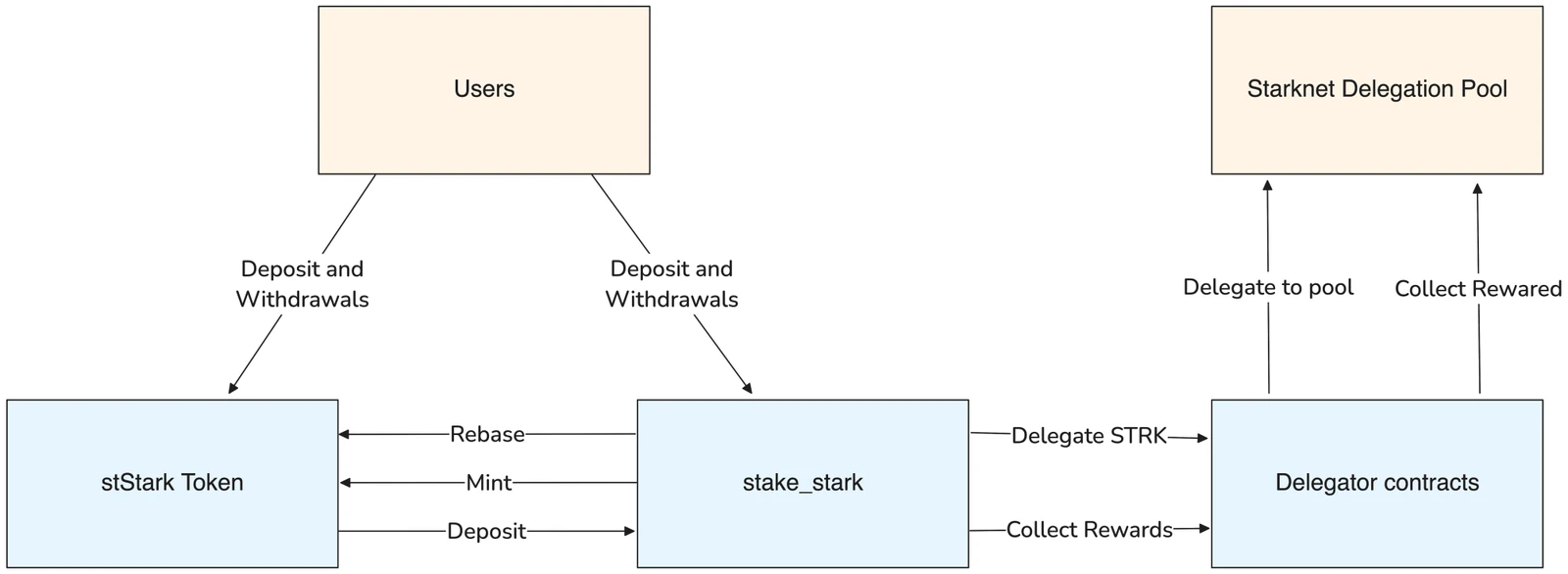
Users interact directly with the stSTRK token or the stake_stark contracts. In both cases, users can execute deposit and withdrawal operations, giving two different entry points to the protocol. Users deposit STRK tokens and receive stSTRK tokens that increase in value over time. The value of the stSTRK token is defined by the amount of STRK held by the protocol and the amount of stSTRK total supply. The protocol behaves similarly to an ERC-4626 vault where the underlying token is STRK.
The received STRK tokens are staked in Starknet in order to generate rewards. The staking occurs through multiple delegator contracts, deployed by the Starkstake_ protocol, that join a staking pool also managed by the protocol itself.

(c)
To execute a deposit, users call the deposit(...) or mint(...) functions. With this action, users will send STRK tokens to the protocol and receive stSTRK tokens in exchange. The deposited funds will stay in the stake_stark contract until the deposits are processed. The amount of stSTRK minted depends on the current ratio of STRK and stSTRK tokens.
The withdrawal of stSTRK tokens is a two-step process. To receive the STRK tokens, the users must first request the withdrawal, wait for the withdrawal window period to pass, and finally withdraw the STRK tokens. Users can submit the requests by calling the request_withdrawal(...) function from the stake_stark contract or the withdraw(...) and redeem(...) functions from the stSTRK contract. By requesting the withdrawal, users burn their stSTRK tokens and start the withdrawal window period of at least 21 days. The request is assigned an ID. The amount of assets to be withdrawn is tied to the user’s address and ID and stored in a mapping, from where it will be retrieved once the withdrawal window period ends. Once the request is ready to be withdrawn, the user can call the withdraw(...) function on the stake_stark contract to receive the STRK tokens.
Users’ withdrawal requests and deposit operations are batched for efficiency reasons. The protocol controlled Operator will simultaneously process the withdrawal requests and deposits. The following section explains the batch processing in greater detail.
Delegating, undelegating, and staking reward collection must be performed regularly in the Starkstake_ protocol. At regular intervals (at least once a day), the account with the Operator role controlled by the Starkstake_ protocol will call the process_batch(...) function to fulfill these duties. Given the fact that some users want to deposit STRK tokens, while others might want to withdraw their tokens, the process_batch(...) function optimizes the process to avoid unnecessary delegation and undelegation operations. If the deposits are higher than the withdrawals, only the difference between the two will be delegated, while the rest will await withdrawal by the user. In the opposite case, only the difference will be undelegated from the Delegation Pool.
The process_batch(...) function also collects the STRK token rewards from the delegators and distributes them in the form of a stSTRK rebase.
The risk rating methodology used by Nethermind Security follows the principles established by the OWASP Foundation. The severity of each finding is determined by two factors: Likelihood and Impact.
Likelihood measures how likely the finding is to be uncovered and exploited by an attacker. This factor will be one of the following values:
When defining the likelihood of a finding, other factors are also considered. These can include but are not limited to motive, opportunity, exploit accessibility, ease of discovery, and ease of exploit.
Impact is a measure of the damage that may be caused if an attacker exploits the finding. This factor will be one of the following values:
When defining the impact of a finding, other factors are also considered. These can include but are not limited to data and state integrity, loss of availability, financial loss, and reputation damage. After defining the likelihood and impact of an issue, the severity is determined according to the table below.
| Impact / Likelihood | Low | Medium | High |
| High | Medium | High | Critical |
| Medium | Low | Medium | High |
| Low | Info / Best Practices | Low | Medium |
| Undetermined | Undetermined | Undetermined | Undetermined |
To address issues that do not fit a High, Medium or Low severity, Nethermind Security also uses three more finding severities: Informational, Best Practices, and Undetermined.
is_in_pool variable should be set to false if all the funds are withdrawn by the delegator| File | Fix commit | Type | Status |
src/contracts/delegator.cairo | c1b14ab | Critical | Fixed |
The process_withdrawal(...) function is called to process the withdrawal request after the withdrawal_window_period has passed for a particular delegator. It further calls pool.exit_delegation_pool_action(...) to withdraw the funds from the pool.
fn process_withdrawal(ref self: ContractState) -> u256 {
// ...
let pool = IPoolDispatcher {contract_address: self.pool_contract.read()};
// @audit Withdraw funds from the pool.
let withdrawn_amount: u256 = pool
.exit_delegation_pool_action(get_contract_address())
.into();
// ...
// @audit Send the withdrawn tokens to the user.
strk_token.transfer(self.stake_stark.read(), withdrawn_amount);
// ...
}The pool.exit_delegation_pool_action(...) function will remove the delegator from the pool if the delegator has withdrawn all the delegated amounts.
fn exit_delegation_pool_action(
ref self: ContractState, pool_member: ContractAddress
) -> Amount {
let mut pool_member_info = self.get_pool_member_info(:pool_member);
// ...
if pool_member_info.amount.is_zero() {
// @audit Delegator will be entirely removed if it no longer
// has any delegated funds.
self.remove_pool_member(:pool_member);
} else {
// @audit Otherwise, update delegator info. The delegator stays
// in the pool. Only this case is considered by process_withdrawal(...).
pool_member_info.unpool_time = Option::None;
self.pool_member_info.write(pool_member, Option::Some(pool_member_info));
}
// ...
}The problem present in the process_withdrawal(...) function is that it does not consider the case where the delegator is removed entirely from the pool. Because of that, the is_in_pool variable will still be set to true even though the delegator is no longer in the pool.
Later, when the delegate(...) function is called by the StakeStark contract to deposit the funds in the pool, since the delegator is still considered to be in the pool, the add_to_delegation_pool(...) function will be called instead of the enter_delegation_pool(...).
fn delegate(ref self: ContractState, amount: u256) {
// ...
if !self.is_in_pool.read() {
// @audit If the delegator is not in the pool, it must first be registered as a pool member.
let success = pool
.enter_delegation_pool(self.stake_stark.read(), amount_u128);
assert(success, 'Failed to enter delegation pool');
self.is_in_pool.write(true);
} else {
// @audit This function will be called instead since `is_in_pool` is set to true.
// The delegation will fail since the delegator is not a pool member.
let new_total = pool.add_to_delegation_pool(get_contract_address(), amount_u128);
// ...
}
// ...
}As a result, the add_to_delegation_pool(...) function will revert since the delegator is no longer a pool member, and the delegation process will fail.
During the deposit process, the Stake Stark protocol balances the delegations across all the available delegators. Whenever the batch of deposits is processed, a delegator with the least stake will be chosen to fulfill the delegation request. Since the delegator mentioned in the previous paragraph is still considered available and has a total stake of 0, it will be chosen every time as the best fit to fulfill the delegation.
Since its delegate(...) function will revert due to the abovementioned issue, no funds will be delegated. Thus, even if only one delegator is affected by this problem, no subsequent deposit will be processed and delegated to the delegation pool.
Recommendation
Consider changing the logic to set the is_in_pool variable to false whenever the delegator’s total_stake reaches 0 and it is no longer a pool member.
Resolution
fixed. commit hash: c1b14ab.
| File | Fix commit | Type | Status |
src/contracts/stake_stark | 1e9cf7e | High | Fixed |
The process_batch(...) function executes multiple critical operations for the protocol. The function settles the pending withdrawal and deposit operations, finishes the current un-delegation actions, and accrues rewards.
fn process_batch(ref self: ContractState) {
self.pausable.assert_not_paused();
self.access_control.assert_only_role(OPERATOR_ROLE);
self.reentrancy_guard.start();
self._process_batch();
self._delegator_withdraw();
let total_rewards = self._collect_rewards_from_delegators();
if total_rewards > 0 {
self._distribute_rewards(total_rewards);
}
self.reentrancy_guard.end();
}The _process_batch(...) function calls _delegate_to_available_delegator(...) or _request_withdrawal_from_available_delegator(...) depending on the pending amount of funds to be withdrawn or deposited. Both of these functions require that at least one delegator is available.
A problem arises because the _delegator_withdraw(...) must be executed in order to make delegators available again. If all the delegators are unavailable at some point, the _delegator_withdraw(...) function must be executed to make delegators available again. However, because there are no available delegators to execute the _delegate_to_available_delegator(...) or _request_withdrawal_from_available_delegator(...), the call to the process_batch(...) function will fail, leaving the protocol in a state where Withdrawals and Deposits are not available.
The protocol can only leave this state if the pending amounts to deposit and withdraw are even.
Recommendation
Consider changing the order of the operations _process_batch(...) and _delegator_withdraw() in the process_batch(...) function. Alternatively, add a function to execute _delegator_withdraw(...) independently.
Resolution
fixed. hash: 1e9cf7e.
get_tx_info().account_contract_address can be exploited if user interacts with malicious contract| File | Fix commit | Type | Status |
src/contracts/stake_stark.cairo | 5f6ac8e3274ccf | Medium | Fixed |
The deposit(...), _process_withdrawal_request(...) and _process_withdrawals(...) functions use get_tx_info().account_contract_address to get the caller address, which returns the address from which the transaction originated. The deposit(...) function is shown below:
fn deposit(ref self: ContractState, amount: u256, receiver: ContractAddress) -> u256 {
// ...
let caller = get_tx_info().account_contract_address;
// ...
// @audit Transfer the tokens from the account that originated the transaction.
assert(
strk_dispatcher.transfer_from(caller, get_contract_address(), amount),
'Transfer failed'
);
let shares = if receiver.is_zero() {
stSTRK.mint(amount, caller)
} else {
// @audit Mint the shares to the receiver passed in as argument to this function.
stSTRK.mint(amount, receiver)
};
// ...
}Consider a case where a user has infinite STRK token approval to the stake_stark contract and interacts with any malicious contract. The malicious contract can call the deposit(...) function with receiver as itself. Now, as get_tx_info().account_contract_address will return the user’s address, the malicious contract will receive the shares, which will be minted using the user’s funds.
The request_withdrawal(...) and withdraw(...) functions have similar issues, but for these functions, there isn’t any receiver parameter. Thus, in this case, a malicious contract can withdraw the user’s funds without the user’s consent, and the user will stop getting the rewards. However, funds received from the withdrawal will be sent to the user only, so there will be no loss of funds by withdrawal, unlike deposits.
Recommendation
Consider replacing the instances of get_tx_info().account_contract_address with get_caller_address() to access the user’s address directly. Since the stSTRK contract also calls deposit(...), request_withdrawal(...), and withdraw(...) functions, one of the possible solutions is to add a user’s address as a parameter to already existing functions and only allow for it to be different than the address returned by get_caller_address() if the caller is stSTRK.cairo.
Resolution
fixed. commit hash: 02e022f.
Update from Nethermind Security
The fix for request_withdrawal(...) would break the redeem(...) and withdraw(...) functions from stSTRK. Also, execute_withdrawals still uses tx.origin
Update from the client
fixed. commit hash: 5f6ac8e, 3274ccf.
Update from Nethermind Security
This was fixed by a redesign of the architeture that removes the deposit/withdraw functionalities from the stSTRK token.
| File | Fix commit | Type | Status |
src/contracts/stake_stark.cairo | b1f15da | Low | Fixed |
The _request_withdrawal_from_available_delegator(...) function is called to request withdrawals from available delegators to fulfill the given amount. It has two loops which go through each of the available delegators and the first one try to select a delegator which is a best fit i.e. a delegator with least delegated stake which can fullfil the withdrawal request. If there isn’t any delegator which can fullfil the given amount then in the second loop, multiple delegators are selected to fullfil the request. But there’s a problem in the implementation of best fit algorithm where if first delegator considered in the loop doesn’t have sufficient delegated stake then it will be considered as best fit and no other delegator will be taken into consideration. Thus, even if a best fit exists, it won’t be selected. The impact of this issue is that multiple delegators would become unavailable which might distrupt withdrawal process i.e. more delay might occur for withdrawal.
fn _request_withdrawal_from_available_delegator(ref self: ContractState, amount: u256) {
let mut remaining_amount = amount;
// First pass: find the best fit delegator
let mut i: u8 = 0;
let mut best_fit_index: u8 = 0;
let mut best_fit_amount: u256 = 0;
while i < self.num_delegators.read() {
if self._is_delegator_available(i) {
let delegator = IDelegatorDispatcher { contract_address: self.delegators.read(i) };
let delegator_stake = delegator.get_total_stake();
// @audit Consider delegators with following stakes: [1,20,40]
// and amount requested for withdrawal be 30
// The best fit in this case would be the first element
// whereas it should be third element.
if delegator_stake > 0 {
if delegator_stake >= remaining_amount
&& (best_fit_amount == 0 || delegator_stake < best_fit_amount) {
best_fit_index = i;
best_fit_amount = delegator_stake;
} else if best_fit_amount == 0 {
best_fit_index = i;
best_fit_amount = delegator_stake;
}
}
}
i += 1;
};
// Second pass: process withdrawal requests
i = 0;
while remaining_amount > 0 && i < self.num_delegators.read() {
// ...
};
assert(remaining_amount == 0, 'Insufficient available funds');
}Recommendation
Consider revisiting the best fit algorithm to be in accordance with the expected strategy.
Resolution
fixed. hash: b1f15da.
STRK token deposits via the stSTRK contract will revert in specific scenarios| File | Fix commit | Type | Status |
src/contracts/stSTRK.cairo | df7f3ffab96ac4 | Low | Fixed |
Users have two entry points to start participating in the liquid staking process in the Stake Stark protocol. To deposit the STRK tokens, users can call the deposit(...) function directly on either the main StakeStark contract or the stSTRK token contract. Under the hood, the deposit(...) function defined in the liquid staking token contract calls the deposit(...) from the StakeStark contract. This means that it shouldn’t matter which function the user chooses since, eventually, they will follow the same execution path. This, however, is not the case since both functions compute the expected stSTRK token shares differently. The deposit(...) function from the stSTRK contract uses the preview_deposit(...) function, while the deposit(...) from the StakeStark contract uses the preview_mint(...). Both preview functions take the amount of assets as an argument and return the computed shares amount, but they differ in the rounding direction used in the computation process.
The preview_deposit(...) function conforms with the ERC4626 standard and correctly rounds down.
// @audit This function is used in the StakeStark deposit(...)
fn preview_deposit(self: @ContractState, assets: u256) -> u256 {
// @audit This rounds down.
self.convert_to_shares(assets)
}
fn convert_to_shares(self: @ContractState, assets: u256) -> u256 {
if self.total_assets() == 0 {
assets * INITIAL_SHARES_PER_ASSET
} else {
// @audit Rounding down in the preview_deposit(...) happens here.
(assets * self.erc20.total_supply()) / self.total_assets()
}
}However, the preview_mint(...) function deviates from the ERC4626 standard since, instead of shares, it accepts assets as an input parameter. The function’s logic follows the standard and rounds up, but since the computation is based on assets instead of shares, this leads to an incorrect behavior. In situations when division results in rounding, the preview_mint(...) function will return a higher shares amount than the preview_deposit(...) function for the same amount of assets.
// @audit-issue The preview_mint function in ERC4626 takes
// shares instead of assets. Because of that, the rounding direction
// in the computation below is incorrect. It rounds up instead of down.
fn preview_mint(self: @ContractState, assets: u256) -> u256 {
if self.erc20.total_supply() == 0 {
assets * INITIAL_SHARES_PER_ASSET
} else {
// @audit This rounds up.
(assets * self.erc20.total_supply() + self.total_assets() - 1)
/ self.total_assets()
}
}Whenever this discrepancy happens, the deposit(...) function from the stSTRK contract will revert.
fn deposit(
ref self: ContractState, assets: u256, receiver: ContractAddress
) -> u256 {
// ...
// @audit shares - rounded down
let shares = self.preview_deposit(assets);
// ...
// @audit shares rounded up
let minted_shares = stake_stark.deposit(assets, receiver);
// @audit-issue Whenever there is a division with a remainder
// and rounding is triggered, this will revert.
assert(minted_shares == shares, 'Shares mismatch');
// ...
}The impact of this issue is limited to the inconvenience that the users might face in case of unexpected reverts.
Recommendation
Consider revisiting the logic in the preview_mint(...) function so that it follows the ERC4626 standard.
Resolution
fixed. commit hash: df7f3ff
Update from Nethermind Security
The preview_mint(...) function should round-up
Update from the client
fixed. commit hash: ab96ac4
Update from Nethermind Security
This was fixed by a redesign of the architeture that removes the deposit/withdraw functionalities from the stSTRK token.
| File | Fix commit | Type | Status |
src/contracts/stake_stark.cairo | 166fa43 | Info | Fixed |
The _delegator_withdraw(...) is called to process withdrawals of the delegators which have already waited for withdrawal_window_period. After calling process_withdrawal(...) function on the delegator, DelegatorStatusChanged event is emitted which have two parameters, one for delegator address and other for available time which should be current timestamp. But rather than passing current timestamp, 0 is passed.
fn _delegator_withdraw(ref self: ContractState) {
let now = get_block_timestamp();
let mut i: u8 = 0;
while i < self.num_delegators.read() {
let (is_available, available_time) = self.delegator_status.read(i);
// If the delegator is unavailable but the available time has passed
if !is_available && now >= available_time {
let delegator_address = self.delegators.read(i);
let delegator = IDelegatorDispatcher { contract_address: delegator_address };
let withdrawn_amount = delegator.process_withdrawal();
self
.emit(
Events::DelegatorWithdrew {
id: i, delegator: delegator_address, amount: withdrawn_amount
}
);
self.delegator_status.write(i, (true, now));
// @audit available_time should be `now` and not `0`
// as can be seen in the above line too.
self
.emit(
Events::DelegatorStatusChanged {
delegator: delegator_address, status: true, available_time: 0,
}
);
}
i += 1;
}
}Recommendation
Replace 0 with now for emitting DelegatorStatusChanged event in _delegator_withdraw(...).
Resolution
fixed. commit hash: 166fa43
BURNER_ROLE and OPERATOR_ROLE constant| File | Fix commit | Type | Status |
src/utils/constants.cairo | 1a042d9 | Info | Fixed |
The value of roles is calculated using the following formula:
hex(int.from_bytes(Web3.keccak(text="ROLE_NAME"), "big") & mask_250)The BURNER_ROLE and OPERATOR_ROLE have the following values assigned:
0x300b0bb5f166fb58587f4b1c6caed43a923bc0edcab7027c1a163433cc7dc3f // BURNER
0x23c157c0618fee210e9000399594099ceb3b2ce43c8f9e316ed8b04190307ad // OPERATORWhereas as per the formula, the values should be:
// hex(int.from_bytes(Web3.keccak(text="BURNER_ROLE"), "big") & mask_250)
0x11d16cbaffd01df69ce1c404f6340ee057498f5f00246190ea54220576a848 // BURNER
// hex(int.from_bytes(Web3.keccak(text="OPERATOR_ROLE"), "big") & mask_250)
0x3667070c54ef182b0f5858b034beac1b6f3089aa2d3188bb1e8929f4fa9b929 // OPERATORRecommendation
Consider correcting the values of BURNER_ROLE and OPERATOR_ROLE.
Resolution
fixed. hash: 1a042d9
pause and unpause functions| File | Fix commit | Type | Status |
src/contracts/delegator.cairo | 166fa43 | Info | Fixed |
In Delegator contract, there is assert to make sure the contract isn’t paused on all state changing functions except upgrade(...) but there isn’t any function to pause or unpause the contract.
Recommendation
Add functions to pause and unpause in the Delegator contract.
Resolution
fixed. commit hash: 166fa43
| File | Fix commit | Type | Status |
src/contracts/stStark.cairo | — | Info | Acknowledged |
The stSTRK token increases its value over time with the accrual of rewards. The change in value for the token occurs when the rebase(...) function is executed, which happens every time rewards are accrued. As a result, all the stStark token holder benefits with a call to rebase(...).
stStark tokens are minted as a result of a deposit operation. A user can execute a deposit operation before a call to rebase(...) occurs, and it will receive part of the rewards accrued since the last rebase(...) operation, even if the newly deposited tokens were not used to generate these rewards. This distribution of rewards is not totally fair as it benefits users who did not contribute to the accrued rewards.
It is important to note that the impact of this issue can be mitigated by frequently calling rebase(...) operations.
Recommendation
Consider revisiting the reward distribution mechanism. Executing minting operations in an async way similar to what is described in the EIP 7540 could solve this problem.
PAUSER_ROLE isn’t granted to any address| File | Fix commit | Type | Status |
src/contracts/stStark.cairo | 166fa43 | Info | Fixed |
The pause(...) and unpause(...) functions assert whether the caller has PAUSER_ROLE, whereas no address is granted the PAUSER_ROLE. Therefore, the contract cannot be paused without upgrading it.
Recommendation
Consider granting PAUSER_ROLE to an address responsible for pausing or unpausing the contract in the constructor.
Resolution
fixed. commit hash 166fa43
burn(...) function doesn’t assert with BURNER_ROLE| File | Fix commit | Type | Status |
src/contracts/stStark.cairo | 4666c9d | Info | Fixed |
The burn(...) function asserts whether the caller has MINTER_ROLE, whereas assert should be done for BURNER_ROLE. Since both roles are granted to the StakeStark contract, it will work as expected.
Recommendation
Consider replacing assert for MINTER_ROLE with BURNER_ROLE in the burn(...) function.
Resolution
fixed. hash: 4666c9d
delegate(...) function uses an outdated delegation pool interface| File | Fix commit | Type | Status |
src/contracts/delegator.cairo | 2d6b38f | Info | Fixed |
The STRK tokens users deposit are delegated to the Starknet Staking’s Delegation Pool via the delegate(...) function in the Delegator contract. If that particular delegator is already a pool member, the tokens will be added to his existing delegation. Otherwise, the delegator must be registered as a member. This is done by calling the enter_delegation_pool(...) function on the Pool contract. The current version of the code expects that this function will return a success boolean value to assert that the pool was entered successfully. This, however, won’t function properly since the interface of the enter_delegation_pool(...) function has been changed in the current implementation of the Pool contract, and it no longer returns a boolean value.
fn delegate(ref self: ContractState, amount: u256) {
// ...
if !self.is_in_pool.read() {
// @audit-issue The enter_delegation_pool function does not return
// boolean value.
let success = pool
.enter_delegation_pool(
self.stake_stark.read(), amount_u128
);
assert(success, 'Failed to enter delegation pool');
// ...
} else {
// @audit If the delegator is already a member,
// then add to existing delegation.
let new_total = pool
.add_to_delegation_pool(
get_contract_address(), amount_u128
);
assert(new_total > 0, 'Failed to add delegation pool');
}
// ...
}As a result, the execution of the delegate(...) function would revert, and the delegation of STRK tokens wouldn’t be possible.
Recommendation
Consider using the most up-to-date implementation of the Staking Contracts interfaces and monitoring them for updates before the actual deployment of the protocol.
Resolution
fixed. commit hash: 2d6b38f
get_withdrawable_amount(...) and get_all_withdrawal_requests(...) functions have incorrect implementations| File | Fix commit | Type | Status |
src/contracts/stake_stark.cairo | 131b6f03e42e23 | Info | Fixed |
The get_withdrawable_amount(...) and get_all_withdrawal_requests(...) function loops through the withdrawal_requests from request_id as 0, and it breaks when requested.assets == 0. The issue is that it’s possible that the initial few requests would have assets equal to 0, whereas the withdrawable requests come after them, and breaking early would not take withdrawable requests into account.
Recommendation
Consider starting with the last request_id, similar to the implementation in the get_available_withdrawal_requests(...) function.
Resolution
fixed. hash: 131b6f0
Update from Nethermind Security
The issue is not currently fixed, the new implementations does not stop after finding the oldest valid request.
Update from the client
Fixed in commit hash 3e42e2.
last_processing_time and last_reward_claim_time state variables could be emitted as an event| File | Fix commit | Type | Status |
src/contracts/stake_stark.cairosrc/contracts/delegator.cairo | b1f15da29845a4 | Best Practices | Fixed |
The last_processing_time state variable tracks the timestamp of the most recent batch processing. The last_reward_claim_time variable records the timestamp when rewards were last claimed. Both variables aren’t tied to any logic in the codebase except for the view functions that allow off-chain components to query their values. If the purpose of the two variables is to inform the off-chain infrastructure about the state of the smart contract and make it react to it, then emitting this information in the form of an event might be more suitable.
Recommendation
To keep the code clean and readable, consider removing redundant state variables and emitting this information as an event. This way, the data needed for the on-chain part of the application is stored on-chain, while the off-chain part is connected with the help of the events.
Resolution
Software documentation refers to the written or visual information that describes the functionality, architecture, design, and implementation of software. It provides a comprehensive overview of the software system and helps users, developers, and stakeholders understand how the software works, how to use it, and how to maintain it. Software documentation can take different forms, such as user manuals, system manuals, technical specifications, requirements documents, design documents, and code comments. Software documentation is critical in software development, enabling effective communication between developers, testers, users, and other stakeholders. It helps to ensure that everyone involved in the development process has a shared understanding of the software system and its functionality. Moreover, software documentation can improve software maintenance by providing a clear and complete understanding of the software system, making it easier for developers to maintain, modify, and update the software over time. Smart contracts can use various types of software documentation. Some of the most common types include:
These types of documentation are essential for smart contract development and maintenance. They help ensure that the contract is properly designed, implemented, and tested, and they provide a reference for developers who need to modify or maintain the contract in the future.
The documentation for the Starkstake_ was provided through their documentation. This documentation provided a high-level overview of the protocol and details of its implementation. Moreover, the Starkstake_ team addressed all questions and concerns raised by the Nethermind Security team, providing valuable insights and a comprehensive understanding of the project’s technical aspects.
| 6Tests passed | 0Failed |
The complete test output is in the full report.
As auditors, we recommend that any changes or updates made to the audited codebase undergo a re-audit or security review to address potential vulnerabilities or risks introduced by the modifications. By conducting a re-audit or security review of the modified codebase, you can significantly enhance the overall security of your system and reduce the likelihood of exploitation. However, we do not possess the authority or right to impose obligations or restrictions on our clients regarding codebase updates, modifications, or subsequent audits. Accordingly, the decision to seek a re-audit or security review lies solely with you.
This report is based on the scope of materials and documentation provided by you to Nethermind in order that Nethermind could conduct the security review outlined in 1. Executive Summary and 2. Audited Files. The results set out in this report may not be complete nor inclusive of all vulnerabilities. Nethermind has provided the review and this report on an as-is, where-is, and as-available basis. You agree that your access and/or use, including but not limited to any associated services, products, protocols, platforms, content, and materials, will be at your sole risk. Blockchain technology remains under development and is subject to unknown risks and flaws. The review does not extend to the compiler layer, or any other areas beyond the programming language, or other programming aspects that could present security risks. This report does not indicate the endorsement of any particular project or team, nor guarantee its security. No third party should rely on this report in any way, including for the purpose of making any decisions to buy or sell a product, service or any other asset. To the fullest extent permitted by law, Nethermind disclaims any liability in connection with this report, its content, and any related services and products and your use thereof, including, without limitation, the implied warranties of merchantability, fitness for a particular purpose, and non-infringement. Nethermind does not warrant, endorse, guarantee, or assume responsibility for any product or service advertised or offered by a third party through the product, any open source or third-party software, code, libraries, materials, or information linked to, called by, referenced by or accessible through the report, its content, and the related services and products, any hyperlinked websites, any websites or mobile applications appearing on any advertising, and Nethermind will not be a party to or in any way be responsible for monitoring any transaction between you and any third-party providers of products or services. As with the purchase or use of a product or service through any medium or in any environment, you should use your best judgment and exercise caution where appropriate. FOR AVOIDANCE OF DOUBT, THE REPORT, ITS CONTENT, ACCESS, AND/OR USAGE THEREOF, INCLUDING ANY ASSOCIATED SERVICES OR MATERIALS, SHALL NOT BE CONSIDERED OR RELIED UPON AS ANY FORM OF FINANCIAL, INVESTMENT, TAX, LEGAL, REGULATORY, OR OTHER ADVICE.
The Leading Engineers of Blockchain Infrastructure