Royco
CCDM Core

Royco's Cross-chain Deposit Module lets protocols pay for liquidity on one chain that lands on another, so new chains can launch with deposits in place. We reviewed the full CCDM system for a source and destination chain pair.
report id
0366
category
Cross-chain & Bridges
language
Solidity
final report
December 9, 2024
lines of code
797
Content

Download audit report

1

Executive Summary

This document presents the security review performed by Nethermind Security of the Cross-chain Deposit Module (CCDM). CCDM is a system that facilitates cross-chain deposit campaigns to provide liquidity to protocols on pre-launch or existing chains. Incentive Providers (IPs) create CCDM enabled Royco markets on the source chain to incentivize Action Providers (APs) to provide liquidity to protocols on a destination chain. CCDM taps into idle or lower-yielding liquidity on other chains to solve the cold-start problem for new protocols and increase liquidity reserves for existing protocols, benefiting the chain and its protocols. A single CCDM instance can facilitate deposit campaigns for a single source-destination chain pair.

The audited code comprises 797 lines of code written in the Solidity language. The audit focused on the implementation of the CCDM system.

The audit was performed using (a) manual analysis of the codebase, (b) automated analysis tools, and (c) creation of test cases.

Audit assessment
Audit TypeSecurity Review
Initial ReportDecember 6, 2024
Final ReportDecember 9, 2024
Repositorycross-chain-deposit-module
Commit98d248d3e1
Final Commitda032b0474
DocumentationDocs
Documentation AssessmentHigh
Test Suite AssessmentLow
Total findings
11
Fixed
10
Acknowledged
1
Mitigated
0
Unresolved
0

Findings by severity

  • Critical3
  • High1
  • Medium2
  • Low0
  • Informational2
  • Best Practices3

2

Audited Files

#ContractLoCCommentsRatioBlankTotal
1src/core/DepositLocker.sol46836978.8%143980
2src/core/DepositExecutor.sol27626796.7%97640
3src/libraries/CCDMPayloadLib.sol534381.1%11107
Total79767985.2%2511727

4

System Overview

The Cross-Chain Deposit Module (CCDM) is a sophisticated system built on Royco that is designed to facilitate cross-chain deposit campaigns. Incentive Providers (IPs) can incentivize Action Providers (APs) to commit liquidity on a source chain towards agreed-upon actions (supplying, LPing, swapping, etc.) on a destination chain. Royco provides efficient price discovery for protocols trying to acquire liquidity for a desired timeframe. CCDM handles safely transporting this liquidity to the intended protocol in a trust-minimized manner. A single CCDM instance can facilitate cross-chain deposit campaigns from a single source chain to a single destination chain. CCDM consists of two core components: the Deposit Locker on the source chain and the Deposit Executor on the destination chain. All incentive negotiation and liquidity provision is powered by Royco Recipe Incentivized Action Markets (IAMs) that live on the source chain.

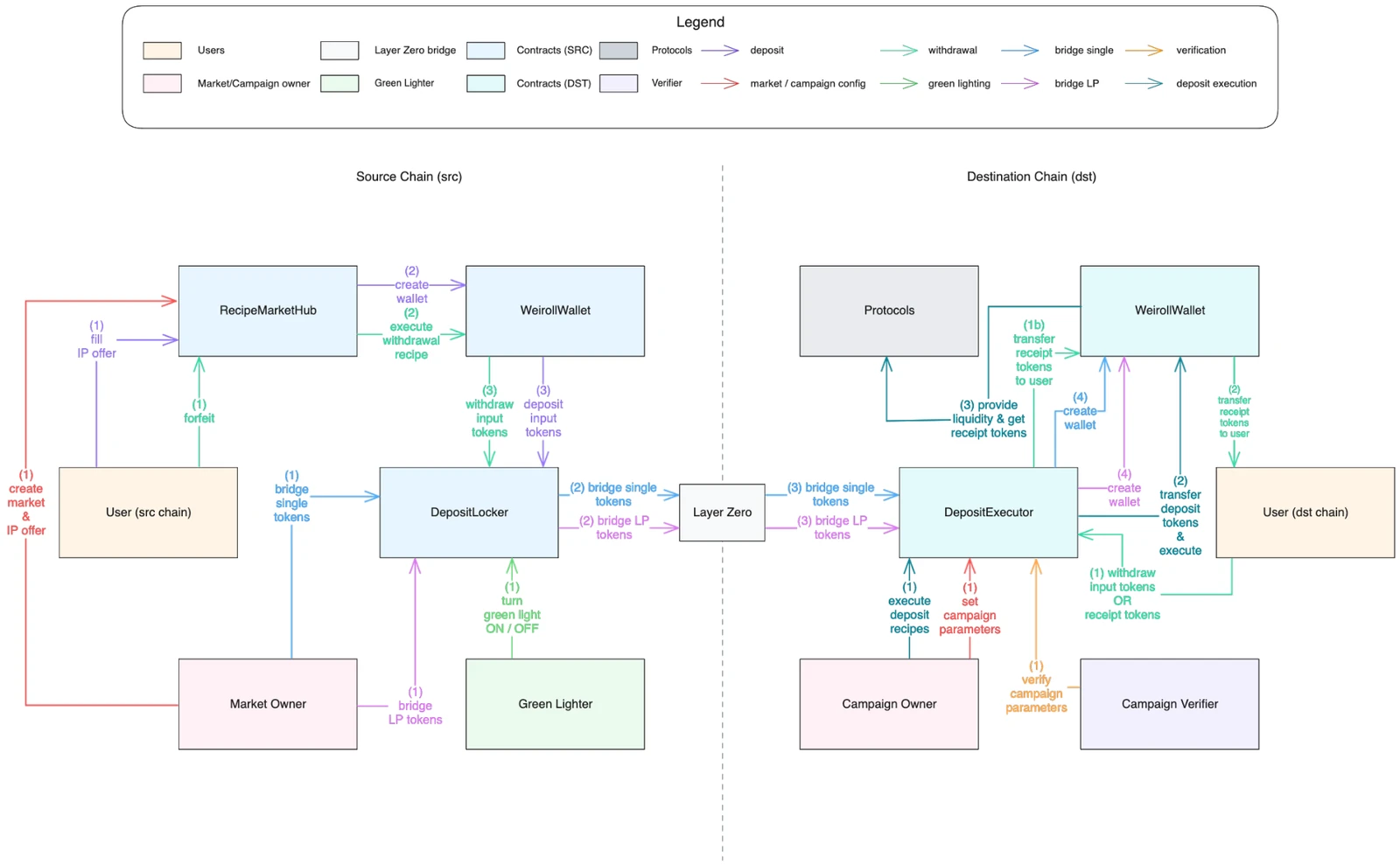
The diagram below showcases a high-level view of the system’s architecture. The following sections delve into the system’s components and their interactions.

CCDM - Structural Diagram of contracts. Note that the diagram does not present the flow of deposit locker configuration
Fig. 2: CCDM - Structural Diagram of contracts. Note that the diagram does not present the flow of deposit locker configuration.

4.1 Actors

  • Deposit Locker and Executor owner: The owner of the DepositLocker and DepositExecutor contracts controls the key parameters of the CCDM system. The party that deployed the contracts to support a new chain is assigned as the first owner. The holder of this role can set and remove other roles, such as campaign/market owners, green lighters, and campaign verifiers.
  • Incentive Providers: Protocols looking for liquidity. They create markets in which users can provide liquidity in return for incentives. They control the deposit campaign settings, such as the accepted input tokens, the deposit recipe, the campaign’s token unlock timestamp, and offered receipt tokens.
  • Action Providers: Users (Depositors) provide liquidity to Incentive Providers in return for incentives.
  • Campaign Verifier: Third party responsible for verifying deposit recipes on the destination chain. Verification also includes validating whether the deposit input and receipt tokens used by the recipe were set correctly by the campaign owner.
  • Green Lighter: A role that monitors the CCDM system and marks users’ deposits as bridgeable if all the other parties fulfilled their duties correctly.

4.2 Depositing assets

Incentive Providers (IPs) offer incentives for Action Providers (APs) to provide liquidity, which will be bridged to protocols launching on new chains. When APs fulfill an IP offer on a CCDM-enabled market, a new Weiroll Wallet will be created that will call the deposit(...) function in the Deposit Locker contract. ERC20 tokens accepted by the Deposit Locker have to be whitelisted by the contrac’s owner. The requirement is that the token has to have the corresponding OFT contract. In the case of Uniswap V2 LP tokens, each constituent have to have a matching OFT. The deposited assets will be mapped to the market hash of the CCDM-enabled market and will be bridged after the green light is given for the market.

4.3 Bridging of assets

Before the assets can be bridged to the destination chain, Green Lighter has to assess the state of the two chains. Once that’s done, a green light will be given, and a rage quit period of 48 hours will start. It gives users a final chance to withdraw the funds before they become bridgeable. After 48 hours, anyone can bridge tokens for a single asset market by calling bridgeSingleTokens(...) function. In the case of LP token markets, bridging must be initiated by the market owner’s call to bridgeLpTokens(...) function. The cross-chain asset transfer is facilitated via LayerZero’s Omnichain Fungible Token (OFT) standard. Each bridging operation is tied to a ccdm nonce. When the cross-chain message is received by the DepositExecutor contract on the destination chain, a Weiroll Wallet is created for each nonce. LP token constituents are assigned the same nonce but are bridged in two separate transactions. Once bridging is complete, the campaign owner can execute the deposit recipes to use the provided liquidity.

4.4 Recipe execution

If the verifier confirms the campaign’s parameters, the campaign is considered verified and is ready to be executed. The campaign’s owner calls the executeDepositRecipes(...) function in the DepositExecutor contract and provides the list of Weiroll Wallets to be executed with the verified deposit recipe. Funds are pulled from the DepositExecutor contract into individual Weiroll Wallets, and the recipe is executed. The steps performed inside the recipe will vary based on the campaign. The common factor among all campaigns, is that the wallet must increase its balance of the campaign’s receipt token after the recipe execution as a sign of provided liquidity. The receipt tokens can be later withdrawn from the wallets by the depositors after the unlock time for the campaign has passed.

4.5 Withdrawal of assets

Users can withdraw the assets; however, the withdrawal process will differ depending on the state of the CCDM system. If the assets have not been bridged yet, they can be withdrawn from the DepositLocker contract in two scenarios:

a. For forfeitable Incentive Action Markets (IAMs), depositors can forfeit their incentives by calling the forfeit(...) function in Recipe Market Hub. If a withdrawal recipe is specified for the market, it will automatically call the withdraw(...) in the Deposit Locker and return the funds to the user. Depositors can also call manualExecuteWeiroll(...) or execute(...) in their Weiroll Wallet with proper arguments to call withdraw(...) manually.

b. In rare cases where the wallet’s unlock timestamp passed, but the funds have not been bridged, depositors can follow similar steps to the ones outlined above, but without forfeiting any incentives.

If the funds were bridged, the withdrawal has to be performed via DepositExecutor contract on the destination chain.

The depositors can withdraw their receipt tokens if the campaign owner has successfully executed the deposit recipe. Otherwise, they can withdraw the originally bridged tokens. Both operations are facilitated via the withdraw(...) function in the Deposit Executor contract.

5

Risk Rating Methodology

The risk rating methodology used by Nethermind Security follows the principles established by the OWASP Foundation. The severity of each finding is determined by two factors: Likelihood and Impact.

Likelihood measures how likely the finding is to be uncovered and exploited by an attacker. This factor will be one of the following values:

  1. High: the issue is trivial to exploit and has no specific conditions that need to be met;
  2. Medium: the issue is moderately complex and may have some conditions that need to be met;
  3. Low: the issue is very complex and requires very specific conditions to be met.

When defining the likelihood of a finding, other factors are also considered. These can include but are not limited to motive, opportunity, exploit accessibility, ease of discovery, and ease of exploit.

Impact is a measure of the damage that may be caused if an attacker exploits the finding. This factor will be one of the following values:

  1. High: the issue can cause significant damage, such as loss of funds or the protocol entering an unrecoverable state;
  2. Medium: the issue can cause moderate damage, such as impacts that only affect a small group of users or only a particular part of the protocol;
  3. Low: the issue can cause little to no damage, such as bugs that are easily recoverable or cause unexpected interactions that cause minor inconveniences.

When defining the impact of a finding, other factors are also considered. These can include but are not limited to data and state integrity, loss of availability, financial loss, and reputation damage. After defining the likelihood and impact of an issue, the severity is determined according to the table below.

Impact / LikelihoodLowMediumHigh
HighMediumHighCritical
MediumLowMediumHigh
LowInfo / Best PracticesLowMedium
UndeterminedUndeterminedUndeterminedUndetermined

To address issues that do not fit a High, Medium or Low severity, Nethermind Security also uses three more finding severities: Informational, Best Practices, and Undetermined.

  1. Informational findings do not pose any risk to the application, but they carry some information that the audit team intends to pass to the client formally;
  2. Best Practice findings are used when some piece of code does not conform with smart contract development best practices;
  3. Undetermined findings are used when we cannot predict the impact or likelihood of the issue.

6

Issues

6.1 Campaign owner can steal tokens bridged for other campaigns

FileFix commitTypeStatus
src/core/DepositExecutor.solPR #5CriticalFixed

Right before a particular Weiroll Wallet is executed in the executeDepositRecipes(...) function, the campaign’s input tokens are transferred from the DepositExecutor contract to the wallet’s address. This ensures that the deposit recipe using the wallet can access relevant tokens. The amount of tokens sent to the wallet equals what was deposited by the user in the DepositLocker and later sent and processed in the DepositExecutor’s lzCompose(...) function. This value is stored in Weiroll Wallet’s accounting tokenToTotalAmountDeposited mapping.

An issue arises if, before calling the executeDepositRecipes(...) function, the campaign owner modifies the campaign’s input tokens to contain duplicated entries. In that case, the _transferInputTokensToWeirollWallet(...) function would iterate over an _inputTokens array and send the user’s deposit multiple times to a single Weiroll Wallet.

function _transferInputTokensToWeirollWallet(
ERC20[] storage _inputTokens,
WeirollWalletAccounting storage _walletAccounting,
address _weirollWallet
)
internal
{
// @audit For each input token, get the user's deposit and send it to the wallet.
for (uint256 i = 0; i < _inputTokens.length; ++i) {
// @audit Fhe _inputTokens array can contain duplicated entries.
ERC20 inputToken = _inputTokens[i];

// @audit The deposited amount has not been decreased/modified; it stays the same.
uint256 amountOfTokenDepositedIntoWallet =
_walletAccounting.tokenToTotalAmountDeposited[inputToken];

// @audit As a result, the deposit amount will be transferred multiple times.
inputToken.safeTransfer(
_weirollWallet, amountOfTokenDepositedIntoWallet
);
}
}

In subsequent loop iterations, the tokens sent to the wallet might come from other deposit campaigns and belong to other users. Malicious campaign owners can exploit this mechanism by depositing to their campaign, adding many duplicated entries to the input tokens array, and executing the deposit recipes, effectively stealing tokens from other campaigns.

Recommendation

Consider removing the setCampaignInputTokens(...) function, thus, remove the ability of campaign owner to modify the input tokens. Rather, input tokens can be set in lzCompose(...) function since they were transferred for that particular market hash after confirming them in the RecipeMarketHub contract on the source chain. Enumerable Set from OpenZeppelin can be used to make sure that the token is a member of the set, that it does not contain duplicate elements, and it can be easily iterated.

Resolution

81d8a0e

6.2 Depositing into a non-existent market allows funds to be stolen when the market is later created

FileFix commitTypeStatus
src/core/DepositLocker.solPR #5CriticalFixed

Whenever the user fills an offer, the deposit(...) function on the DepositLocker contract transfers the market’s input token from the user to the locker contract. The token to be used is queried from the RecipeMarketHub contract, based on the marketHash associated with the Weiroll Wallet performing the deposit. After that, the token is taken from the user, and internal accounting is updated to reflect the user’s deposit.

The problem present in the deposit(...) function is that it does not validate the queried token’s address. The mapping that associates token addresses with market hashes will return an invalid token address in two cases:

  • The market was created for a token that is not yet deployed (e.g., a future UniV2 Pair);
  • The market with that particular market hash does not exist;

In both scenarios, the safeTransferFrom(...) function from the Solmate library will be called on an address that is not a token contract. This poses an issue since Solmate’s SafeTransferLib uses inline assembly and does not check for code existence at the token address. This responsibility is delegated to the caller. The token transfer wouldn’t revert in the scenarios outlined above even though no tokens were sent. The internal accounting would still be updated in the DepositLocker contract.

function deposit() external nonReentrant {
WeirollWallet wallet = WeirollWallet(payable(msg.sender));
bytes32 targetMarketHash = wallet.marketHash();
address depositor = wallet.owner();
uint256 amountDeposited = wallet.amount();

// @audit The market input token can be address 0 or have no code.
(, ERC20 marketInputToken,,,,,) =
RECIPE_MARKET_HUB.marketHashToWeirollMarket(targetMarketHash);
// ...

// @audit Solmate's safeTransferFrom won't revert.
marketInputToken.safeTransferFrom(
msg.sender, address(this), amountDeposited
);

// @audit-issue Accounting is updated, which allows the attacker to withdraw later.
marketHashToDepositorToAmountDeposited[targetMarketHash][depositor] +=
amountDeposited;
marketHashToDepositorToWeirollWallets[targetMarketHash][depositor].push(
msg.sender
);
depositorToWeirollWalletToAmount[depositor][msg.sender] =
amountDeposited;
// ...
}

Once the market or the token pair is eventually created and legitimate users make deposits, the attacker can call withdraw(...) to steal the funds from the DepositLocker contract.

A malicious user can perform this attack by monitoring and front-running createMarket(...) transactions on the RecipeMarketHub contract by depositing to a soon-to-be-created marketHash. The same can be done for markets that anticipate the creation of a Uniswap V2 pair.

Recommendation

Consider adding a code size check for marketInputToken to ensure that artificial token transfers are not possible.

Resolution

e484c55

6.3 The lzCompose(...) function can be provided with arbitrary input to create artificial deposits and steal other users funds

FileFix commitTypeStatus
src/core/DepositExecutor.solPR #5CriticalFixed

Stargate is an oApp built on top of LayerZero’s cross-chain messaging system. To communicate between two chains, it defines the lzSend(...) function on the source chain and lzReceive(...) on the destination chain. These two functions form the basis of cross-chain communication. The LayerZero’s V2 upgrade introduced the composability feature called lzCompose(...), which allows oApps to pack an arbitrary external call and send it along the standard send-and-receive message. On the destination chain, the calls to lzReceive(...) and lzCompose(...) are executed independently in two separate transactions.

The lzReceive(...) function defined in the Stargate’s TokenMessaging contract is called first. It calls Stargate’s Pool contract to perform the token transfers and inform the LZ endpoint about the incoming compose call. This is done by calling the sendCompose(...) function of the EndpointV2 contract.

// EndpointV2.sol
function sendCompose(
address _to,
bytes32 _guid,
uint16 _index,
bytes calldata _message
)
external
{
// @audit sendCompose is permissionless to allow any oApp
// use the composability features.
if (composeQueue[msg.sender][_to][_guid][_index] != NO_MESSAGE_HASH) {
revert Errors.LZ_ComposeExists();
}
composeQueue[msg.sender][_to][_guid][_index] = keccak256(_message);
emit ComposeSent(msg.sender, _to, _guid, _index, _message);
}

The sendCompose(...) function is permissionless and allows any oApp to store the message to be executed in lzCompose(...). The entry in the composeQueue is tied to the destination chain’s receiver contract that called sendCompose(...). In the case of Stargate, this is the Stargate’s Pool.

The lzCompose(...) can be called right after that. This function is also permissionless but is often called by LayerZero’s executor bot. As long as the data passed to this function matches what was previously stored in sendCompose(...), the target (DepositExecutor contract) will be called.

// EndpointV2.sol
function lzCompose(
address _from,
address _to,
bytes32 _guid,
uint16 _index,
bytes calldata _message,
bytes calldata _extraData
)
external
payable
{
// @audit check that hash was stored by calling sendCompose earlier
bytes32 expectedHash = composeQueue[_from][_to][_guid][_index];
bytes32 actualHash = keccak256(_message);
if (expectedHash != actualHash) {
revert Errors.LZ_ComposeNotFound(expectedHash, actualHash);
}

composeQueue[_from][_to][_guid][_index] = RECEIVED_MESSAGE_HASH;

// @audit Call the target e.g. DepositExecutor
ILayerZeroComposer(_to).lzCompose{ value: msg.value }(
_from, _guid, _message, msg.sender, _extraData
);
}

The inherent risk of this permissionless design is that the target of the external call must validate who stored the message in the composeQueue. This is not the case in the DepositExecutor’s lzCompose(...) function.

// DepositExecutor.sol
function lzCompose(
address _from,
bytes32 _guid,
bytes calldata _message,
...
)
external
payable
nonReentrant
{
// @audit endpoint will call this function as a result of a permissionless
// call to lzCompose on the endpoint. The check will pass.
require(msg.sender == LAYER_ZERO_V2_ENDPOINT, NotFromLzV2Endpoint());

// @audit-issue The attacker controls the compose msg via sendCompose(...)
bytes memory composeMsg = OFTComposeMsgCodec.composeMsg(_message);

// @audit-issue The amountLD is normally controlled by Stargate,
// but the attacker can manipulate it as well.
uint256 tokenAmountBridged = OFTComposeMsgCodec.amountLD(_message);

// @audit Data from the _message is used in the internal accounting,
// but is fully controlled by the attacker.

// ...
}

By controlling the message, the attacker does not have to deposit any campaign tokens, but they will be credited to him in the campaign’s weirollWalletToAccounting mapping. Once the campaign’s owner executes the deposit recipes, the attacker’s weiroll wallet will receive the receipt tokens in exchange for liquidity that was provided by other users.

Recommendation

When receiving a composable LayerZero message, three things should be checked by the DepositExecutor contract:

  • Checking that the current caller is LZ Endpoint;
  • Checking that the compose message was registered by an authorized OFT;
  • Checking that DepositLocker sent the message on the source chain;

The first check is already implemented. To resolve the issue, consider implementing the two missing checks. The _from address of lzCompose(...) can be used to handle the 2nd check, e.g., _from == Stargate Pool similarly in which tokenToLzV2OFT holds authorized OFTs in the Locker contract. For the 3rd check, the address of the DepositLocker can be retrieved by using the composeFrom(...) function from the OFTComposeMsgCodec.

Resolution

b9e2dfc

6.4 If WeirollWallet is executed before all the assets are bridged, tokens will be permanently stuck

FileFix commitTypeStatus
src/core/DepositExecutor.solPR #5HighFixed

Whenever the LP tokens are bridged from the DepositLocker contract, they are sent as two separate bridging transactions but are assigned the same ccdm nonce. The nonce is tied to a single Weiroll Wallet on the destination chain. Once the funds are bridged, the executeDepositRecipes(...) function can be called to execute the deposit recipe and use the liquidity provided by the user. Once that’s done, the wallet is marked as executed, and subsequent executions of the same wallet are not possible. An issue might arise if the executeDepositRecipes(...) function happens to be called in between the two bridging transactions of the LP token pair constituents. The token that arrived first will be used in the deposit recipe. Since liquidity was provided successfully, this operation will yield a certain amount of receipt tokens. Once the second bridging transaction is finished, the Weiroll Wallet tied to the ccdm nonce that was just bridged is already executed. The second token can’t be used to provide liquidity and will not yield receipt tokens.

The problem is that these tokens are permanently stuck in the DepositExecutor contract. They can’t be withdrawn directly since the wallet is considered executed. At the same time, they can’t be withdrawn as receipt tokens since they were not used in a deposit recipe and internal accounting was not updated. This scenario can happen by accident on every LP token bridge or on purpose if the campaign owner is malicious or compromised.

Recommendation

Consider adding a field in compose message received in lzCompose(...) function to know the number of tokens bridged and associated with the same ccdm nonce. So untill and unless all the tokens are bridged i.e. in case of LP tokens, both the tokens are bridged, executeDepositRecipes(...) function shouldn’t be allowed to be called.

Resolution

98d2bd9

6.5 Bridged tokens can be stuck permanently if the campaign’s input tokens are changed after bridging but before the wallet’s execution

FileFix commitTypeStatus
src/core/DepositExecutor.solPR #5MediumFixed

Once the Green Lighter validates the campaign’s action logic and parameters, a green light is given, and the funds can be bridged from the DepositLocker to the DepositExecutor contract. After the DepositExecutor processes the bridging transactions, the created Weiroll Wallets can be executed with deposit recipe actions to start the liquidity provision campaign. An issue might arise if the campaign owner is compromised or acts maliciously by removing one of the previously configured input tokens for this campaign. If the wallet is executed with a single input token configured, even though two were previously bridged, the second token will be stuck for the same reason outlined in [High] If WeirollWallet is executed before all the assets are bridged, tokens will be permanently stuck finding. This can happen even if the Green Lighter fulfills its duties correctly, as certain campaign parameters, such as input tokens, can be changed after the green light is given (e.g., removing one of the two input tokens).

Recommendation

Consider removing the setCampaignInputTokens(...) function, thus, remove the ability of campaign owner to modify the input tokens. Rather, input tokens can be set in lzCompose(...) function since they were transferred for that particular market hash after confirming them in the RecipeMarketHub contract on the source chain. Enumerable Set from OpenZeppelin can be used to make sure that the token is a member of the set, that it does not contain duplicate elements, and it can be easily iterated.

Resolution

81d8a0e

6.6 Token bridging can be griefed

FileFix commitTypeStatus
src/core/DepositLocker.solPR #5
PR #5
MediumFixed

Whenever the user deposits funds into the DepositLocker contract, the address of the Weiroll Wallet used in this interaction is pushed as an entry in the marketHashToDepositorToWeirollWallets array.

While bridging tokens from the source chain to the destination chain, the _clearDepositorData(...) function is used to clear the depositor’s data and the abovementioned array. The array will be iterated in this function to clear the data entries.

Since this iteration is unbounded, a problem might arise. Any malicious contract can act as a Weiroll Wallet and call deposit(...) on behalf of any user with a very small amount (like one wei) multiple times to increase the array’s length. This will lead to an out-of-gas error when the _clearDepositorData(...) function loops through the array, preventing a particular user’s funds from being bridged.

function deposit() external nonReentrant {
// @audit Any malicious contract can also act as a Weiroll Wallet
WeirollWallet wallet = WeirollWallet(payable(msg.sender));
bytes32 targetMarketHash = wallet.marketHash();
address depositor = wallet.owner();
uint256 amountDeposited = wallet.amount();

// ...
marketHashToDepositorToAmountDeposited[targetMarketHash][depositor] +=
amountDeposited;

// @audit Calling this function would increase the length of the array
marketHashToDepositorToWeirollWallets[targetMarketHash][depositor].push(
msg.sender
);
depositorToWeirollWalletToAmount[depositor][msg.sender] =
amountDeposited;
// ...
}

function _clearDepositorData(
bytes32 _marketHash,
address _depositor
)
internal
{
address[] storage depositorWeirollWallets =
marketHashToDepositorToWeirollWallets[_marketHash][_depositor];

// @audit-issue Looping through the large array can lead to out of gas error
for (uint256 i = 0; i < depositorWeirollWallets.length; ++i) {
// Set the amount deposited by the Weiroll Wallet to zero
delete depositorToWeirollWalletToAmount[_depositor][
depositorWeirollWallets[i]
];
}
// ...
}

Although the user (victim) can withdraw their funds at any point, any token deposit linked with the user’s address can’t be bridged due to the out-of-gas issue. The user would be forced to deposit from a different account. Competitors of protocols are incentivized to carry out this attack on whales, providing liquidity to the protocol to discourage them from doing so.

Recommendation

Consider changing the accounting variables for deposits. The array corresponding to marketHashToDepositorToWeirollWallets mapping can be removed. Instead, the nonce can be used which increments after tokens are bridged. Thus, keeping an array of all the deposits won’t be needed.

Resolution

a1811e5, 9bbb29c

Update from Nethermind Security

In the _processSingleTokenDepositor(...) function the bridging nonce is incremented even in the case when deposit amount exceeds the uint96 and no actual tokens are bridged. It makes it impossible to withdraw the funds then because the nonce was increased.

Update from Nethermind Security

Fixed.

6.7 Bridged deposits that revert with out of gas error, must be re-tried to start participating in the campaign

FileFix commitTypeStatus
src/core/DepositLocker.sol—InfoAcknowledged

The permissionless nature of the bridgeSingleTokens(...) allows anyone to to bridge the deposits of any depositor to the destination chain. It allows market owners to select deposits that they wish to bridge to to their protocol. The caller of the bridgeSingleTokens(...) provides the gas to be used to process the deposits on the destination chain. If either on purpose or by accident the caller specifies insufficient gas, the transaction will revert on the destination chain and must be retried by interacting with the destination chain’s endpoint contract.

It is by design and in the best interest of market owners to monitor these transactions and re-try them if necessary. However, if that does not happen, the users might be forced to do it on their own which might cause inconvenience if they lack gas tokens on the destination chain.

Recommendation

Consider adding documentation around this edge case for the users to understand the conditions to which they agree when using CCDM.

6.8 Dust amounts left in Weiroll Wallet after executing the deposit recipes are not explicitly handled

FileFix commitTypeStatus
src/core/DepositExecutor.solPR #6InfoFixed

In the executeDepositRecipes(...) function, the deposit recipe is executed in the Weiroll Wallet containing the deposited tokens. In some cases, after executing the recipe there might be a dust amount of input tokens left in the Weiroll Wallet, that is not transferred back to the user. The deposit recipe may contain logic to handle that case, but there’s no logic in the DepositExecutor to guarantee that depositors receive dust amounts of input tokens back.

Recommendation

Consider returning the unspent tokens to the user in the withdraw(...) function.

Resolution

PR 6

6.9 Weiroll Wallet can have an unlock timestamp of zero if funds were bridged before campaign params were set

FileFix commitTypeStatus
src/core/DepositExecutor.solPR #5Best PracticesFixed

In the lzCompose(...) function, Weiroll Wallet is created if it wasn’t created previously for a ccdm nonce. It is possible, however, that the bridging transaction was processed before the campaign parameters were set. If that’s the case, a wallet might be created with an unlock timestamp of 0. Some users might be able to withdraw the tokens. Still, the campaign owner can then modify the unlock timestamp by calling the setCampaignUnlockTimestamp(...) function, which will make the experience inconsistent for other users as they won’t be able to withdraw instantly.

Recommendation

Consider validating that the campaign parameters were set before giving the green light.

Resolution

This makes unlock timestamp immutable after it is set once or the first batch of deposits is received: 81d8a0e

Although this doesn’t stop a campaign owner from manipulating the unlock timestamp in between the first batch of deposits being bridged from the Locker and received by the Executor, it does keep the unlock timestamp consistent for all depositors in a campaign. The IP/Campaign owner’s reputation will be tarnished if they choose to change the terms of the agreement before depositors have a chance to exit on the source chain. To mitigate the likelihood of this attack, if the campaign unlock timestamp is unset on the destination, Depositors should be notified of the risk on any CCDM interface. If campaign’s intend on not having a lockup period, they should set their unlock timestamp to any non-zero timestamp less than the current timestamp.

6.10 Missing event emission in constructor(...)

FileFix commitTypeStatus
src/core/DepositLocker.sol
src/core/DepositExecutor.sol
PR #5Best PracticesFixed

During the project’s deployment, it is worth emitting events with the initial values for important protocol parameters. These make tracking on-chain issues easier in case they arise post-deployment. No such events are emitted:

  • In the constructor(...) of the DepositLocker contract for GREEN_LIGHTER, dstChainLzEid, and depositExecutor state variables;
  • In the constructor(...) of the DepositExecutor contract for the campaignVerifier address;

Such events are already emitted in the respective setter functions.

Recommendation

Consider emitting events with initial values in the constructor(...).

Resolution

5c6adc9

6.11 Missing input validation in _setLzV2OFTForToken when _token is a chain’s native asset

FileFix commitTypeStatus
src/core/DepositLocker.sol—Best PracticesFixed

The _setLzV2OFTForToken(...) function is used to set the LayerZero V2 OFT for a given token in the tokenToLzV2OFT mapping. When _lzV2OFT argument passed to the function corresponds to a native asset, i.e., _lzV2OFT.token() == address(0), the _token argument isn’t validated.

In this case, the _token should equal WRAPPED_NATIVE_ASSET_TOKEN. If _setLzV2OFTForToken(...) is called with a different _token equal to something other than WRAPPED_NATIVE_ASSET_TOKEN, the tx wouldn’t fail, leading to undefined behavior later, especially while bridging the tokens.

function _setLzV2OFTForToken(ERC20 _token, IOFT _lzV2OFT) internal {

address underlyingToken = _lzV2OFT.token();

// @audit When underlyingToken == address(0),
// no validation is done for address(_token)
require(
underlyingToken == address(_token) || underlyingToken == address(0),
InvalidLzV2OFTForToken()
);
tokenToLzV2OFT[_token] = _lzV2OFT;
// ...
}

Recommendation

Consider adding a check to ensure that the _token passed in _setLzV2OFTForToken(...) is equal to WRAPPED_NATIVE_ASSET_TOKEN if the underlyingToken is equal to address(0).

7

Documentation Evaluation

Software documentation refers to the written or visual information that describes the functionality, architecture, design, and implementation of software. It provides a comprehensive overview of the software system and helps users, developers, and stakeholders understand how the software works, how to use it, and how to maintain it. Software documentation can take different forms, such as user manuals, system manuals, technical specifications, requirements documents, design documents, and code comments. Software documentation is critical in software development, enabling effective communication between developers, testers, users, and other stakeholders. It helps to ensure that everyone involved in the development process has a shared understanding of the software system and its functionality. Moreover, software documentation can improve software maintenance by providing a clear and complete understanding of the software system, making it easier for developers to maintain, modify, and update the software over time. Smart contracts can use various types of software documentation. Some of the most common types include:

  • Technical whitepaper: A technical whitepaper is a comprehensive document describing the smart contract’s design and technical details. It includes information about the purpose of the contract, its architecture, its components, and how they interact with each other;
  • User manual: A user manual is a document that provides information about how to use the smart contract. It includes step-by-step instructions on how to perform various tasks and explains the different features and functionalities of the contract;
  • Code documentation: Code documentation is a document that provides details about the code of the smart contract. It includes information about the functions, variables, and classes used in the code, as well as explanations of how they work;
  • API documentation: API documentation is a document that provides information about the API (Application Programming Interface) of the smart contract. It includes details about the methods, parameters, and responses that can be used to interact with the contract;
  • Testing documentation: Testing documentation is a document that provides information about how the smart contract was tested. It includes details about the test cases that were used, the results of the tests, and any issues that were identified during testing;
  • Audit documentation: Audit documentation includes reports, notes, and other materials related to the security audit of the smart contract. This type of documentation is critical in ensuring that the smart contract is secure and free from vulnerabilities.

These types of documentation are essential for smart contract development and maintenance. They help ensure that the contract is properly designed, implemented, and tested, and they provide a reference for developers who need to modify or maintain the contract in the future.

8

Remarks & Test Suite

The documentation for the CCDM contracts was provided through their official docs as well as detailed code comments. This documentation provided a high-level overview of the protocol and details of its implementation. Moreover, the CCDM team addressed all questions and concerns raised by the Nethermind Security team, providing valuable insights and a comprehensive understanding of the project’s technical aspects.

Remarks about the CCDM contract’s test suite

The test suite of the CCDM contracts covers all major flows of the protocol. However, upon closer review, it was observed that the suite lacks the necessary depth to validate certain edge cases and specific state changes. This limitation makes the test suite prone to errors, such as off-by-one issues, which can compromise the reliability of the protocol in critical scenarios. In particular, the absence of targeted assertions to verify state transitions after each operation reduces the effectiveness of the tests in identifying subtle bugs. Enhancing the granularity and precision of the assertions could significantly improve the suite’s resilience. To address these gaps, incorporating mutation testing could be an effective approach. Mutation testing introduces small changes to the contract code to verify whether the test suite is capable of detecting them. This method can highlight untested or weakly tested paths in the code, providing a clear roadmap for improving test coverage.

Test suite
8Tests passed0Failed

The complete test output is in the full report.

As auditors, we recommend that any changes or updates made to the audited codebase undergo a re-audit or security review to address potential vulnerabilities or risks introduced by the modifications. By conducting a re-audit or security review of the modified codebase, you can significantly enhance the overall security of your system and reduce the likelihood of exploitation. However, we do not possess the authority or right to impose obligations or restrictions on our clients regarding codebase updates, modifications, or subsequent audits. Accordingly, the decision to seek a re-audit or security review lies solely with you.

This report is based on the scope of materials and documentation provided by you to Nethermind in order that Nethermind could conduct the security review outlined in 1. Executive Summary and 2. Audited Files. The results set out in this report may not be complete nor inclusive of all vulnerabilities. Nethermind has provided the review and this report on an as-is, where-is, and as-available basis. You agree that your access and/or use, including but not limited to any associated services, products, protocols, platforms, content, and materials, will be at your sole risk. Blockchain technology remains under development and is subject to unknown risks and flaws. The review does not extend to the compiler layer, or any other areas beyond the programming language, or other programming aspects that could present security risks. This report does not indicate the endorsement of any particular project or team, nor guarantee its security. No third party should rely on this report in any way, including for the purpose of making any decisions to buy or sell a product, service or any other asset. To the fullest extent permitted by law, Nethermind disclaims any liability in connection with this report, its content, and any related services and products and your use thereof, including, without limitation, the implied warranties of merchantability, fitness for a particular purpose, and non-infringement. Nethermind does not warrant, endorse, guarantee, or assume responsibility for any product or service advertised or offered by a third party through the product, any open source or third-party software, code, libraries, materials, or information linked to, called by, referenced by or accessible through the report, its content, and the related services and products, any hyperlinked websites, any websites or mobile applications appearing on any advertising, and Nethermind will not be a party to or in any way be responsible for monitoring any transaction between you and any third-party providers of products or services. As with the purchase or use of a product or service through any medium or in any environment, you should use your best judgment and exercise caution where appropriate. FOR AVOIDANCE OF DOUBT, THE REPORT, ITS CONTENT, ACCESS, AND/OR USAGE THEREOF, INCLUDING ANY ASSOCIATED SERVICES OR MATERIALS, SHALL NOT BE CONSIDERED OR RELIED UPON AS ANY FORM OF FINANCIAL, INVESTMENT, TAX, LEGAL, REGULATORY, OR OTHER ADVICE.