Etherspot
Smart Wallet

Etherspot's wallet is an ERC-4337 account that several owners can control, with guardians who vote to recover it. We reviewed the wallet, its paymaster and the factory that creates new wallets.
report id
0112
category
Infra & Wallets
language
Solidity
final report
August 15, 2023
lines of code
898
Content

Download audit report

1

Executive Summary

This document presents the security review performed by Nethermind on the EtherSpot Wallet Smart Contracts. The smart contracts implement the functionalities of the EtherSpot wallet. EtherspotWallet is an EIP-4337 compliant smart contract serving as a multiownership wallet. It enables multiple owners to control a single account and execute transactions through an EntryPoint contract. It also integrates with the EtherspotPaymaster contract, allowing sponsors to cover gas costs for user operations.

The wallet implements an access control mechanism by inheriting the AccessController contract. This mechanism enables the wallet to have multiple owners and guardians. Guardians play a crucial role in account recovery; they participate in a voting mechanism to authorize adding new owners to the wallet. To reach a quorum and validate an owner, at least 60% of guardians must validate a vote, and a minimum of three guardians is required to initiate the voting process. To simplify the creation of new wallets, EtherspotWalletFactory comes into play, where users can effortlessly generate new wallets by calling the createAccount function.

EtherspotPaymaster is the smart contract that allows external signers to endorse UserOperations and take responsibility for covering the associated gas costs. The paymaster and the wallet engage in a dual-signature mechanism: the paymaster signs to commit to paying for gas, while the wallet signs to verify its identity and ownership of the account. Additionally, this contract incorporates a Whitelist functionality by inheriting a Whitelist contract, where sponsors should add specific users they wish to cover gas expenses for.

The audit was performed using (a) manual analysis of the codebase, (b) automated analysis tools, (c) simulation of the smart contract, and (d) creation of test cases.

Audit assessment
Audit TypeSecurity Review
Initial ReportAug. 1, 2023
Response from ClientAug. 10, 2023
Final ReportAug. 15, 2023
MethodsManual Review, Automated Analysis
Repositoryhttps://github.com/etherspot/etherspot-prime-contracts/blob/6379fb0f6a0f538151bd6003f69fc05cc32fabe5
Commit Hash (Audit)6379fb0f6a
Documentationdocs folder
Documentation AssessmentMedium
Test Suite AssessmentMedium
Total findings
26
Fixed
23
Acknowledged
3
Mitigated
0
Unresolved
0

Findings by severity

  • Critical0
  • High0
  • Medium3
  • Low2
  • Informational9
  • Best Practices12

3

Summary of Issues

#FindingSeverityUpdate
1Guardians can cosign an old proposalMediumFixed
2Any guardian can remove owners from the Etherspot walletMediumFixed
3Improve the proposals’ voting designMediumFixed
4In case a post user operation reverts, _postOp(...) function totally refunds the sponsorLowFixed
5proposalId 0 can be cosigned by guardians without being proposedLowFixed
6Owners cannot remove themselves from the walletInfoFixed
7Proposals history/traceability is not accessible from the smart contract storageInfoFixed
8Removed guardian’s signature in the latest proposal remains validInfoAcknowledged
9Resolved proposals can be discarded afterwardInfoFixed
10Unnecessary inheritance in Whitelist.solInfoFixed
11Unused variables in EtherspotWallet.solInfoFixed
12EntryPoint address should be immutable in EtherspotWallet contractInfoFixed
13EtherspotWallet can be initialized with an invalid EntryPoint contract addressInfoFixed
14QuorumNotReached event has an incorrect parameter nameInfoFixed
15onlyOwner modifier name represents incorrect logicBest PracticesAcknowledged
16Apply Checks-Effects-Interactions patternBest PracticesFixed
17Contract Whitelist does not use IWhitelist.solBest PracticesFixed
18Functions that can have external visibilityBest PracticesFixed
19Interface and implementation are not matching in EtherspotWallet.solBest PracticesFixed
20Remove unused UniversalSignatureValidator contract from the codebaseBest PracticesAcknowledged
21Unclear function names in the Whitelist ContractBest PracticesFixed
22Unnecessary usage of input parameterBest PracticesFixed
23Unused WhitelistInitialized event in Whitelist.solBest PracticesFixed
24NewOwnerProposal struct is not reordered to consume less gasBest PracticesFixed
25accountImplementation cannot be updatedBest PracticesFixed
26checkSponsorFunds name is confusingBest PracticesFixed

4

System Overview

The audit covers the following smart contracts and interfaces:

   − wallet/Proxy.sol
− wallet/EtherspotWalletFactory.sol
  • wallet/EtherspotWallet.sol & interfaces/IEtherspotWallet.sol
   − access/AccessController.sol
  • paymaster/Whitelist.sol & interfaces/IWhitelist.sol
  • paymaster/EtherspotPaymaster.sol & interfaces/IEtherspotPaymaster.sol
   − paymaster/BasePaymaster.sol
− helpers/UniversalSignatureValidator.sol
− interfaces/IERC721Wallet.sol

4.1 wallet/Proxy.sol

This contract presents a standard proxy implementation similar to the one provided by OpenZeppelin in this link. It is used as a proxy for the newly created wallet contracts. The contract code is shown below.

contract Proxy {
bytes32 internal constant _IMPLEMENTATION_SLOT = 0x360894a13ba1a3210667c828492db98dca3e2076cc3735a920a3ca505d382bbc;

constructor(address _singleton) {
require(_singleton != address(0), "Invalid address provided");
assembly {
sstore(_IMPLEMENTATION_SLOT, _singleton)
}
}

fallback() external payable {
address target;
// solhint-disable-next-line no-inline-assembly
assembly {
target := sload(_IMPLEMENTATION_SLOT)
calldatacopy(0, 0, calldatasize())
let success := delegatecall(gas(), target, 0, calldatasize(), 0, 0)
returndatacopy(0, 0, returndatasize())
if eq(success, 0) {
revert(0, returndatasize())
}
return(0, returndatasize())
}
}
}

4.2 wallet/EtherspotWalletFactory.sol

This contract is a factory for creating new wallet accounts using a proxy pattern. It allows for the efficient deployment of multiple wallet contracts using the same implementation address.

The contract emits the following event when a new wallet is created.

event AccountCreation(
address indexed wallet,
address indexed owner,
uint256 index
);

It has one immutable storage variable accountImplementation that stores the wallet implementation address.

address public immutable accountImplementation;

The contract has the following public/external methods:

1. constructor(): The contract constructor function, it deploys a new EtherspotWallet contract and initializes the accountImplementation variable with its address. This address is immutable and will serve as the implementation of the proxy wallets.

2. accountCreationCode(): This function allows users to retreive the creation code for deploying a proxy contract, which can be used to calculate the predicted address of a deployed proxy.

3. createAccount(IEntryPoint entryPoint, address owner, uint256 index): The main function of this contract, it enables users to create a new wallet by passing the entryPoint address, the wallet owner address, and an index as input parameters. The function deploys a proxy contract pointing to the wallet implementation stored in accountImplementation variable. It returns the account address.

4. getAddress(IEntryPoint entryPoint, address owner, uint256 index): This function calculates and returns the address of a wallet based on the entryPoint, owner, and index values, as it would be returned by createAccount(...).

4.3 wallet/EtherspotWallet.sol & interfaces/IEtherspotWallet.sol

The EtherspotWallet contract is an upgradeable multi-ownership wallet implementation. It provides functionalities that enable users to manage funds, execute function calls, manage owners and guardians for account recovery, and verify signatures. The contract allows owners to interact with an entry point contract, which is the main interface for executing user operations. It also includes mechanisms for executing batch function calls, enabling efficient execution of multiple operations within a single transaction. The interface IEtherspotWallet.sol defines the different functions and events to be implemented by the EtherspotWallet, the code is presented below.

import {IEntryPoint} from "../../account-abstraction/contracts/interfaces/IEntryPoint.sol";

interface IEtherspotWallet {
event EtherspotWalletInitialized(
IEntryPoint indexed entryPoint,
address indexed owner
);
event EtherspotWalletReceived(address indexed from, uint256 indexed amount);
event EntryPointChanged(address oldEntryPoint, address newEntryPoint);
event OwnerAdded(address newOwner, uint256 blockFrom);
event OwnerRemoved(address removedOwner, uint256 blockFrom);

function nonce() external view returns (uint256);
function entryPoint() external view returns (IEntryPoint);
receive() external payable;
function execute(address dest, uint256 value, bytes calldata func) external;
function executeBatch(address[] calldata dest, bytes[] calldata func) external;
function getDeposit() external view returns (uint256);
function addDeposit() external payable;
function isOwner(address _owner) external view returns (bool);
function isGuardian(address _guardian) external view returns (bool);
function updateEntryPoint(address _newEntryPoint) external;
}

The contract defines the following events.

event EtherspotWalletInitialized(IEntryPoint indexed entryPoint, address indexed owner);
event EtherspotWalletReceived(address indexed from, uint256 indexed amount);
event EntryPointChanged(address oldEntryPoint, address newEntryPoint);

We summarize below the external and public functions implemented by the IEtherspotWallet.sol contract:

1. execute(address dest, uint256 value, bytes calldata func) external onlyOwnerOrEntryPoint(address(entryPoint())): Main function used to execute a transaction. Only the owner or the entry point contract can call this method.

2. executeBatch(address[] calldata dest, uint256[] calldata value, bytes[] calldata func): This method allows the owner or the entry point contract to execute multiple transactions in a batch. It takes arrays of inputs that should have the same length.

3. updateEntryPoint(address _newEntryPoint) external onlyOwner: This method updates the entry point contract associated with the wallet to a new address. Only the owner can call this method.

4. isValidSignature(bytes32 hash, bytes calldata signature) external view returns (bytes4 magicValue): This method implements the isValidSignature function from the ISignatureValidator interface. It verifies the validity of a signature based on a provided hash and signature data. If the signature is valid and the signer is the owner of the wallet, it returns the ERC1271_SUCCESS magic value; otherwise, it returns bytes4(0xffffffff).

5. receive() external payable: Fallback function triggered when the contract receives Ether. It emits an event indicating the sender address and amount of Ether received.

6. entryPoint() public view virtual override returns (IEntryPoint): This method returns the current entry point contract address associated with the wallet. 7. getDeposit() public view returns (uint256): Returns the current deposit balance of the wallet in the entry point contract.

8. initialize(IEntryPoint anEntryPoint, address anOwner) public virtual initializer: This method initializes the wallet by setting the anEntryPoint address and adding anOwner as the owner of the wallet. It can be called only once after deployment.

9. addDeposit() public payable: This method allows users to deposit funds to the EntryPoint contract via the wallet.

10. withdrawDepositTo(address payable withdrawAddress, uint256 amount) public onlyOwner: This method allows a wallet owner to withdraw funds from the wallet’s deposit to a specified withdrawAddress. The amount parameter indicates the amount to be withdrawn.

4.4 access/AccessController.sol

The AccessController contract provides a mechanism for managing access control within EtherspotWallet.sol, enabling multiple owners and guardians. Owners are allowed to add or remove owners and guardians in the wallet, while guardians can propose and approve new owners. The contract ensures a quorum is reached before adding a new owner by requiring 60% of guardian approvals.

The contract defines the following events.

event OwnerAdded(address newOwner);
event OwnerRemoved(address removedOwner);
event GuardianAdded(address newGuardian);
event GuardianRemoved(address removedGuardian);
event ProposalSubmitted(
uint256 proposalId,
address newOwnerProposed,
address proposer
);
event QuorumNotReached(
uint256 proposalId,
address newOwnerProposed,
uint256 guardiansApproved
);
event ProposalDiscarded(uint256 proposalId);

The contract defines the struct NewOwnerProposal.

struct NewOwnerProposal {
address newOwnerProposed;
uint256 approvalCount;
address[] guardiansApproved;
bool resolved;
}

The contract has the following storage variables.

uint128 immutable MULTIPLY_FACTOR = 1000;
uint16 immutable SIXTY_PERCENT = 600;
uint256 public ownerCount;
uint256 public guardianCount;
uint256 public proposalId;
mapping(address => bool) private owners;
mapping(address => bool) private guardians;
mapping(uint256 => NewOwnerProposal) private proposals;

It offers multiple functions to check and manage owners, guardians and proposals within the wallet. We summarize these functions below:

1. function isOwner(address _address) public view returns (bool): Function that checks if the specified address is an owner.

2. function isGuardian(address _address) public view returns (bool): Function that checks if the specified address is a guardian.

3. function addOwner(address _newOwner) external onlyOwner: Adds a new owner to the wallet. Only an owner can call this function.

4. function removeOwner(address _owner) external onlyOwnerOrGuardian: Removes an existing owner, requires the wallet to have at least two owners. This function can be called by a wallet owner or a guardian.

5. function addGuardian(address _newGuardian) external onlyOwner: Adds a new guardian to the wallet. It requires the caller to be an owner.

6. function removeGuardian(address _guardian) external onlyOwner: Removes an existing guardian from the wallet. It requires the caller to be an owner.

7. function getProposal(uint256 _proposalId) public view returns (address ownerProposed_, uint256 approvalCount_, address[] memory guardiansApproved_, bool resolved_): This function returns the details of a proposal identified by the given _proposalId. It returns the proposed owner’s address, the approval count, the array of guardians who approved the proposal, and a boolean indicating if the proposal is resolved. 8. function discardCurrentProposal() external onlyOwnerOrGuardian: This external function allows the owner or guardian to discard the current proposal. By discarding it, the proposal is marked as resolved without adding the owner to the wallet.

9. function guardianPropose(address _newOwner) external onlyGuardian: This function is used by guardians to propose a new owner. It requires the wallet to have at least 3 guardians, creates a new proposal with the proposed owner and the guardian’s approval.

10. function guardianCosign(uint256 _proposalId) external onlyGuardian: This function allows a guardian to cosign a proposal. If quorum is reached (60% of guardians cosigned the proposal), the proposal is marked as resolved and the proposed owner is added to the wallet.

4.5 paymaster/Whitelist.sol & interfaces/IWhitelist.sol

The main goal of the Whitelist contract is to provide a mechanism for managing a whitelist of accounts associated with a specific EtherspotPaymaster contract. It enables sponsors to add or remove accounts they want to pay gas for, from the whitelist. The contract provides an external function to check if an account is whitelisted for a specific sponsor. Additionally, it emits events to track the initialization of the whitelist, the addition and removal of accounts, and batch operations on the whitelist. The interface interfaces/IWhitelist.sol defines the different functions and events to be implemented by the Whitelist contract. The code is presented below.

interface IWhitelist {
event WhitelistInitialized(address owner, string version);
event AddedToWhitelist(address indexed paymaster, address indexed account);
event AddedBatchToWhitelist(
address indexed paymaster,
address[] indexed accounts
);
event RemovedFromWhitelist(
address indexed paymaster,
address indexed account
);
event RemovedBatchFromWhitelist(
address indexed paymaster,
address[] indexed accounts
);

function check(
address _sponsor,
address _account
) external view returns (bool);

function add(address _account) external;

function addBatch(address[] calldata _accounts) external;

function remove(address _account) external;

function removeBatch(address[] calldata _accounts) external;
}

The contract defines the following events.

event WhitelistInitialized(address owner);
event AddedToWhitelist(address indexed paymaster, address indexed account);
event AddedBatchToWhitelist(
address indexed paymaster,
address[] indexed accounts
);
event RemovedFromWhitelist(
address indexed paymaster,
address indexed account
);
event RemovedBatchFromWhitelist(
address indexed paymaster,
address[] indexed accounts
);

The contract has one storage variable whitelist, storing the whitelisted accounts for each sponsor address.

mapping(address => mapping(address => bool)) private whitelist;

Whitelist contract defines the following public and external functions:

1. check(address _sponsor, address _account) external view returns (bool): This function checks whether a given account is whitelisted for a specific sponsor. 2. add(address _account) external: This function allows anyone to add an account to the whitelist for the calling entity (msg.sender). It emits the AddedToWhitelist event.

3. addBatch(address[] calldata _accounts) external: This function allows batch addition of multiple accounts to the whitelist. It emits the AddedBatchToWhitelist event upon successful batch addition.

4. remove(address _account) external: This function allows the removal of an account from the whitelist of the caller. It emits the RemovedFromWhitelist event upon successful removal.

5. removeBatch(address[] calldata _accounts) external: This function allows batch removal of multiple accounts from the caller whitelist. It emits the RemovedBatchFromWhitelist event upon successful batch removal.

4.6 paymaster/EtherspotPaymaster.sol & interfaces/IEtherspotPaymaster.sol

EtherspotPaymaster contract is a smart contract that allows an external signer to sign a given UserOperation and pay for the gas costs of executing it. The contract leverages the functionality provided by the BasePaymaster contract and the Whitelist contract to achieve its objectives. One of the key features of the EtherspotPaymaster contract is its trust in an external signer. The external signer performs off-chain verification of the user operation and signs the transaction accordingly. The paymaster relies on this signature to agree to pay for the gas costs associated with the transaction. EtherspotPaymaster contract also incorporates the Whitelist functionality. By inheriting from the Whitelist contract, sponsors funds are used to pay for gas of accounts they whitelisted.

The interface interfaces/IEtherspotPaymaster.sol is presented below.

import {IEntryPoint} from "../../account-abstraction/contracts/interfaces/IEntryPoint.sol";

interface IEtherspotWallet {
event EtherspotWalletInitialized(
IEntryPoint indexed entryPoint,
address indexed owner
);
event EtherspotWalletReceived(address indexed from, uint256 indexed amount);
event EntryPointChanged(address oldEntryPoint, address newEntryPoint);
event OwnerAdded(address newOwner, uint256 blockFrom);
event OwnerRemoved(address removedOwner, uint256 blockFrom);

function nonce() external view returns (uint256);
function entryPoint() external view returns (IEntryPoint);
receive() external payable;
function execute(address dest, uint256 value, bytes calldata func) external;
function executeBatch(address[] calldata dest, bytes[] calldata func) external;
function getDeposit() external view returns (uint256);
function addDeposit() external payable;
function isOwner(address _owner) external view returns (bool);
function isGuardian(address _guardian) external view returns (bool);
function updateEntryPoint(address _newEntryPoint) external;
}

The contract provides functions to manage sponsors funds, check if enough funds are deposited, verifying the signatures and handling the post operation process. We summarize below the main public and external functions of the contract:

- function depositFunds() external payable nonReentrant: The contract allows users to deposit funds by calling the this function. The deposited funds are credited to the sender’s account and stored in the sponsorFunds mapping. This mapping keeps track of the funds deposited by each sponsor.

- function withdrawFunds(address payable _sponsor, uint256 _amount) external nonReentrant: Users can withdraw their deposited funds by calling this function. The contract verifies that the caller is the rightful sponsor and that they have sufficient funds deposited.

- function checkSponsorFunds(address _sponsor) public view returns (uint256): The contract provides this function to allow users to check the amount of funds they have deposited in the paymaster.

- function getHash(UserOperation calldata userOp, uint48 validUntil, uint48 validAfter) public view returns (bytes32): This function generates the hash used for off-chain signing and on-chain validation. This hash covers all fields of the UserOperation, except the paymasterAndData.

Additionally, the contract overrides two functions from the BasePaymaster contract:

- function _validatePaymasterUserOp(UserOperation calldata userOp, bytes32 /*userOpHash*/, uint256 requiredPreFund) internal override returns (bytes memory context, uint256 validationData): This function verifies the validity of the user operation and the signature provided by the external signer. This validation includes checking the paymaster’s whitelist, verifying the sponsor’s deposited funds, and debiting the required pre-fund amount.

- function _postOp(PostOpMode mode, bytes calldata context, uint256 actualGasCost) internal override: This function handles the post-operation logic based on the execution mode and actual gas cost. It ensures that any unused funds are credited back to the sponsor’s account. The contract defines the following events.

event WhitelistInitialized(address owner);
event AddedToWhitelist(address indexed paymaster, address indexed account);
event AddedBatchToWhitelist(
address indexed paymaster,
address[] indexed accounts
);
event RemovedFromWhitelist(
address indexed paymaster,
address indexed account
);
event RemovedBatchFromWhitelist(
address indexed paymaster,
address[] indexed accounts
);

The contract has the following storage variable.

IEntryPoint private _entryPoint;

4.7 paymaster/BasePaymaster.sol

BasePaymaster is an abstract contract that serves as a base implementation for a paymaster contract. The contract is based on ethinfinitism account-abstraction BasePaymaster contract, removing the two functionalities deposit() and withdrawTo() which were moved to the wallet contract.

4.8 helpers/UniversalSignatureValidator.sol

The contract is a universal signature validator that provides functionality to verify signatures in Ethereum transactions. This implementation is taken from the reference implementation prposed in are the reference implementation of EIP-6492 about Signature Validation for Predeploy Contracts.

4.9 interfaces/IERC721Wallet.sol

The interface defines the function isValidSignature(...).

interface IERC1271Wallet {
function isValidSignature(
bytes32 hash,
bytes calldata signature
) external view returns (bytes4 magicValue);
}

4.10 Etherspot Wallet upgrade architecture

4.10.1 Current EtherspotWallet upgrade architecture

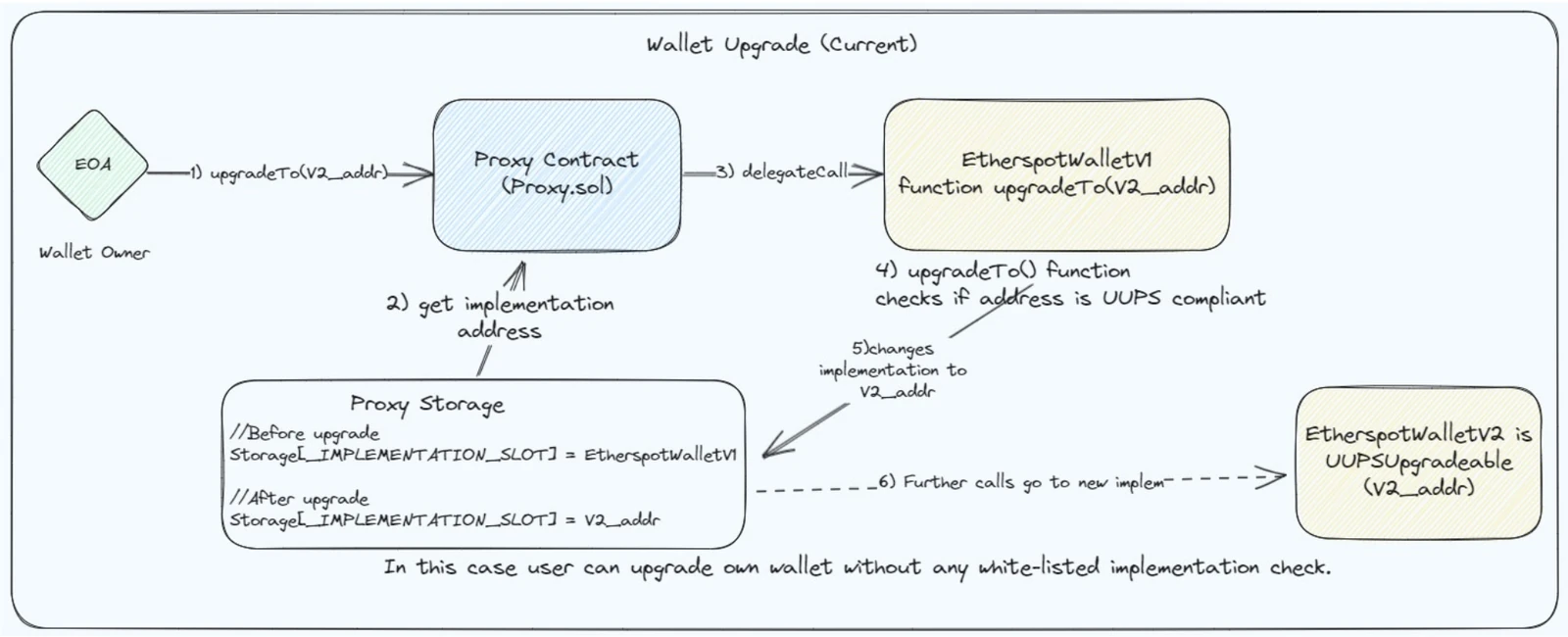
The EtherspotWalletFactory is in charge of creating a new instance of the Proxy. The proxy follows the EIP-1967 standard and its implementation slot points to the EtherspotWallet implementation contract. This design has the following advantages and disadvantages.

Pros:

  • This architecture is gas efficient as each new account only needs to deploy the minimal Proxy contract;
  • Upgrade of the implementation follows the Universal Upgradeable Proxy Standard (UUPS) EIP-1822.

Cons:

  • This architecture does not restrict the value of the updated implementation of the EtherspotWallet;
  • With the current pattern, the new wallets are always obliged to deploy with the first implementation (the immutable one), then upgrade to a new one;
  • The current EtherSpotWalletFactory contract cannot update the accountImplementation variable (currently set as immutable).
Current Wallet Upgrade
Fig. 2: Current Wallet Upgrade

The upgrade of EtherspotWallet is illustrated in Fig. 2. The process of upgrading the EtherspotWallet is currently done as follows:

a. User triggers an update of the implementation wallet calling upgradeTo(...) providing the address of the new EtherspotWallet implementation (V2_addr in the diagram).

b. Proxy contract retrieves the current EtherspotWallet implementation address into its storage slot.

c. Proxy contract forwards (delegatecall()) this call to the current EtherspotWallet implementation contract.

d. EtherspotWallet implementation follows the UUPS standard. The upgradeTo(...) function checks the new implementation (V2_addr) to be UUPS compliant.

e. If provided implementation address follows the UUPS standard, Proxy implementation slot is updated to the provided address (V2_addr).

f. Further calls to the Proxy are delegated to the new implementation address.

4.10.2 Suggested upgrade architecture

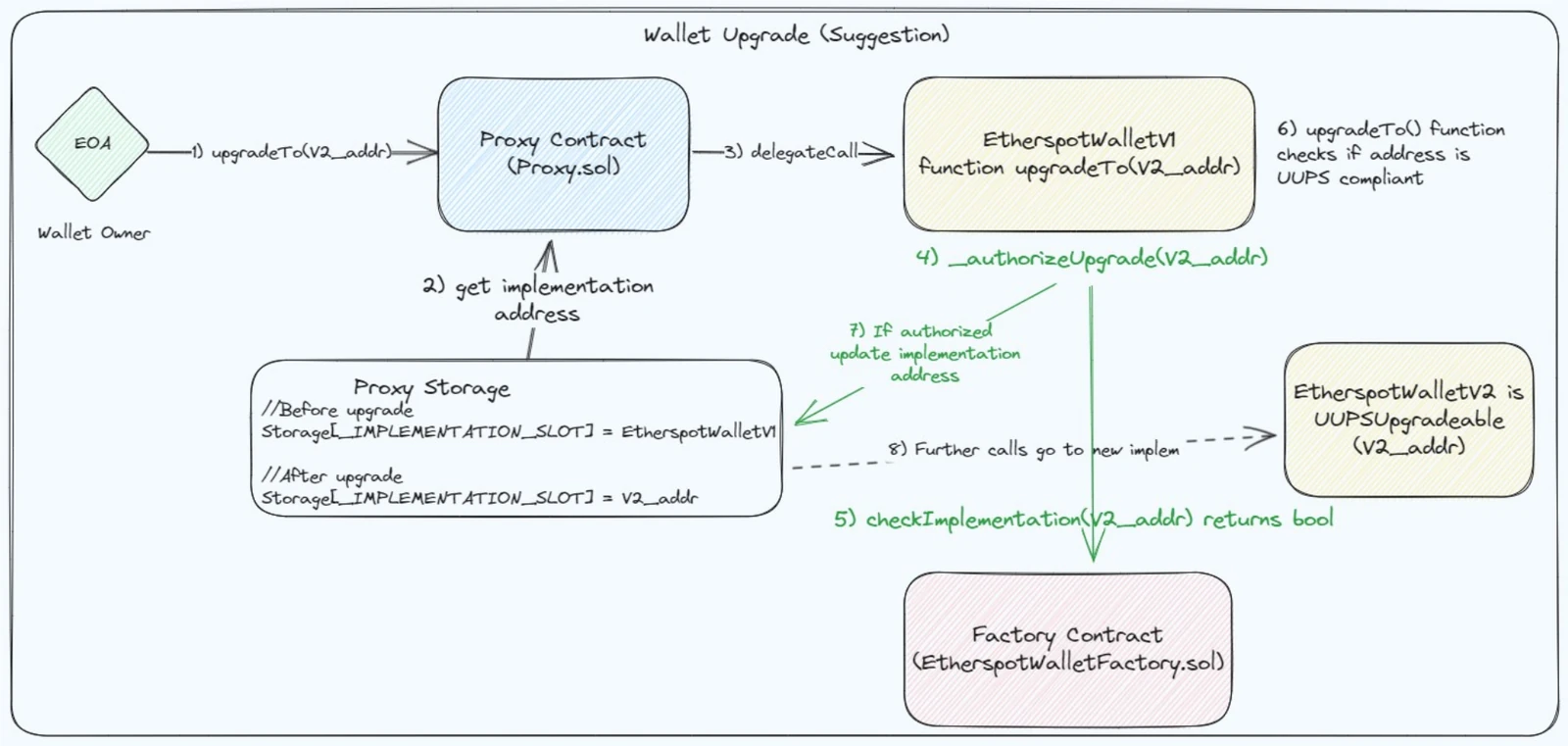
The current upgrading scheme of EtherspotWallet is well designed but needs a few improvements to limit updates to a restricted set of EtherspotWallet implementations. One constraint is that the user can only trigger the upgrade of the EtherspotWallet implementation. To restrict the upgrade of the EtherspotWallet to a set of contracts, the upgrade mechanism must query an external-and-trusted smart contract (EtherspotWalletFactory, in our case) before allowing the upgrade. The suggested process is illustrated in Fig. 3. The green text and green arrows represent the additional steps/actions that should be done to restrict the upgrade to a set of whitelisted EtherspotWallet implementation addresses. The suggested upgrade process of the EtherspotWallet would be as follows:

Suggested Wallet Upgrade
Fig. 2: Suggested Wallet Upgrade

1. User triggers an update of the implementation wallet calling upgradeTo(...) providing the address of the new EtherspotWallet implementation (V2_addr in the diagram).

2. Proxy contract retrieves the current EtherspotWallet implementation address from its storage slot.

3. Proxy contract forwards (delegatecall()) this call to the current EtherspotWallet implementation contract.

4. The UUPS standard provides the _authorizeUpgrade(...) function that can be overridden by the implementing contract (EtherspotWallet in our case) to add new checks before triggering the update. This can be used to restrict the provided implementation address.

5. The _authorizeUpgrade(...) would make an external call (checkImplementation(V2_addr)) to the EhterspotWalletFactory contract with the address provided by the Wallet’s owner. EtherspotWalletFactory contract would return a boolean, indicating that the provided contract address is whitelisted or not (returning respectively true or false).

6. If contract is authorized, The upgradeTo(...) function checks that the new implementation (V2_addr) is UUPS compliant.

7. Then, if provided implementation address follows the UUPS scheme, it is stored in the Proxy implementation slot.

8. Further calls to the Proxy are delegated to the new implementation address.

5

Risk Rating Methodology

The risk rating methodology used by Nethermind Security follows the principles established by the OWASP Foundation. The severity of each finding is determined by two factors: Likelihood and Impact.

Likelihood measures how likely the finding is to be uncovered and exploited by an attacker. This factor will be one of the following values:

  1. High: the issue is trivial to exploit and has no specific conditions that need to be met;
  2. Medium: the issue is moderately complex and may have some conditions that need to be met;
  3. Low: the issue is very complex and requires very specific conditions to be met.

When defining the likelihood of a finding, other factors are also considered. These can include but are not limited to motive, opportunity, exploit accessibility, ease of discovery, and ease of exploit.

Impact is a measure of the damage that may be caused if an attacker exploits the finding. This factor will be one of the following values:

  1. High: the issue can cause significant damage, such as loss of funds or the protocol entering an unrecoverable state;
  2. Medium: the issue can cause moderate damage, such as impacts that only affect a small group of users or only a particular part of the protocol;
  3. Low: the issue can cause little to no damage, such as bugs that are easily recoverable or cause unexpected interactions that cause minor inconveniences.

When defining the impact of a finding, other factors are also considered. These can include but are not limited to data and state integrity, loss of availability, financial loss, and reputation damage. After defining the likelihood and impact of an issue, the severity is determined according to the table below.

Impact / LikelihoodLowMediumHigh
HighMediumHighCritical
MediumLowMediumHigh
LowInfo / Best PracticesLowMedium
UndeterminedUndeterminedUndeterminedUndetermined

To address issues that do not fit a High, Medium or Low severity, Nethermind Security also uses three more finding severities: Informational, Best Practices, and Undetermined.

  1. Informational findings do not pose any risk to the application, but they carry some information that the audit team intends to pass to the client formally;
  2. Best Practice findings are used when some piece of code does not conform with smart contract development best practices;
  3. Undetermined findings are used when we cannot predict the impact or likelihood of the issue.

6

Issues

6.1 Guardians can cosign an old proposal

FileFix commitTypeStatus
AccessController.sol6779123MediumFixed

The guardianCosign(...) function in the AccessController contract allows guardians to co-sign a proposal. However, an inconsistency in the usage of proposal ID can lead to guardians co-signing old proposals that were discarded.

The function uses both the _proposalId input argument and the proposalId state variable in its logic. The _proposalId parameter is checked to be a valid ID. However, when checking whether a proposal is not resolved, and that quorum is reached, the function uses the proposalId state variable. This inconsistency can lead to unintended behavior. A guardian can co-sign a proposal that was discarded previously, adding the discarded proposal’s owner to the wallet and marking the latest proposal as resolved.

function guardianCosign(uint256 _proposalId) external onlyGuardian {
require(_proposalId <= proposalId, "ACL:: invalid proposal id");
require(
!_checkIfSigned(_proposalId),
"ACL:: guardian already signed proposal"
);
//////////////////////////////////////////////////////////////////////////////////////
// @audit: Checking if latest proposal is resolved, but _proposalId can be different
/////////////////////////////////////////////////////////////////////////////////////
require(
!proposals[proposalId].resolved,
"ACL:: proposal already resolved"
);
proposals[_proposalId].guardiansApproved.push(msg.sender);
proposals[_proposalId].approvalCount += 1;
address newOwner = proposals[_proposalId].newOwnerProposed;

///////////////////////////////////////////////////////////////////////////
// @audit: Resolving latest proposal based on quorum check of _proposalId
//////////////////////////////////////////////////////////////////////////
if (_checkQuorumReached(_proposalId)) {
proposals[proposalId].resolved = true;
_addOwner(newOwner);
} else {
emit QuorumNotReached(
_proposalId,
newOwner,
proposals[_proposalId].approvalCount
);
}
}

Recommendation

Remove the _proposalId parameter and exclusively use the proposalId state variable. Since the system is designed to have only one active proposal at a time (with ID stored in proposalId), there is no need for the parameter.

Resolution

Recommended fix applied. Can be found at the following commit https://github.com/etherspot/etherspot-primecontracts/commit/67791238b9025785c3a98051a24cb55a65f312b6.

6.2 Any guardian can remove owners from the Etherspot wallet

FileFix commitTypeStatus
src/access/AccessController.sol—MediumFixed

The removeOwner() function from the AccessController contract removes an owner from the wallet. This function has the onlyOwnerOrGuardian modifier, allowing any owner or guardian to call it. A malicious guardian can remove owners from the Etherspot wallet. The code is shown below.

modifier onlyOwnerOrGuardian() {
require(
isOwner(msg.sender) ||
msg.sender == address(this) ||
isGuardian(msg.sender),
"ACL:: only owner or guardian"
);
_;
}
/////////////////////////////////////////////////////////////////////////////////////
// @audit Guardian should not be able to delete an owner
/////////////////////////////////////////////////////////////////////////////////////
function removeOwner(address _owner) external onlyOwnerOrGuardian {
_removeOwner(_owner);
}

Recommendation

Consider restricting this action to only wallet owners.

Resolution

removeOwner() now uses onlyOwner modifier.

6.3 Improve the proposals’ voting design

FileFix commitTypeStatus
src/access/AccessController.sol—MediumFixed

Below, we describe two issues with the voting system design.

Proposal design does not account for disagree votes: The current implementation of the proposal’s vote doesn’t work when the consensus discards a proposal. That is because the contract doesn’t keep track of the guardians who disagree, and there is no way to vote against a proposal.

As an example, if there are 3 guardians, one agrees to a proposal and the last two don’t; The guardian who agrees can call the function guardianCosign() to make his vote, while the two other guardians who disagree don’t have a way to make their vote rather than just doing nothing. The owner (who can call the discardCurrentProposal(...) function) has no way to determine if most guardians disagree. If there is no available owner, the proposal could hang forever.

discardCurrentProposal can be abused: The discardCurrentPropsal() function has the modifier onlyOwnerOrGuardian. This modifier allows a malicious guardian to discard any proposal without waiting for its settlement.

function discardCurrentProposal() external onlyOwnerOrGuardian {
delete proposals[proposalId].newOwnerProposed;
delete proposals[proposalId].guardiansApproved;
delete proposals[proposalId].approvalCount;
proposals[proposalId].resolved = true;
emit ProposalDiscarded(proposalId);
}

Recommendation

The proposal design should a) account for disagreeing votes or b) implement expiration of the proposal after a specific duration. Additionally, Consider restricting access to the discardCurrentProposal(...) function to wallet owners.

Resolution

Added in a proposal timelock mechanism. This is set to 24 hours as a default but can be changed by the wallet owner. This will allow guardians to call discardCurrentProposal() and as long as the current timestamp is greater than the time at which the proposal was created (stored in the NewOwnerProposal struct) plus the proposal timelock period, it will allow guardians to remove proposals. The call will revert if it does not comply with these parameters.

Comments: I disagree with this example: "As an example, if there are 3 guardians, one agrees to a proposal and the last two don’t; The guardian who agrees can call the function guardianCosign() function to make his vote, while the two other guardians who disagree don’t have a way to make their vote rather than just doing nothing. The owner (who can call the discardCurrentProposal(...) function) has no way to figure out if the majority of the guardians disagree."

If there are 3 guardians, then this would be the scenario:

1. guardian1 make the proposal; 2. guardian2 and guardian3 don’t agree; 3. proposals require a 60% quorum to pass. Therefore the proposal does not pass;

The way for the owner to see if the majority of guardians agree is that the proposal passes. If the proposal does not pass (or achieve quorum), then it is self-evident that the majority of guardians don’t agree.

Update from Nethermind Security

The timelock mechanism addresses all issues. So, we agree with the client.

6.4 In case a post user operation reverts, _postOp(...) function totally refunds the sponsor

FileFix commitTypeStatus
src/paymaster/EtherspotPaymaster.sol—LowFixed

In the contract EtherspotPaymaster, the _postOp(...) function is in charge of handling the user operation after it has been executed, reverted, or reverted during post-operation itself. This function contains accounting logic to refund the sponsor if the prefundedAmount is too high. When the user operation succeeds but postOp() call is reverted, a second call to postOp() is done with PostOpMode.postOpReverted mode. The handling of this case totally refunds the sponsor, although the user operation has succeeded and consumed gas.

if (mode == PostOpMode.postOpReverted) {
/////////////////////////////////////////////////////////////////////////////////////
// @audit Should not fully refund sponsor. User operation has succeeded and consumed gas
/////////////////////////////////////////////////////////////////////////////////////
_creditSponsor(paymaster, prefundedAmount);
emit SponsorUnsuccessful(paymaster, sender);
} else {

Recommendation

Consider removing the current handling of PostOpMode.postOpReverted mode and exclusively refund unused gas to the sponsor (as currently done when the mode is different from PostOpMode.postOpReverted).

Resolution

Removed handling of PostOpMode.postOpReverted and now just refunds unused gas to the sponsor.

6.5 proposalId 0 can be cosigned by guardians without being proposed

FileFix commitTypeStatus
src/access/AccessController.sol—LowFixed

The proposalId 0 can be cosigned by any guardian. This can result in approving an invalid owner address (address(0)):

if (
proposals[proposalId].resolved == false
proposals[proposalId].guardiansApproved.length != 0 &&
) revert("ACL:: latest proposal not yet resolved");

The current check in the guardianCosign(...) function allows signing the current proposal but does not check that the proposalId if above 0.

function guardianCosign(uint256 _proposalId) external onlyGuardian {
require(_proposalId <= proposalId, "ACL:: invalid proposal id"); //@audit proposal id can be 0
require(!_checkIfSigned(_proposalId), "ACL:: guardian already signed proposal");

Recommendation

Consider checking that the _proposalId is above 0:

- require(_proposalId <= proposalId, "ACL:: invalid proposal id");
+ require(_proposalId > 0 && _proposalId <= proposalId, "ACL:: invalid proposal id");

Resolution

Fixed by adding the following check:

require(
_proposalId != 0 && _proposalId <= proposalId,
"ACL:: invalid proposal id"
);

6.6 Owners cannot remove themselves from the wallet

FileFix commitTypeStatus
src/access/AccessController.sol—InfoFixed

The current implementation of _removeOwner(...) function disallows an owner from removing himself, even if there are other owners in the wallet. The check of ownerCount is sufficient to ensure that the wallet is not ownerless.

function _removeOwner(address _owner) internal {
require(msg.sender != _owner, "ACL:: removing self"); //@audit an owner cannot remove himself from the wallet
require(owners[_owner], "ACL:: non-existent owner");
require(ownerCount > 1, "ACL:: wallet cannot be ownerless");
emit OwnerRemoved(_owner);
owners[_owner] = false;
ownerCount = ownerCount - 1;
}

Recommendation

If this is not an intended behavior, consider removing the check to allow an owner to remove himself from a wallet if he is not the only owner.

Resolution

Check for owner removing themselves has been removed.

6.7 Proposals history/traceability is not accessible from the smart contract storage

FileFix commitTypeStatus
src/access/AccessController.sol—InfoFixed

When a proposal is discarded, the struct fields are deleted from the storage of the smart contract. However, this approach lacks traceability and makes it challenging to investigate historical data in case of incidents. Additionally, the resolved field does not give clear information if a proposal was discarded or passed through a quorum.

function discardCurrentProposal() external onlyOwnerOrGuardian {
/////////////////////////////////////////////////////////////////////////////////////
// @audit Proposal fields are deleted from the storage
/////////////////////////////////////////////////////////////////////////////////////
delete proposals[proposalId].newOwnerProposed;
delete proposals[proposalId].guardiansApproved;
delete proposals[proposalId].approvalCount;
proposals[proposalId].resolved = true;
emit ProposalDiscarded(proposalId);
}
struct NewOwnerProposal {
address newOwnerProposed;
uint256 approvalCount;
address[] guardiansApproved;
bool resolved;
}

Recommendation

To improve traceability, consider not deleting the proposal fields when it is discarded. Moreover, adding a field that denotes the type of proposal settlement (discarded or passed) is recommended.

Resolution

When discarding proposals, the data contained in the proposal is no longer deleted.

6.8 Removed guardian’s signature in the latest proposal remains valid

FileFix commitTypeStatus
src/access/AccessController.sol—InfoAcknowledged

If a guardian creates a new proposal or co-signs an existing one and is removed afterward for his malicious behavior, his proposal/ signature will still be considered in the latest proposal.

function removeGuardian(address _guardian) external onlyOwner {
_removeGuardian(_guardian);
}

Recommendation

Consider discarding the current proposal when removing one of the guardians.

Resolution

We are happy with this approach as it would still require a quorum of 60% of total guardians to pass, so even if there is one bad actor, it would require multiple votes to pass the proposal.

6.9 Resolved proposals can be discarded afterward

FileFix commitTypeStatus
src/access/AccessController.sol—InfoFixed

The discardCurrentProposal() function does not check that the current proposal is resolved before discarding it. Once a proposal is resolved, discarding it should not be possible.

function discardCurrentProposal() external onlyOwnerOrGuardian {
/////////////////////////////////////////////////////////////////////////////////////
// @audit Check that the proposal is not already resolved
/////////////////////////////////////////////////////////////////////////////////////
delete proposals[proposalId].newOwnerProposed;
delete proposals[proposalId].guardiansApproved;
delete proposals[proposalId].approvalCount;
proposals[proposalId].resolved = true;
emit ProposalDiscarded(proposalId);
}

Recommendation

Before discarding a proposal, consider checking that the proposal is not already resolved.

Resolution

The function discardCurrentProposal() now checks to see if the proposal has been resolved and the function will revert if it has.

6.10 Unnecessary inheritance in Whitelist.sol

FileFix commitTypeStatus
src/paymaster/Whitelist.sol—InfoFixed

The Whitelist contract is inheriting from Ownable library while it does not have any owner-specific operations. The code snippet is shown below.

import "@openzeppelin/contracts/access/Ownable.sol";
contract Whitelist is Ownable {...}

Recommendation

Revisit the usage of Ownable library in the contract and consider removing the inheritance if it is not intended to be used.

Resolution

Removed Openzeppelin Ownable contract import.

6.11 Unused variables in EtherspotWallet.sol

FileFix commitTypeStatus
src/wallet/EtherspotWallet.sol—InfoFixed

Both magicValue and validationData variables are not respectively used in the functions isValidSignature(...) and _validateSignature(...). The code snippet is reproduced below.

function isValidSignature(
bytes32 hash,
bytes calldata signature
) external view returns (bytes4 magicValue) {
address owner = ECDSA.recover(hash, signature);
if (isOwner(owner)) {
return ERC1271_SUCCESS;
}
return bytes4(0xffffffff);
}
function _validateSignature(
UserOperation calldata userOp,
bytes32 userOpHash
) internal virtual override returns (uint256 validationData) {
bytes32 hash = userOpHash.toEthSignedMessageHash();
if (!isOwner(hash.recover(userOp.signature)))
return SIG_VALIDATION_FAILED;
return 0;
}

Recommendation

Remove unused variables from the returns signatures.

Resolution

Removed magicValue and validationData return variables.

6.12 EntryPoint address should be immutable in EtherspotWallet contract

FileFix commitTypeStatus
src/wallet/EtherspotWallet.sol—InfoFixed

According to the EIP-4337 standard, EntryPoint address contained in EtherspotWallet contract is expected to be hardcoded.

This component is a highly sensitive point of trust in the EIP-4337 architecture. There should be only one entry point deployed per chain.

If a new entry point is deployed, users should update to a new version of the EtherspotWallet that would point to it. However, in the current implementation of the EtherspotWallet, the wallet owner can update the entry point address.

modifier onlyOwner() {
require(
isOwner(msg.sender) || msg.sender == address(this),
"ACL:: only owner"
);
_;
}
/////////////////////////////////////////////////////////////////////////////////////
// @audit Owners should not be allowed to update the EntryPoint contract address
/////////////////////////////////////////////////////////////////////////////////////
function updateEntryPoint(address _newEntryPoint) external onlyOwner {
require( _newEntryPoint != address(0), "EtherspotWallet:: EntryPoint address cannot be zero" );
emit EntryPointChanged(address(_entryPoint), _newEntryPoint);
_entryPoint = IEntryPoint(payable(_newEntryPoint));
}

Recommendation

Consider declaring _entryPoint variable as immutable and initialize its value within the constructor.

Resolution

Passing _entryPoint variable value in on implementation contract construction. Removed any ability to update this variable and the only way to do so is for a new implementation contract to be deployed and a user upgrade to that new implementation.

6.13 EtherspotWallet can be initialized with an invalid EntryPoint contract address

FileFix commitTypeStatus
src/wallet/EtherspotWallet.sol—InfoFixed

EtherspotWallet contract takes the EntryPoint contract address as a parameter during initialization. However, it does not perform a zero address check before assigning it.

function _initialize(
address anEntryPoint,
address anOwner
) internal virtual {
//////////////////////////////////////////////////////////////////
// @audit: `anEntryPoint` can be address(0)
//////////////////////////////////////////////////////////////////
_entryPoint = anEntryPoint;
_addOwner(anOwner);
emit EtherspotWalletInitialized(_entryPoint, anOwner);
}

Recommendation

Ensure that anEntryPoint is valid and not address(0).

Resolution

EntryPoint contract address is no longer passed in on initialization. Address checks provided for both EntryPoiny and WalletFactory (which is now passed in to provide callback to validate implementation).

6.14 QuorumNotReached event has an incorrect parameter name

FileFix commitTypeStatus
src/access/AccessController.sol—InfoFixed

The guardiansApproved field in the NewOwnerProposal structure is an array of addresses. However, the guardiansApproved parameter in the QuorumNotReached event is declared uint256 and represents the approval count. Using the same name within the structure and the event can be confusing. The code snippet is reproduced below.

struct NewOwnerProposal {
address newOwnerProposed;
uint256 approvalCount;
address[] guardiansApproved;
bool resolved;
};
event QuorumNotReached(
uint256 proposalId,
address newOwnerProposed,
uint256 guardiansApproved
);

Recommendation

Consider changing the parameter name.

Resolution

Renamed guardiansApproved in QuorumNotReached event to approvalCount.

6.15 onlyOwner modifier name represents incorrect logic

FileFix commitTypeStatus
src/access/AccessController.sol—Best PracticesAcknowledged

The contract has three modifiers: onlyOwnerOrEntryPoint, onlyOwnerOrGuardian, and onlyOwner. The onlyOwner and onlyOwnerOrGuardian modifiers return true when the caller is address(this). However, onlyOwnerOrEntryPoint returns false in that case which can lead to confusion.

Recommendation

Consider changing the modifier name to make it more explicit.

Resolution

We have decided to keep this as is, as this reflects the current implementation in Infintism’s codebase.

6.16 Apply Checks-Effects-Interactions pattern

FileFix commitTypeStatus
src/paymaster/EtherspotPaymaster.sol—Best PracticesFixed

The function depositFunds(...) violates the Checks Effects Interactions pattern as it makes an external call to entryPoint, followed by a state update of the sponsor funds (in _creditSponsor() function). The code is reproduced below.

function depositFunds() external payable nonReentrant {
entryPoint.depositTo{value: msg.value}(address(this));
_creditSponsor(msg.sender, msg.value);
}

Recommendation

Apply the Checks-Effects-Interactions pattern by placing the state update before the external call.

function depositFunds() external payable nonReentrant {
+ _creditSponsor(msg.sender, msg.value);
entryPoint.depositTo{value: msg.value}(address(this));
- _creditSponsor(msg.sender, msg.value);
}

Resolution

Applied Checks-Effects-Interactions pattern.

6.17 Contract Whitelist does not use IWhitelist.sol

FileFix commitTypeStatus
src/paymaster/Whitelist.sol—Best PracticesFixed

The contract Whitelist.sol does not import the interface IWhitelist.sol, resulting in not using its functionalities. Additionally, some functions and events are declared in the interface but are not used in the contract.

/////////////////////////////////////////////////////////////
// @audit Whitelist.sol is not using its interface
/////////////////////////////////////////////////////////////
import "@openzeppelin/contracts/access/Ownable.sol";

contract Whitelist is Ownable {...}

Recommendation

To avoid duplicated code, consider importing IWhitelist.sol interface in Whitelist.sol contract and remove unused events or functions from the interface declaration.

Resolution

Imported IWhitelist.sol interface in Whitelist.sol. Removed unused events.

6.18 Functions that can have external visibility

FileFix commitTypeStatus
src/wallet/EtherspotWallet.sol
src/wallet/EtherspotWalletFactory.sol
—Best PracticesFixed

The following functions have public visibility instead of external. External functions and public functions are both used to allow external access to contract functions. However, there are some key differences between them. External functions are more gas-efficient compared to public functions. Moreover, external functions can only be called from outside the contract. This restriction can enhance security by preventing potential reentrancy attacks and unintended recursive calls that can be exploited to manipulate the contract state. Finally, using external functions improves the readability of the code. The functions that can be made external are listed below.

- EtherspotWalletFactory.createAccount(...)
- EtherspotWallet.withdrawDepositTo(...)

Recommendation

Set these functions’ visibility as external.

Resolution

Set visibility of EtherspotWalletFactory.createAccount(...) and EtherspotWallet.withdrawDepositTo(...) to external.

6.19 Interface and implementation are not matching in EtherspotWallet.sol

FileFix commitTypeStatus
src/wallet/EtherspotWallet.sol—Best PracticesFixed

The contract EtherspotWallet.sol does not import the interface IEtherspotWallet.sol. The interface defines 5 events, while the contract only defines 3 events. The code snippets are shown below.

/////////////////////////////////////////////////////////////
// @audit Interface "IEtherspotWallet" defines 5 events
/////////////////////////////////////////////////////////////
event EtherspotWalletInitialized(
IEntryPoint indexed entryPoint,
address indexed owner
);
event EtherspotWalletReceived(address indexed from, uint256 indexed amount);
event EntryPointChanged(address oldEntryPoint, address newEntryPoint);
event OwnerAdded(address newOwner, uint256 blockFrom);
event OwnerRemoved(address removedOwner, uint256 blockFrom);
/////////////////////////////////////////////////////////////
// @audit Contract "EtherspotWallet" defines only three events
/////////////////////////////////////////////////////////////

event EtherspotWalletInitialized(
IEntryPoint indexed entryPoint,
address indexed owner
);
event EtherspotWalletReceived(address indexed from, uint256 indexed amount);
event EntryPointChanged(address oldEntryPoint, address newEntryPoint);

/////////////////////////////////////////////////////////////
// @audit Contract is not IEtherspotWallet
/////////////////////////////////////////////////////////////
contract EtherspotWallet is
BaseAccount,
UUPSUpgradeable,
Initializable,
TokenCallbackHandler,
AccessController,
IERC1271Wallet
{...}

Recommendation

Remove contradictions between the interface and the contract.

Resolution

Removed unused/unnecessary events.

6.20 Remove unused UniversalSignatureValidator contract from the codebase

FileFix commitTypeStatus
src/helpers/UniversalSignatureValidator.sol—Best PracticesAcknowledged

The UniversalSignatureValidator contract is not used anywhere in the codebase of the Etherspot Wallet project. It seems to be a remainder from a previous version.

Recommendation

Remove unused contracts from the codebase.

Resolution

We have decided to keep this contract in the repo as it will be used at some point in the future.

6.21 Unclear function names in the Whitelist Contract

FileFix commitTypeStatus
src/paymaster/Whitelist.sol—Best PracticesFixed

The current function names in the Whitelist contract are unclear in conveying that they relate to whitelist functionalities. The functions add(...), addBatch(...), remove(...), and removeBatch(...) perform operations on the whitelist, but their names do not explicitly indicate this. These functions’ names should be more specific, as the Whitelist contract will be inherited and exposed by the EtherspotPaymaster contract.

Recommendation

To improve clarity, it is suggested to rename the functions to reflect better their purpose related to the whitelist, e.g., addToWhitelist(...), addBatchToWhitelist(...), removeFromWhitelist(...), removeBatchFromWhitelist(...).

Resolution

Amended function names to addToWhitelist(...), addBatchToWhitelist(...), removeFromWhitelist(...), removeBatchFromWhitelist(...).

6.22 Unnecessary usage of input parameter

FileFix commitTypeStatus
src/paymaster/EtherspotPaymaster.sol—Best PracticesFixed

The function withdrawFunds(...) takes address payable _sponsor as an input. However, it checks the funds and performs the withdrawal of msg.sender as he/she is the only one allowed to withdraw his/hers funds. The input is only checked to equal the msg.sender variable. The withdrawal can be exclusively based on the msg.sender variable instead of using the _sponsor parameter. The code snippet is shown below.

function withdrawFunds(
address payable _sponsor,
uint256 _amount
) external nonReentrant {
/////////////////////////////////////////////////////////////
// @audit _sponsor parameter is unnecessary
/////////////////////////////////////////////////////////////
require(
msg.sender == _sponsor,
"EtherspotPaymaster:: can only withdraw own funds"
);
require(
checkSponsorFunds(_sponsor) >= _amount,
"EtherspotPaymaster:: not enough deposited funds"
);
_debitSponsor(_sponsor, _amount);
entryPoint.withdrawTo(_sponsor, _amount);
}

Recommendation

Consider removing the _sponsor parameter and using the msg.sender transaction variable.

Resolution

Removed _sponsor function parameter in favour of using msg.sender.

6.23 Unused WhitelistInitialized event in Whitelist.sol

FileFix commitTypeStatus
src/paymaster/Whitelist.sol—Best PracticesFixed

WhitelistInitialized event in Whitelist.sol is never emitted.

/////////////////////////////////////////////////////////////
// @audit Event not used
/////////////////////////////////////////////////////////////
event WhitelistInitialized(address owner);

Recommendation

Check if you need the event. In case you don’t need it, remove any unused event declarations.

Resolution

Removed.

6.24 NewOwnerProposal struct is not reordered to consume less gas

FileFix commitTypeStatus
src/access/AccessController.sol—Best PracticesFixed

The struct NewOwnerProposal can be reordered to fit fewer slots. This reordering saves gas when storing new structure data in the smart contract storage.

////////////////////////////////////////////////////////////////////////////////////////////////////
// @audit: Struct order can be changed to (address, bool, uint256, address[]) to fit in 1 slot less.
////////////////////////////////////////////////////////////////////////////////////////////////////
struct NewOwnerProposal {
address newOwnerProposed;
uint256 approvalCount;
address[] guardiansApproved;
bool resolved;
}

Recommendation

Reorder struct properties like following.

struct NewOwnerProposal {
address newOwnerProposed;
+ bool resolved;
uint256 approvalCount;
address[] guardiansApproved;
- bool resolved;
}

Resolution

Rearranged variables instruction to:

struct NewOwnerProposal {
address newOwnerProposed;
bool resolved;
uint256 approvalCount;
address[] guardiansApproved;
}

6.25 accountImplementation cannot be updated

FileFix commitTypeStatus
src/wallet/EtherspotWalletFactory.sol—Best PracticesFixed

The accountImplementation variable stores the implementation address used to deploy new wallets. This variable is declared immutable in EtherspotWalletFactory.sol. It cannot be updated to set newer implementations.

contract EtherspotWalletFactory {
////////////////////////////////////////////////////////////
// @audit: accountImplementation cannot be updated
///////////////////////////////////////////////////////////
address public immutable accountImplementation;

constructor() {
accountImplementation = address(new EtherspotWallet());
}

Recommendation

Consider removing the immutable attribute to the accountImplementation variable and adding accessors functions to update it.

Resolution

Removed immutable keyword and added function for updating accountImplementation.

6.26 checkSponsorFunds name is confusing

FileFix commitTypeStatus
src/paymaster/EtherspotPaymaster.sol—Best PracticesFixed

The function checkSponsorFunds(...) within the EtherspotPaymaster.sol contract is a getter for the mapping sponsorFunds and does not check any specific condition. The current name can lead to misunderstandings.

Recommendation

Consider renaming the function to a more descriptive name that accurately reflects its role.

Resolution

Renamed mapping from sponsorFunds to _sponsorBalances. Renamed checkSponsorFunds() to getSponsorBalance().

7

Documentation Evaluation

Software documentation refers to the written or visual information that describes the functionality, architecture, design, and implementation of software. It provides a comprehensive overview of the software system and helps users, developers, and stakeholders understand how the software works, how to use it, and how to maintain it. Software documentation can take different forms, such as user manuals, system manuals, technical specifications, requirements documents, design documents, and code comments. Software documentation is critical in software development, enabling effective communication between developers, testers, users, and other stakeholders. It helps to ensure that everyone involved in the development process has a shared understanding of the software system and its functionality. Moreover, software documentation can improve software maintenance by providing a clear and complete understanding of the software system, making it easier for developers to maintain, modify, and update the software over time. Smart contracts can use various types of software documentation. Some of the most common types include:

  • Technical whitepaper: A technical whitepaper is a comprehensive document describing the smart contract’s design and technical details. It includes information about the purpose of the contract, its architecture, its components, and how they interact with each other;
  • User manual: A user manual is a document that provides information about how to use the smart contract. It includes step-by-step instructions on how to perform various tasks and explains the different features and functionalities of the contract;
  • Code documentation: Code documentation is a document that provides details about the code of the smart contract. It includes information about the functions, variables, and classes used in the code, as well as explanations of how they work;
  • API documentation: API documentation is a document that provides information about the API (Application Programming Interface) of the smart contract. It includes details about the methods, parameters, and responses that can be used to interact with the contract;
  • Testing documentation: Testing documentation is a document that provides information about how the smart contract was tested. It includes details about the test cases that were used, the results of the tests, and any issues that were identified during testing;
  • Audit documentation: Audit documentation includes reports, notes, and other materials related to the security audit of the smart contract. This type of documentation is critical in ensuring that the smart contract is secure and free from vulnerabilities.

These types of documentation are essential for smart contract development and maintenance. They help ensure that the contract is properly designed, implemented, and tested, and they provide a reference for developers who need to modify or maintain the contract in the future.

8

Remarks & Test Suite

The documentation of the EtherSpot Wallet is presented in inline comments over the code, and also in the folder docs. The folder presents documentation for the Access Controller, EtherSpot Paymaster, EtherSpot Wallet, and WhiteList.

9.1 Contracts Compilation

9.3 Code Coverage

The relevant output is presented below.

Test suite
81Tests passed0Failed

The complete test output is in the full report.

As auditors, we recommend that any changes or updates made to the audited codebase undergo a re-audit or security review to address potential vulnerabilities or risks introduced by the modifications. By conducting a re-audit or security review of the modified codebase, you can significantly enhance the overall security of your system and reduce the likelihood of exploitation. However, we do not possess the authority or right to impose obligations or restrictions on our clients regarding codebase updates, modifications, or subsequent audits. Accordingly, the decision to seek a re-audit or security review lies solely with you.

This report is based on the scope of materials and documentation provided by you to Nethermind in order that Nethermind could conduct the security review outlined in 1. Executive Summary and 2. Audited Files. The results set out in this report may not be complete nor inclusive of all vulnerabilities. Nethermind has provided the review and this report on an as-is, where-is, and as-available basis. You agree that your access and/or use, including but not limited to any associated services, products, protocols, platforms, content, and materials, will be at your sole risk. Blockchain technology remains under development and is subject to unknown risks and flaws. The review does not extend to the compiler layer, or any other areas beyond the programming language, or other programming aspects that could present security risks. This report does not indicate the endorsement of any particular project or team, nor guarantee its security. No third party should rely on this report in any way, including for the purpose of making any decisions to buy or sell a product, service or any other asset. To the fullest extent permitted by law, Nethermind disclaims any liability in connection with this report, its content, and any related services and products and your use thereof, including, without limitation, the implied warranties of merchantability, fitness for a particular purpose, and non-infringement. Nethermind does not warrant, endorse, guarantee, or assume responsibility for any product or service advertised or offered by a third party through the product, any open source or third-party software, code, libraries, materials, or information linked to, called by, referenced by or accessible through the report, its content, and the related services and products, any hyperlinked websites, any websites or mobile applications appearing on any advertising, and Nethermind will not be a party to or in any way be responsible for monitoring any transaction between you and any third-party providers of products or services. As with the purchase or use of a product or service through any medium or in any environment, you should use your best judgment and exercise caution where appropriate. FOR AVOIDANCE OF DOUBT, THE REPORT, ITS CONTENT, ACCESS, AND/OR USAGE THEREOF, INCLUDING ANY ASSOCIATED SERVICES OR MATERIALS, SHALL NOT BE CONSIDERED OR RELIED UPON AS ANY FORM OF FINANCIAL, INVESTMENT, TAX, LEGAL, REGULATORY, OR OTHER ADVICE.