Download audit report
This document presents the security review conducted by Nethermind for the ClayStack ETH Staking Contracts. ClayStack is a platform that enables ETH staking on the Ethereum blockchain. It allows users to participate in the staking process by delegating their stake to validators on the Ethereum Beacon chain. This staking process involves users locking up their ETH in exchange for a token called csETH. This csETH token represents their staked amount and is minted on the Ethereum network. The validator pool on ClayStack is managed by the platform, and those who operate and manage the validators are rewarded for their efforts. These operators can either be direct nodes or operators using a DVT based approach. In the audited version of ClayStack, validators are trusted/controlled entities that are not likely to be malicious.
When users want to unstake their ETH, they burn the csETH tokens they received during the staking process. Unstaking involves waiting for an unbonding period before the users can claim their unstaked ETH. This period is likely a security measure to ensure that the network remains stable even if a large number of users decide to unstake their funds simultaneously. To optimize gas costs and efficiency, ClayStack employs a batching process. This means that users’ staking and unstaking actions are aggregated and processed in batches, aiming to reduce the overall gas fees associated with Ethereum transactions. Furthermore, the staking and unstaking process is netted, meaning that the deposits made by users who are staking can cover the withdrawal requests from users who are unstaking.
The audit was performed using (a) manual analysis of the codebase, (b) automated analysis tools and (c) simulation of the smart contract.
| Audit assessment | |
| Audit Type | Security Review |
| Initial Report | Aug. 24, 2023 |
| Response from Client | Aug. 29, 2023 |
| Final Report | Sep. 04, 2023 |
| Methods | Manual Review, Automated Analysis |
| Repository | claystack-ethereum |
| Commit Hash (Audit) | cc2659a3e8 |
| Documentation | README |
| Documentation Assessment | Medium |
| Test Suite Assessment | High |
Findings by severity
| # | Contract | LoC | Comments | Ratio | Blank | Total |
| 1 | ClayMain.sol | 537 | 162 | 30.2% | 142 | 841 |
| 2 | CsToken.sol | 23 | 23 | 100.0% | 7 | 53 |
| 3 | NodeManager.sol | 301 | 114 | 37.9% | 83 | 498 |
| 4 | RoleManager.sol | 47 | 41 | 87.2% | 12 | 100 |
| 5 | TimeLock.sol | 10 | 12 | 120.0% | 3 | 25 |
| 6 | deposits/DepositsManager.sol | 176 | 70 | 39.8% | 44 | 290 |
| 7 | deposits/interfaces/IDepositsManager.sol | 41 | 32 | 78.0% | 7 | 80 |
| 8 | deposits/interfaces/IrETH.sol | 13 | 1 | 7.7% | 10 | 24 |
| 9 | deposits/interfaces/IStETH.sol | 7 | 1 | 14.3% | 4 | 12 |
| 10 | deposits/interfaces/IStrategy.sol | 20 | 11 | 55.0% | 9 | 40 |
| 11 | deposits/interfaces/IWithdrawalQueueERC721.sol | 41 | 51 | 124.4% | 9 | 101 |
| 12 | deposits/interfaces/IWstETH.sol | 10 | 38 | 380.0% | 7 | 55 |
| 13 | deposits/interfaces/IWToken.sol | 6 | 2 | 33.3% | 3 | 11 |
| 14 | deposits/strategies/StrategyRETH.sol | 80 | 33 | 41.2% | 23 | 136 |
| 15 | deposits/strategies/StrategyStETH.sol | 128 | 52 | 40.6% | 36 | 216 |
| 16 | interfaces/IClayMain.sol | 81 | 79 | 97.5% | 33 | 193 |
| 17 | interfaces/ICSToken.sol | 8 | 6 | 75.0% | 5 | 19 |
| 18 | interfaces/IDepositContract.sol | 12 | 15 | 125.0% | 4 | 31 |
| 19 | interfaces/INodeManager.sol | 39 | 43 | 110.3% | 13 | 95 |
| 20 | interfaces/IRoleManager.sol | 4 | 2 | 50.0% | 1 | 7 |
| Total | 1584 | 788 | 49.7% | 455 | 2827 |
The audit covers the following smart contracts and interfaces:
ClayMain.sol & interfaces/IClayMain.solCsToken.sol & interfaces/ICSToken.solNodeManager.sol & interfaces/INodeManager.solRoleManager.sol & interfaces/IRoleManager.sol − TimeLock.sol
− interfaces/IDepositContract.soldeposits/DepositsManager.sol & deposits/interfaces/IDepositsManager.soldeposits/strategies/StrategyRETH.sol & deposits/interfaces/IrETH.soldeposits/strategies/StrategyStETH.sol & deposits/interfaces/IStETH.sol − deposits/interfaces/IStrategy.sol
− deposits/interfaces/IWithdrawQueueERC721.sol
− deposits/interfaces/IWstETH.sol
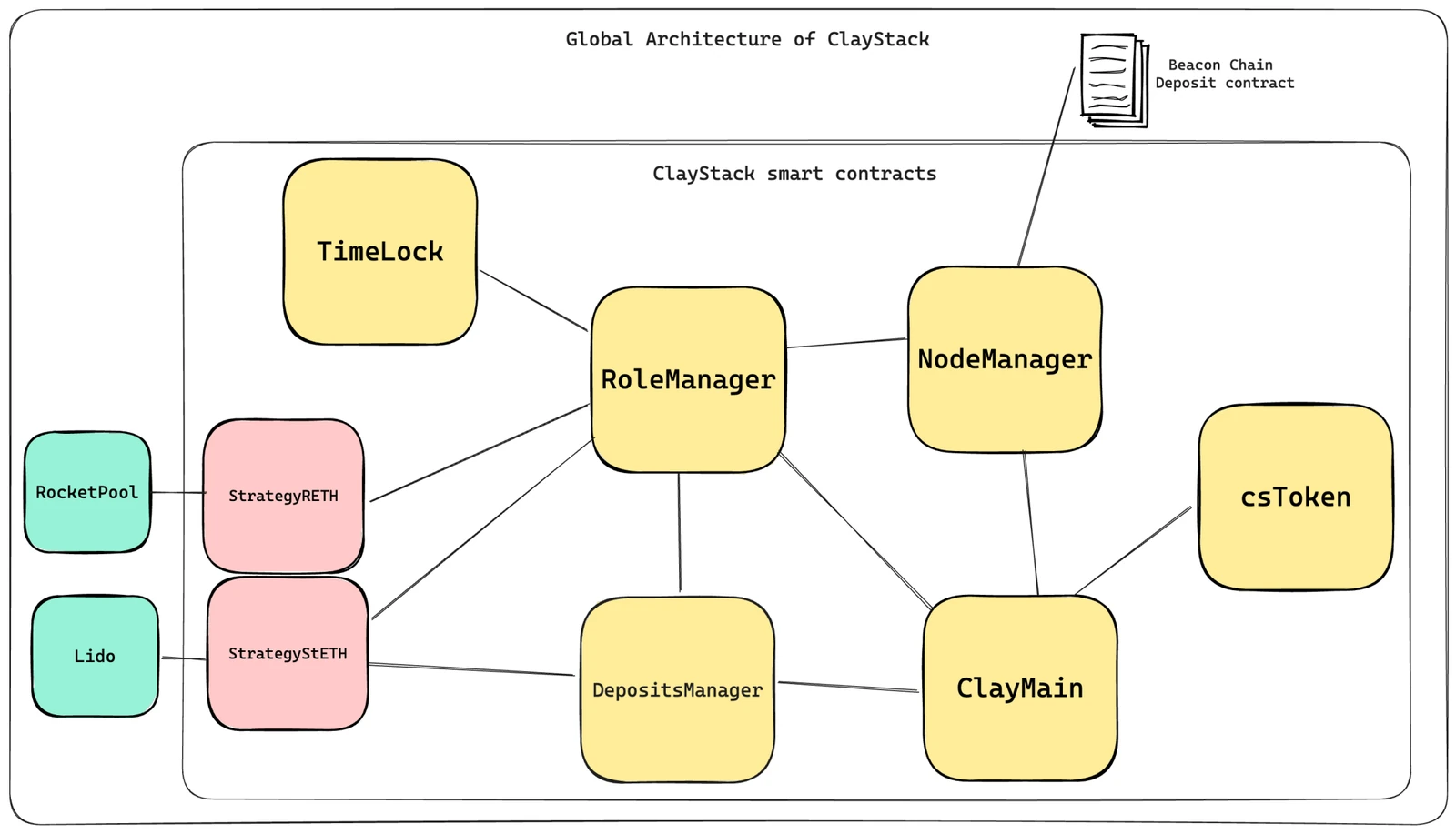
− deposits/interfaces/IWToken.solThe following schema (Fig. 2) shows a high-level overview of the relationship between contracts in the ClayStack protocol:

ClayMain.solThe ClayMain contract serves as the main entry point for users to interact with the ClayStack protocol. It provides users with the following features:
These features are based on other external functions, such as:
To begin stacking ETH with ClayStack, the user must first call the deposit() function. In exchange, the user will receive csETH tokens. When the protocol is deployed, one ETH will be exchanged for one csETH. Over time, as rewards are gained through validators, the value of csETH tokens will be compared to that of ETH. The exchange rate between ETH and csETH can be retrieved by calling the getExchangeRate() function.
When users want to withdraw, they will need to deposit csETH to the contract and create a claim order that will track the amount and time to claim. During this period, penalties are still applied to users, and only after the unbonding process, users are able to claim their ETH.
CsToken.solThe CsToken contract is responsible for tracking user shares. It inherites from OpenZeppelin’s ERC20 and implements custom minting and burning functions. Both functions are only callable from the ClayMain contract.
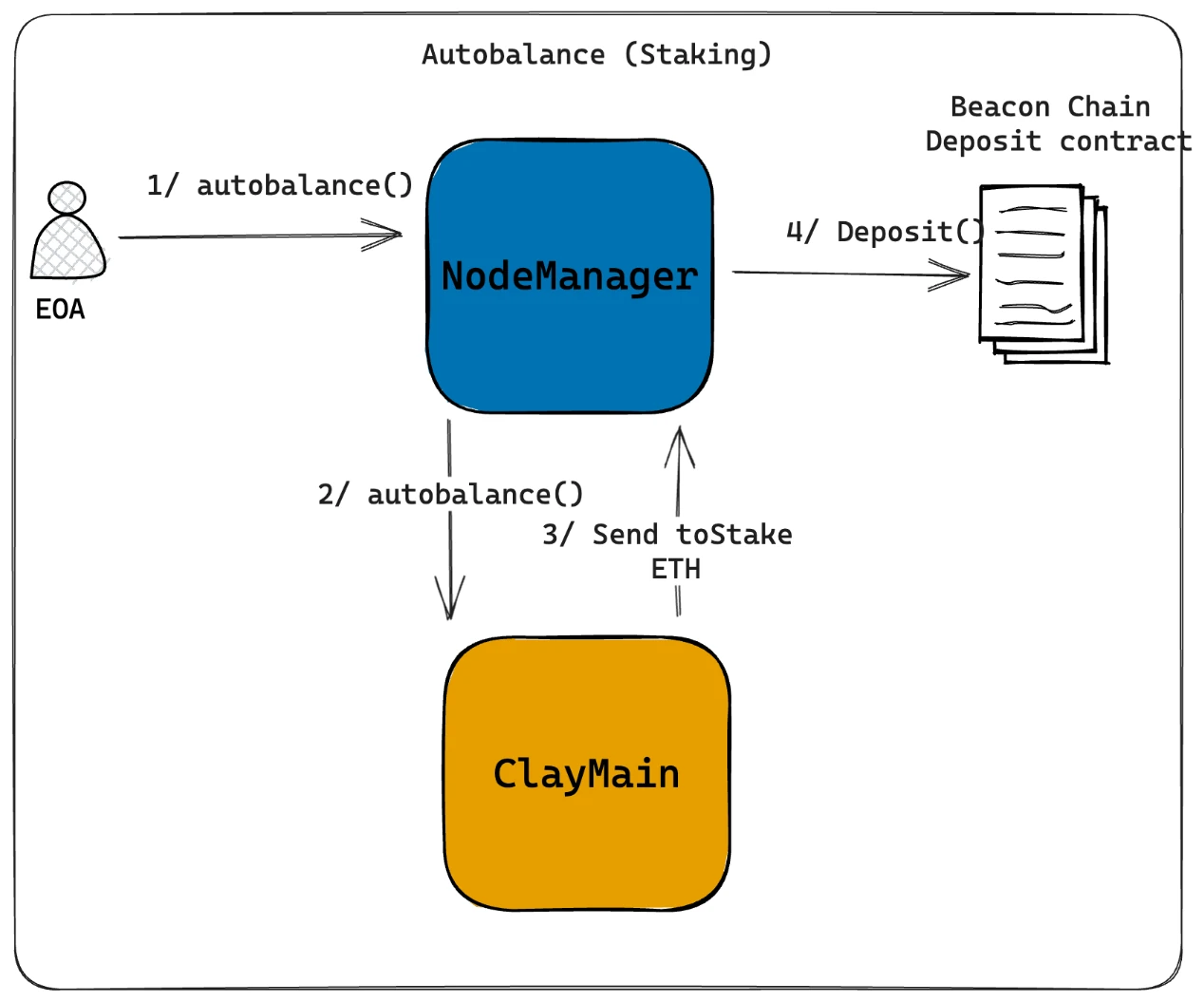
NodeManager.solThe NodeManager component is in charge of managing the deposit and withdrawal from ClayMain contract. Deposits are done to the Beacon Chain Deposit Contract. This contract is in charge of managing the registration and the exit of validators. It is also in charge of integrating the data from Oracle reports into the ClayStack protocol. The NodeManager component is heavily linked to the ClayMain contract.
Fig. 3 illustrates how a new validator registration happens:
1. Autobalance function is called on the NodeManager contract
2. NodeManager calls the Autobalance function on the ClayMain contract
3. ClayMain sends necessary ETH to be deposited to the Beacon Chain
4. NodeManager deposits the ETH to the BeaconChain Deposit Contract

RoleManager.solThe RoleManager contract is responsible for managing access control within the system to prevent unauthorized access to critical functions. It encompasses various roles, such as:
CS_SERVICE_ROLE is the role that can change the settings of the contracts including pausing and unpausing.TIMELOCK_ROLE is the role that can grant and revoke roles.TIMELOCK_UPGRADES_ROLE is the role that can upgrade the contracts.Timelock.solThe TimeLock contract serves as protection for users against critical changes in the system settings. It inherits from the TimelockController contract of OpenZeppelin and initializes all important parameters in its constructor. Any critical changes in settings or contract upgrades in ClayStack protocol must go through this contract. It provides users with a reasonable period of time to review the action and respond to it.
DepositsManager.solThe DepositsManager contract assists users in migrating from one Liquidity Staking Protocol to ClayStack. A strategy is defined for each Liquid Staking protocol, with two strategies currently implemented:
StrategyRETH)StrategyStETH)Each strategy exposes multiple functions, the main ones are claim() and withdraw().
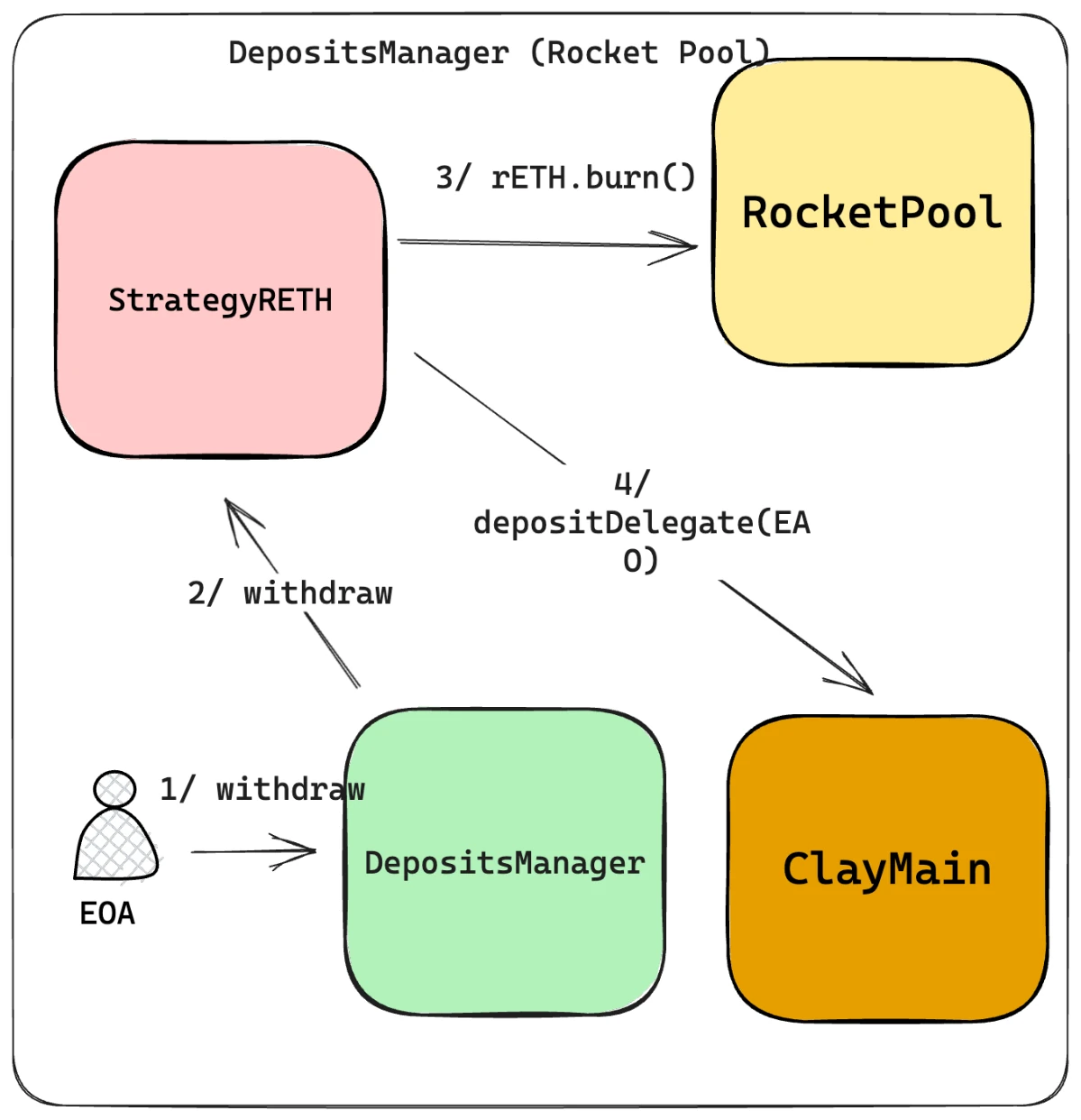
For the Rocket Pool protocol, the migration can be done in a single call to the withdraw() function, as the user only needs to burn rETH to retrieve ETH. The DepositManager then deposits the funds to ClayMain.
Fig. 4 shows the flow of how the migration is done for the RETH (Rocket Pool).

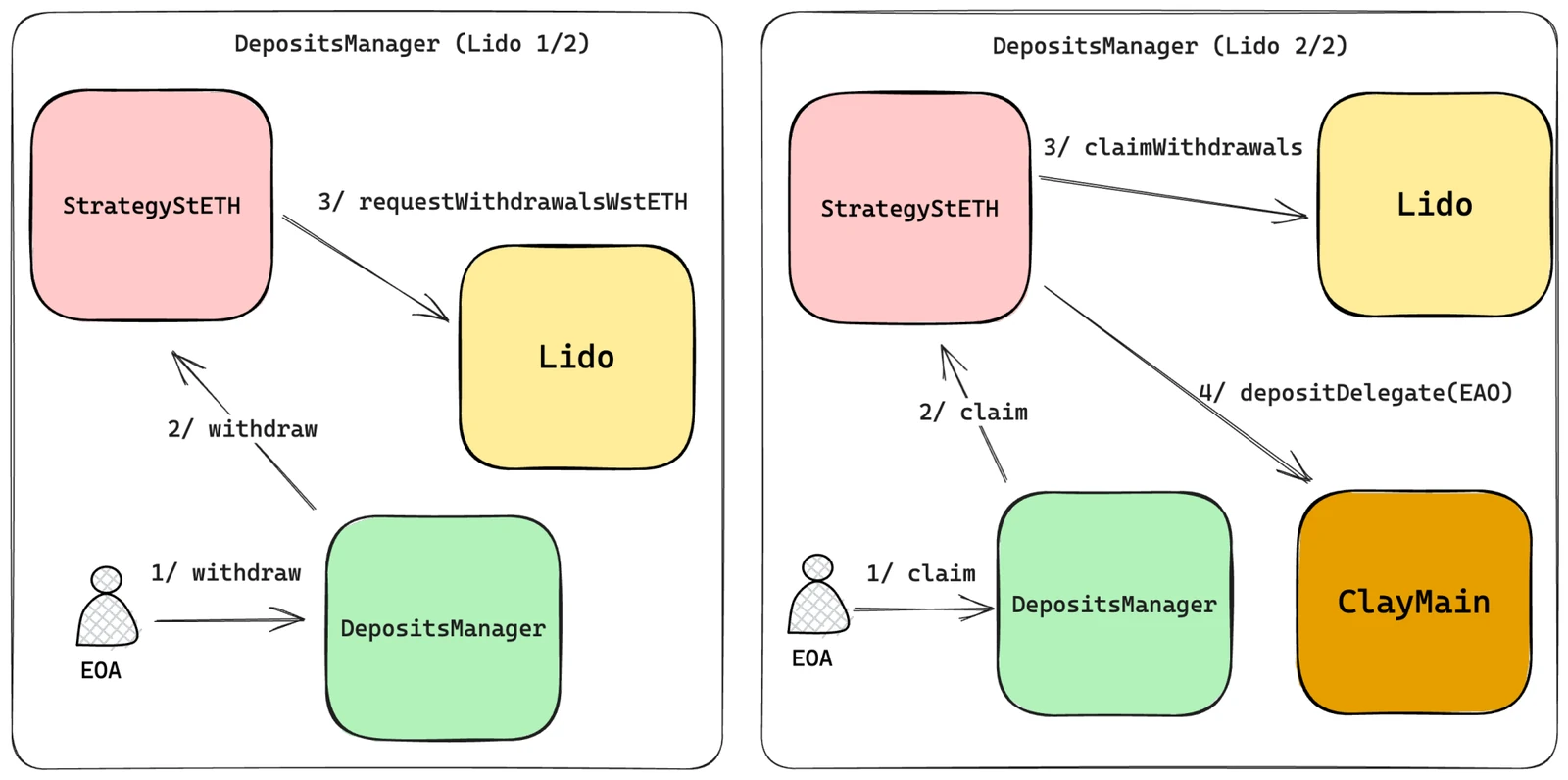
For the Lido protocol, the migration is done in two steps. Users must first start the withdrawal process by calling the withdraw() function and then wait for a period of time. When withdrawal is ready, users can call the function claim() to claim ETH and deposit it to ClayMain.
Fig. 5 shows the flow of how the migration is done for the StETH (Lido).

The risk rating methodology used by Nethermind Security follows the principles established by the OWASP Foundation. The severity of each finding is determined by two factors: Likelihood and Impact.
Likelihood measures how likely the finding is to be uncovered and exploited by an attacker. This factor will be one of the following values:
When defining the likelihood of a finding, other factors are also considered. These can include but are not limited to motive, opportunity, exploit accessibility, ease of discovery, and ease of exploit.
Impact is a measure of the damage that may be caused if an attacker exploits the finding. This factor will be one of the following values:
When defining the impact of a finding, other factors are also considered. These can include but are not limited to data and state integrity, loss of availability, financial loss, and reputation damage. After defining the likelihood and impact of an issue, the severity is determined according to the table below.
| Impact / Likelihood | Low | Medium | High |
| High | Medium | High | Critical |
| Medium | Low | Medium | High |
| Low | Info / Best Practices | Low | Medium |
| Undetermined | Undetermined | Undetermined | Undetermined |
To address issues that do not fit a High, Medium or Low severity, Nethermind Security also uses three more finding severities: Informational, Best Practices, and Undetermined.
| File | Fix commit | Type | Status |
ClayMain.sol | 4dba840 | Critical | Fixed |
The ClayMain contract contains an essential invariant that is checked after each interaction, within the _balanced(...) function. This invariant is designed to ensure that the total user flow equals the staking flow. However, the current implementation calculates the stakingFlow by directly using address(this).balance. This practice is risky, as it opens a vulnerability where an attacker can manipulate the balance by self-destructing other contracts and sending ETH to ClayMain. Since self-destruct does not execute any code, the receive() function won’t be triggered either. The problematic section of the code is provided below.
// @dev Assures contract state remains balanced by comparing user flows deposits vs staking flows.
function _balanced() internal {
uint256 currentDeposit = funds.currentDeposit;
require(currentDeposit > 0, "Current deposits cannot go to zero");
uint256 userFlow = (funds.currentDeposit + funds.withdrawQueue) / 1e16;
if (userFlow != 0) {
///////////////////////////////////////////////////////////////////
// @audit address(this).balance can be manipulated by self-destruct
///////////////////////////////////////////////////////////////////
uint256 stakingFlow = (address(this).balance +
funds.stakedDeposit +
funds.unstakeInternal +
funds.unstakeExternal) / 1e16;
require(stakingFlow <= userFlow + 1 && userFlow <= stakingFlow + 1, "Unbalanced contract");
}
_exchangeRateProtection();
}Recommendation
Consider maintaining a state variable to track the contract balance instead of relying on address(this).balance.
Resolution
Fixed in commit 4dba840
claim(...) in StrategyStETH has no access control, allowing attackers to steal all funds in the withdrawal requests| File | Fix commit | Type | Status |
deposits/strategies/StrategyStETH.sol | e54b6a2 | Critical | Fixed |
The claim(...) function in the StrategyStETH contract lacks access control, which allows attackers to call it with arbitrary _requestId and _owner, thereby stealing funds from withdrawal requests. This function should only be called by DepositsManager to complete the withdrawal process of stETH.
// @audit No access control, can be called with arbitrary _owner param
function claim(uint256 _requestID, address _owner, bytes memory _data) external nonReentrant returns (uint256) {
require(_requestID != 0, "Invalid requestID");
require(_owner != address(0), "Invalid owner");
...
// Mint csETH
uint256 claimedAmount = address(this).balance - balanceBefore;
uint256 csEthMinted = clayMain.depositDelegate{value: claimedAmount}(_owner);
return csEthMinted;
}Recommendation
Consider adding access control to only allow DepositManager to call the claim(...) function.
Resolution
Fixed in commit e54b6a25
oracleReport() function| File | Fix commit | Type | Status |
NodeManager.sol | b2a2fa8 | High | Fixed |
The oracleReport() function is used to provide information from the consensus layer to the protocol. This information can be reported by anyone but must be signed by whitelisted oracles.
The function starts by checking that the provided _reportBlock parameter is strictly above the oracleReportBlock state variable. This check ensures that the provided information is newer than the last provided Oracle report.
function oracleReport(
uint256 _reportBlock,
uint256 _validatorsCount,
uint256 _validatorsBalance,
uint256 _validatorsExited,
bool _withdrawalsDisabled,
bytes[] calldata _signatures
) external whenNotPaused nonReentrant {
//@audit _reportBlock parameter must be higher than oracleReportBlock
require(_reportBlock > oracleReportBlock, "Invalid report block");
[...]However, in the NodeManager contract, the oracleReportBlock state variable is updated to the latest block.number each time the receive() function is invoked.
receive() external payable {
// next report must be after this to confirm a post-balance
oracleReportBlock = block.number;
}The receive() function is invoked when a transaction with empty calldata and msg.value (i.e with ether) is sent to the contract.
An attacker could take advantage of this feature to deny any update of data from the consensus layer. He would have to proceed this way:
oracleReport() function;1 wei to the NodeManager contract to update the oracleReportBlock state variable;oracleReport() transaction reverts;Recommendation
Consider updating the oracleReportBlock state variable exclusively when an Oracle report has been validated.
Resolution
Fixed in commit b2a2fa8
amountNewRewards from Oracles’s reported data| File | Fix commit | Type | Status |
NodeManager.sol | 12ef32e | Medium | Fixed |
The oracleReport() function calculates the amount of new rewards since the last report. The calculated amountNewRewards is then used to send fees to the nodeOperator.
However, the amountNewRewards are exclusively calculated based on the liquid rewards provided to the contract. If there are no amountLiquidRewards, there won’t be any accounting for the rewards to be sent to the nodeOperator.
uint256 amountRewards = _validatorsBalance > amountPrincipal ? _validatorsBalance - amountPrincipal : 0;
[...]
uint256 previousRewardsAccrued = rewardsAccrued;
[...]
rewardsAccrued = amountRewards;
[...]
uint256 amountLiquid = address(this).balance;
if (amountLiquid != 0) {
uint256 amountExited = _min(amountLiquid, newExits * DEPOSIT_SIZE);
uint256 amountLiquidRewards = amountLiquid - amountExited;
uint256 totalRewards = amountRewards + amountLiquidRewards;
uint256 amountNewRewards = totalRewards > previousRewardsAccrued ? totalRewards - amountRewards : 0;There are cases where the rewards are partially accounted for, leading to wrong accounting of the getBalance() function from the NodeManager contract. This could lead to the wrong exchange rate between CS and ETH tokens.
Recommendation
Account for the accrued fees allocated to the nodeOperators regardless of the liquidity.
Resolution
There is indeed a missing accrued rewards on non-liquid rewards that must be deducted updated (e.g. on penalties). See replicated unit test with the provided example and an additional where there is both partial payment additional not accounted for. The report 3 suggested wasn’t too clear if you can expand, we can replicate.
There are two cases, where new rewards are 100% or potentially partially already accounted for by a previous oracle report. Thus a comparison is missing. This slightly changes the logic.
After our second meeting, clarified the liquid rewards are paid as they come and nodeOperatorAccruedFees is used to ensure the exchange rate reflects any fees due.
Fixed 12ef32e.
_closeBatches() always calls _deleteBatchFromQueue() with index = 0 incorrectly| File | Fix commit | Type | Status |
NodeManager.sol | f6c5609 | Medium | Fixed |
In the function _closeBatches(...), after calculating the number of fulfilled batches, it loops through the queue and calls the function _deleteBatchFromQueue(...) with index = 0 to delete each element from the queue. The function _deleteBatchFromQueue(...) swaps the deleting element with the last element and pops it from the queue. However, this rearranges the order of elements in the queue and makes calling _deleteBatchFromQueue(index = 0) incorrect, resulting in the wrong element being deleted.
function _closeBatches(uint256 _newExits) internal {
...
// create output
uint256[] memory batches = new uint256[](fulfilledBatches);
for (uint256 i = 0; i < fulfilledBatches; i++) {
batches[i] = batchExitQueue[0];
//////////////////////////////////////////////
// @audit Always delete index = 0 is incorrect
//////////////////////////////////////////////
_deleteBatchFromQueue(0);
}
...
}
function _deleteBatchFromQueue(uint256 _indexToDelete) internal {
require(_indexToDelete < batchExitQueue.length, "Invalid index");
// Move the last element to the index to be deleted
batchExitQueue[_indexToDelete] = batchExitQueue[batchExitQueue.length - 1];
// Remove the last element
batchExitQueue.pop();
}Recommendation
Consider rewriting the process to ensure the order of the elements in the queue remains the same after deleting.
Resolution
Fixed in commit f6c5609
totalPages in getter functions| File | Fix commit | Type | Status |
ClayMain.solNodeManager.soldeposits/DepositsManager.sol | 89dc5e7 | Low | Fixed |
In various contract getter functions that support pagination, there is an issue with the computation of the totalPages variable. This leads to an incorrect value, exceeding the expected count by 1 in certain scenarios.
Let’s examine one such case. In the provided code snippet, where pageSize is set to 10, the intended behaviour is that if the number of user orders (length) falls within the range of 1 to 10, the totalPages should have the same value. However, the current calculation results in different outcomes: when length = 5, totalPages = 0, and when length = 10, totalPages = 1.
uint256 pageSize = 10;
uint256 length = userWithdrawIds[_user].length;
uint256 totalPages = length / pageSize;Recommendation
Consider correcting the calculation of totalPages in these getter functions.
Resolution
Fixed in commit 89dc5e
userFlow == 0 breaks its meaning| File | Fix commit | Type | Status |
ClayMain.sol | eaef200 | Low | Fixed |
The function _balanced(...) includes an invariant check that must hold in all cases. However, when userFlow == 0, the check is skipped, without taking into account the value of stakingFlow. This behaviour breaks the meaning of the invariant and could potentially enable attackers to cause userFlow to be nearly 0 while stakingFlow > 0.
// @audit In case userFlow = 0, invariant check is skipped
if (userFlow != 0) {
uint256 stakingFlow = (address(this).balance +
funds.stakedDeposit +
funds.unstakeInternal +
funds.unstakeExternal) / 1e16;
require(stakingFlow <= userFlow + 1 && userFlow <= stakingFlow + 1, "Unbalanced contract");
}Recommendation
Consider modifying the function _balanced(...) to ensure that the invariant check holds in all cases.
Resolution
Fixed in commit eaef200
_closeBatches() function returns a different output from the fulfilledBatches| File | Fix commit | Type | Status |
NodeManager.sol | 4880df2 | Low | Fixed |
The _closeBatches() function closes batches that were in the exit queue. Each exit request is associated with a batch id and each batch id is related to a request count, which is the number of exits contained in the request.
If the request contains too many exit orders, the function goes to the next batch request to fulfill it.
for (uint256 i = 0; i < batchExitQueue.length; i++) {
uint256 batchId = batchExitQueue[i];
uint256 requestCount = batchExitRequests[batchId];
//@audit: if batch request has too many exit orders
//we will try to fulfill the next batch
if (requestCount <= exitsTotal) {
fulfilledBatches++;
exitsTotal -= requestCount;
fulfilledCount += requestCount;
}
if (exitsTotal <= 0) break;
}The _closeBatches() function then creates an output report that will be provided to the closeBatches() function from the clayMain contract.
This output takes batches in the exit queue sequentially without taking into account the batches that were avoided because of their requestCount value.
[...]
// create output
uint256[] memory batches = new uint256[](fulfilledBatches);
for (uint256 i = 0; i < fulfilledBatches; i++) {
//@audit: output sequentially pops the first element of the exit queue
//based on fulfillBatches value regardless the number of requestCount
batches[i] = batchExitQueue[0];
_deleteBatchFromQueue(0);
}
clayMain.closeBatches(batches);
[...]Recommendation
Modify the function to send effectively fulfilled batches to the closeBatches() function of ClayMain contract.
Resolution
Suggested change simplifies logic updating partial fulfilled batches and exiting loop. Added unit test from your example too
Commit: 4880df2
claimablePool Amount Prior to ETH Transfer| File | Fix commit | Type | Status |
ClayMain.sol | d2d0a04 | Low | Fixed |
In both claim(...) and instantWithdraw(...) functions, _updateClaimablePool() is called to update the claimablePool amount, the call is followed by an ETH transfer.
function claim(uint256[] calldata _orderIds) external override whenNotPaused nonReentrant returns (bool) {
[...]
_updateClaimablePool();
// @audit ETH transfer after updating the `claimablePool` amount
(bool success, ) = msg.sender.call{value: amountsToUser}("");
[...]
}
function instantWithdraw(uint256 _amountCs) external whenNotPaused nonReentrant returns (bool) {
[...]
_updateClaimablePool();
[...]
// @audit ETH transfer after updating the `claimablePool` amount
(bool success, ) = msg.sender.call{value: amountTokenWithdrawToUser}("");
[...]
}The _updateClaimablePool() function uses the contract balance to adjust its amount, which might result in inaccurate accounting.
function _updateClaimablePool() internal {
[...]
funds.claimablePool = _max(
_min(funds.claimablePool, funds.withdrawQueue),
_min(funds.withdrawQueue - unstakeExternal, address(this).balance)
);
}Recommendation
Consider moving _updateClaimablePool() call after the ETH transfer in both functions.
Resolution
Fixed in commit d2d0a0
ClayStack protocol does not have any protection against deposit frontrunning| File | Fix commit | Type | Status |
NodeManager.sol | ecd3e2e | Low | Fixed |
Once enough amount of ETH is available (at least 32 ETH), the autobalance() function from the NodeManager contract is in charge of depositing the ETH to the Beacon Chain Deposit contract.
This function takes the following parameters:
The root cause of the vulnerability comes from the fact that Beacon Chain permits multiple deposits for a single validator public key. It does not verify that all deposits have the same withdrawal credentials. Moreover, it will assume that the withdrawal credential is in the first valid deposit.
The risk is that a malicious validator front-run the deposit to be made by the NodeManager contract specifying a controlled withdrawal credential instead of the NodeManager address. The rogue validator would be able to steal the funds brought by the NodeManager.
The severity of this finding is rated Low because validators are trusted entities that are not likely to try to attack the protocol.
However, this problem should be addressed in the future when validators will be external (and untrusted) entities.
Ref: https://github.com/rocket-pool/rocketpool-research/blob/master/Reports/withdrawal-creds-exploit.md
Recommendation
Implement a protection that checks that the deposit has not been front-runned. Ref: https://research.lido.fi/t/mitigationsfor-deposit-front-running-vulnerability/1239
Resolution
Fixed in commit ecd3e2e
getOrder does not consider all possible Strategy statuses| File | Fix commit | Type | Status |
deposits/DepositsManager.sol | af3e1d3 | Low | Fixed |
The DepositsManager contract currently interacts with StrategyStETH and StrategyRETH strategies that primarily use three order statuses: Unbonding, Claimable, and Claimed. However, the contract may potentially interact with other future strategies that could introduce additional order statuses such as Expired. As of now, the getOrder logic is heavily tied to the existing strategies and doesn’t cover all potential cases that may arise in the future, which could lead to incorrect status determination for certain strategies.
enum OrderStatus {
Unbonding,
Claimable,
Expired,
Claimed
}The current logic considers only Unbonding status and handles the rest as Claimable, the Claimed status returned by the strategy is never taken into consideration. Moreover, Expired status is currently handled as Claimable.
IStrategy.OrderStatus statusStrategy = strategy.getStatus(order.id);
if (statusStrategy == IStrategy.OrderStatus.Unbonding) {
status = Status.Unbonding;
} else {
//@audit All other statuses are narrowed to `Claimable`.
status = Status.Claimable;
}Recommendation
Consider revisiting the current behaviour of the function and take into consideration all possible strategy statuses that may emerge in the future. This would involve extending the conditional checks to handle Claimed and Expired statuses.
Resolution
Fixed in commit af3e1d
previousExits updated with the total unfulfilled exits requests| File | Fix commit | Type | Status |
NodeManager.sol | 4880df2 | Low | Fixed |
In the _closeBatches(...) function, previousExits variable is summed up with the newly reported exits to represent the total not used exits. This total is used to fulfill and close batches in the queue.
uint256 exitsTotal = _newExits + previousExits;However, when updating this variable, it is set to the total of unfulfilled exit requests.
previousExits = _min(exitsTotal, _positiveSub(exitRequestsCount, fulfilledCount));Recommendation
Consider not using the total unfulfilled exit requests when updating previousExits.
Resolution
The suggested changes simplifying the approach will avoid keeping track of partial batches in a variable: Commit: 4880df2
setClayMain() function initializer is not restricted| File | Fix commit | Type | Status |
CsToken.sol | — | Low | Acknowledged |
The setClayMain() function does not have any access control. A malicious user could front-run initialization of the CsToken contract with a controlled ClayMain contract address.
/// @notice Sets `_clayMain` address.
/// @dev ClayMain can be set only once.
/// @param _clayMain : Address of new ClayMain contract.
function setClayMain(address _clayMain) external {
require(_clayMain != address(0), "Invalid ClayMain");
require(clayMain == address(0), "ClayMain Already Set");
clayMain = _clayMain;
}Recommendation
Consider making the clayMain variable immutable and initialize it within the CsToken contract constructor().
Resolution
Noted. This is concious by design. Setting it on constructor creates an extra complexity step as address needs to be pre-computed given the dependency as well on ClayMain, while making the testing more complex. There is no risk of front running as at initial deployment time the addressed will be verified before the contracts are then considered as the protocol’s contract.
withdrawQueueNew always resets to 0 when swapping internal and external unstake| File | Fix commit | Type | Status |
ClayMain.sol | a1967e0 | Low | Fixed |
In the ClayMain contract, there are two variables that account for the unstaking amount. The state variable funds.unstakeExternal is the amount of ETH that has already been unstaked from validators. While the state variable funds.unstakeInternal is the amount of ETH waiting to be unstaked from validators.
Also, funds.withdrawQueueNew accounts for the amount of ETH in the current batch of withdrawals that has not yet been accounted for in auto balance. This variable is checked to decide whether to close the current batch or not. However, its value is always reset to 0 in the function _updateClaimablePool(...) after swapping internal and external unstake. As a result, the batch of withdrawals is ignored and not closed.
function _updateClaimablePool() internal {
uint256 unstakeExternal = funds.unstakeExternal;
// Unstake update swap given new withdrawals
if (funds.unstakeInternal > 0) {
uint256 swaps = _min(
funds.withdrawQueue - funds.unstakeExternal - funds.claimablePool,
funds.unstakeInternal
);
unstakeExternal += swaps;
// @audit funds.withdrawQueueNew is always reset to 0
funds.withdrawQueueNew = 0;
funds.unstakeExternal = unstakeExternal;
funds.unstakeInternal = funds.unstakeInternal - swaps;
}
...
}Recommendation
Consider not resetting withdrawQueueNew to 0 when swapping internal and external unstake.
Resolution
Fixed in commit a1967e0
withdrawQueueNew is not updated after closing a batch| File | Fix commit | Type | Status |
ClayMain.sol | d486bea | Low | Fixed |
In the ClayMain contract, the state variable funds.withdrawQueueNew keeps track of the amount of ETH in the current batch of withdrawals that has not yet been accounted for in autobalance. This variable is checked to decide whether to close the current batch or not. However, its value is not reset after closing a batch, which could cause extra batches to close.
// Close batch if staked or if withdrawals within batch to unlock them
// @audit funds.withdrawQueueNew is not reset after closing batch
if (validatorCount != 0 || funds.withdrawQueueNew != 0) {
_closeBatch(currentBatchId, minClaimDays);
batchId++;
}Recommendation
Consider updating value of withdrawQueueNew when closing a batch.
Resolution
Fixed in commit d486bea
minClaimDays)| File | Fix commit | Type | Status |
ClayMain.sol | ee2514a | Best Practices | Fixed |
The minClaimDays state variable is used to allow withdrawal orders to be processed after a minimum amount of time has passed. However, this state variable is a uint256, which refers to elapsed seconds.
/// @notice Sets the minimum time for a claim tokens when netted locally.
/// @param _seconds claim time
function setMinClaimTime(uint256 _seconds) external onlyRole(TIMELOCK_ROLE) {
require(_seconds <= MAX_UNBONDING, "Minimum claim time too high");
minClaimDays = _seconds;
}Recommendation
Consider renaming the minClaimDays state variable to reflect its unit (seconds).
Resolution
Fix ee2514
withdrawQueueNew a boolean instead of uint256| File | Fix commit | Type | Status |
ClayMain.sol | 9f843c4 | Best Practices | Fixed |
In the ClayMain contract, funds.withdrawQueueNew is only incremented, checked against zero, and then reset to zero. Additionally, no other contracts appear to use this variable. Given these observations, funds.withdrawQueueNew could be modified to be a boolean to save gas.
...
funds.withdrawQueueNew += amountTokenWithdraw;
...
if (validatorCount != 0 || funds.withdrawQueueNew != 0) {
...
funds.withdrawQueueNew = 0;Recommendation
Consider modifying funds.withdrawQueueNew to be a boolean instead of a uint256.
Resolution
Changed in 9f843c4
| File | Fix commit | Type | Status |
ClayMain.solNodeManager.sol | 71c6800 | Best Practices | Fixed |
Some functions in both ClayMain.sol and NodeManager.sol contracts, are updating important storage variables and not emitting any event. It is a good practice to emit an event in that case to enhance traceability and facilitate monitoring of the product.
Some functions that are updating important parameters and could emit an event are:
NodeManager.setClayMain(...);NodeManager.setNodeOperator(...);ClayMain.setMinClaimTime(...);ClayMain.setWithdrawalsDisabled(...);ClayMain.setExchangeDeviation(...);Recommendation
Consider emitting an event where relevant.
Resolution
Added 71c680
getValidators() in the NodeManager could break earlier to save gas| File | Fix commit | Type | Status |
NodeManager.sol | c0df5993fecb6b | Best Practices | Fixed |
In the NodeManager contract, the validators[] list starts with id = 1, making validators[0] non-existent. However, the function getValidators(...) still accepts index = 0 as a valid input, and this can lead to unexpected behaviour and cost more gas. The relevant code snippet is shown below:
function getValidators(uint256 _page) external view returns (ValidatorView[] memory, uint256) {
ValidatorView[] memory info = new ValidatorView[](10);
uint256 pageSize = 10;
uint256 length = validatorNonce;
uint256 totalPages = length / pageSize;
if (_page <= totalPages && length != 0) {
for (uint256 i = 0; i < pageSize; i++) {
uint256 index = length - _page * pageSize - i;
Validator memory validator = validators[index];
info[i] = ValidatorView({
id: index,
publicKey: validator.publicKey,
validatorType: validator.validatorType
});
// @audit validators index 0 is non-existent
if (index == 0) break;
}
}
return (info, totalPages);
}Recommendation
Consider breaking the loop when index has a value of 1 instead of 0.
Resolution
As discussed, this is not an issue but the function returns as expected. Added the following unit test to aid the discussion: Commit c0df599
Furthermore as part of the discussion, gas can be saved by breaking the loop one iteration earlier. Implemented in this commit 3fecb6b

| File | Fix commit | Type | Status |
DepositsManager.sol | 834af08 | Best Practices | Fixed |
In multiple functions within the DepositsManager.sol contract, the strategy address is retrieved from storage without prior existence validation. This could lead to failures in calls to the strategy without clear error messages.
In both claim(...) and getOrder(...) functions, the orderId is provided as an input and used to access the associated strategy address. However, the case where the order does not exist is not handled.
function claim(
uint256[] calldata _orderIds,
bytes[] memory _data
) external whenNotPaused nonReentrant returns (bool) {
require(_orderIds.length == _data.length, "Param length mismatch");
for (uint256 i = 0; i < _orderIds.length; i++) {
uint256 id = _orderIds[i];
WithdrawOrder memory order = withdrawOrders[id];
//@audit order could be non-existent.
require(!order.isClaimed, "Already claimed");
// Claim from strategy
IStrategy strategy = IStrategy(strategies[order.token].strategy);
//@audit A call to address(0) will occur if `_orderIds[i]` does not correspond to an existing order.
uint256 amountCsETH = strategy.claim(order.id, order.owner, _data[i]);
[...]
}
function getOrder(uint256 _orderId) public view returns (UserWithdrawOrderInfo memory) {
//@audit order could be non-existent.
WithdrawOrder memory order = withdrawOrders[_orderId];
[...]
//@audit Similarly, if `_orderId` does not correspond to an existing order, a call to `address(0)` will occur.
IStrategy.OrderStatus statusStrategy = strategy.getStatus(order.id);
[...]
}The function updateStrategy is used to update the strategy status of a given token to active/inactive. However, it lacks a check to determine whether a strategy is registered for the given token.
function updateStrategy(address _token, bool _isActive) external nonReentrant onlyRole(TIMELOCK_ROLE) {
require(_token != address(0), "Invalid token in strategy");
// @audit A check should be included to ensure that a strategy exists for the provided token (strategies[_token] != address(0))
strategies[_token].isActive = _isActive;
}Recommendation
Consider implementing existence checks before accessing strategies and orders. This can be achieved by adding a conditional check such as:
require(strategies[order.token].strategy != address(0), "Strategy does not exist for this order token")in both the claim(...) and getOrder(...) functions.
Additionally, in the updateStrategy(...) function, include a check like the following to ensure a strategy is registered for the provided token before updating its status.
require(strategies[_token].strategy != address(0), "Strategy does not exist for this token");Implementing these checks provides users with clear error messages in case of non-existent strategies or orders.
Resolution
Fixed in commit 834af0
| File | Fix commit | Type | Status |
ClayMain.sol | 4dba840 | Best Practices | Fixed |
*: The claim(...) function in the DepositsManager contract allows users to input a list of order IDs to be claimed. Within the function, the code iterates through these orders and calls the internal function _claim(...) for each order. This internal function is responsible for verifying if both the ClaimablePool and the contract’s balance are sufficient to cover the order amount.
In scenarios where the cumulative amounts of the orders exceed the available ClaimablePool amount, the function appropriately handles this situation as it updates the ClaimablePool during the iteration. However, the contract balance is individually checked for each order and not updated.
for (uint256 i = 0; i < _orderIds.length; i++) {
(uint256 _amountsToUser, uint256 _orderFee) = _claim(_orderIds[i], msg.sender);
amountsToUser += _amountsToUser;
ordersFees += _orderFee;
}
[...]
//@audit There is no guarantee that contract balance is sufficient.
(bool success, ) = msg.sender.call{value: amountsToUser}("");The variable amountsToUser stores the total amount of ETH to be sent to the user, _claim function does not guarantee that the contract balance covers this value. As a result, if the contract’s balance is insufficient, the ETH transfer will fail without providing a clear error message.
Recommendation
In order to enhance code clarity and prevent unexpected failures, consider adding a balance check before performing the ETH transfer.
Resolution
Given the update due to the self-destruct fix, the contract will update the ethBalance variable and when balance is below it should revert.
getValidators() function’s documentation is incorrect| File | Fix commit | Type | Status |
NodeManager.sol | 303007a | Best Practices | Fixed |
The getValidators() function’s documentation mentions that this function returns a list of nodes for a user. However, this function does not return the list of nodes depending on a specific user.
/// @notice Returns validators and status
/// @notice Returns list of nodes for a user.
/// @dev Max 10 results starting at page 0
/// @param _page : Page to query.
/// @return info Array for struct of nodes view
/// @return totalPages supported for given user.
function getValidators(uint256 _page) external view returns (ValidatorView[] memory, uint256) {
[...]Recommendation
Modify the documentation to reflect what the function does.
Resolution
Changed in 3037af
addStrategy(...)| File | Fix commit | Type | Status |
deposits/DepositsManager.sol | 0532083 | Best Practices | Fixed |
In the DepositsManager contract, the timelock can call the function addStrategy(...) to add a new liquid strategy contract for a token or call the function updateStrategy(...) to update the strategy contract. However, the function addStrategy(...) does not check if the strategy for the token already exists or not. This can result in the existing strategy being modified to a new address, which can cause funds to be locked in the previous strategy.
// @audit Not check if strategy for `_token` existed
function addStrategy(address _strategy, address _token) external nonReentrant onlyRole(TIMELOCK_ROLE) {
require(_strategy != address(0), "Invalid strategy");
IStrategy strategy = IStrategy(_strategy);
require(strategy.isValidToken(_token), "Invalid token in strategy");
strategies[_token] = IStrategy.Strategy({strategy: _strategy, isActive: true});
}Recommendation
We recommend that you add a check in the addStrategy(...) function to ensure that the strategy for the token does not already exist before modifying it.
Resolution
Fixed in commit 053208
PausableUpgradeable contract| File | Fix commit | Type | Status |
deposits/strategies/StrategyStETH.soldeposits/strategies/StrategyRETH.sol | 562b9d8 | Best Practices | Fixed |
Both StrategyStETH and StrategyRETH contracts import PausableUpgradeable but do not use it in their logic.
Recommendation
For better code readability, consider removing unused imports.
Resolution
Fixed in commit 562b9d
updateBalances() function visibility can be reduced to external| File | Fix commit | Type | Status |
ClayMain.sol | d37162f | Best Practices | Fixed |
The current updateBalances() function is declared with a public visibility. But, it is exclusively invoked from outside the contract.
Recommendation
Consider setting the visibility to external.
Resolution
Fixed in commit d37162
Software documentation refers to the written or visual information that describes the functionality, architecture, design, and implementation of software. It provides a comprehensive overview of the software system and helps users, developers, and stakeholders understand how the software works, how to use it, and how to maintain it. Software documentation can take different forms, such as user manuals, system manuals, technical specifications, requirements documents, design documents, and code comments. Software documentation is critical in software development, enabling effective communication between developers, testers, users, and other stakeholders. It helps to ensure that everyone involved in the development process has a shared understanding of the software system and its functionality. Moreover, software documentation can improve software maintenance by providing a clear and complete understanding of the software system, making it easier for developers to maintain, modify, and update the software over time. Smart contracts can use various types of software documentation. Some of the most common types include:
These types of documentation are essential for smart contract development and maintenance. They help ensure that the contract is properly designed, implemented, and tested, and they provide a reference for developers who need to modify or maintain the contract in the future.
The ClayStack contracts’ documentation is presented through inline comments within the code, providing explanations for the objectives and operations of various functions and formulas. Additionally, the README file, accessible at this link, outlines the deposit and withdrawal processes and delineates different roles within the system. Furthermore, the ClayStack team remained available to address any inquiries or concerns raised by the Nethermind auditors.
The relevant output is presented below.
As auditors, we recommend that any changes or updates made to the audited codebase undergo a re-audit or security review to address potential vulnerabilities or risks introduced by the modifications. By conducting a re-audit or security review of the modified codebase, you can significantly enhance the overall security of your system and reduce the likelihood of exploitation. However, we do not possess the authority or right to impose obligations or restrictions on our clients regarding codebase updates, modifications, or subsequent audits. Accordingly, the decision to seek a re-audit or security review lies solely with you.
This report is based on the scope of materials and documentation provided by you to Nethermind in order that Nethermind could conduct the security review outlined in 1. Executive Summary and 2. Audited Files. The results set out in this report may not be complete nor inclusive of all vulnerabilities. Nethermind has provided the review and this report on an as-is, where-is, and as-available basis. You agree that your access and/or use, including but not limited to any associated services, products, protocols, platforms, content, and materials, will be at your sole risk. Blockchain technology remains under development and is subject to unknown risks and flaws. The review does not extend to the compiler layer, or any other areas beyond the programming language, or other programming aspects that could present security risks. This report does not indicate the endorsement of any particular project or team, nor guarantee its security. No third party should rely on this report in any way, including for the purpose of making any decisions to buy or sell a product, service or any other asset. To the fullest extent permitted by law, Nethermind disclaims any liability in connection with this report, its content, and any related services and products and your use thereof, including, without limitation, the implied warranties of merchantability, fitness for a particular purpose, and non-infringement. Nethermind does not warrant, endorse, guarantee, or assume responsibility for any product or service advertised or offered by a third party through the product, any open source or third-party software, code, libraries, materials, or information linked to, called by, referenced by or accessible through the report, its content, and the related services and products, any hyperlinked websites, any websites or mobile applications appearing on any advertising, and Nethermind will not be a party to or in any way be responsible for monitoring any transaction between you and any third-party providers of products or services. As with the purchase or use of a product or service through any medium or in any environment, you should use your best judgment and exercise caution where appropriate. FOR AVOIDANCE OF DOUBT, THE REPORT, ITS CONTENT, ACCESS, AND/OR USAGE THEREOF, INCLUDING ANY ASSOCIATED SERVICES OR MATERIALS, SHALL NOT BE CONSIDERED OR RELIED UPON AS ANY FORM OF FINANCIAL, INVESTMENT, TAX, LEGAL, REGULATORY, OR OTHER ADVICE.
The Leading Engineers of Blockchain Infrastructure